LLM과 내부 API의 경계를 어디에 둘 것인가
이 글에서는 Function Calling을 이용해 LLM과 내부 API를 연결할 때 어떤 경계를 잡아야 하는지 정리합니다.
Function Calling은 모델이 외부 시스템과 상호작용할 수 있게 해줍니다. 사용자의 질문에 답만 하는 것이 아니라, DB에서 데이터를 조회하고, 티켓을 만들고, 문서를 검색하고, 워크플로우를 실행할 수 있습니다.
하지만 여기서 중요한 질문이 생깁니다.
모델에게 어디까지 맡길 것인가?
어떤 API를 tool로 노출할 것인가?
권한 검사는 누가 할 것인가?
실패했을 때 어떻게 되돌릴 것인가?
분석 기준일: 2026-05-12
실습 기준 환경: OpenAI API, FastAPI, PostgreSQL
주요 참고자료: OpenAI Function Calling Docs, Structured Outputs Docs, AWS Idempotency
핵심 요약
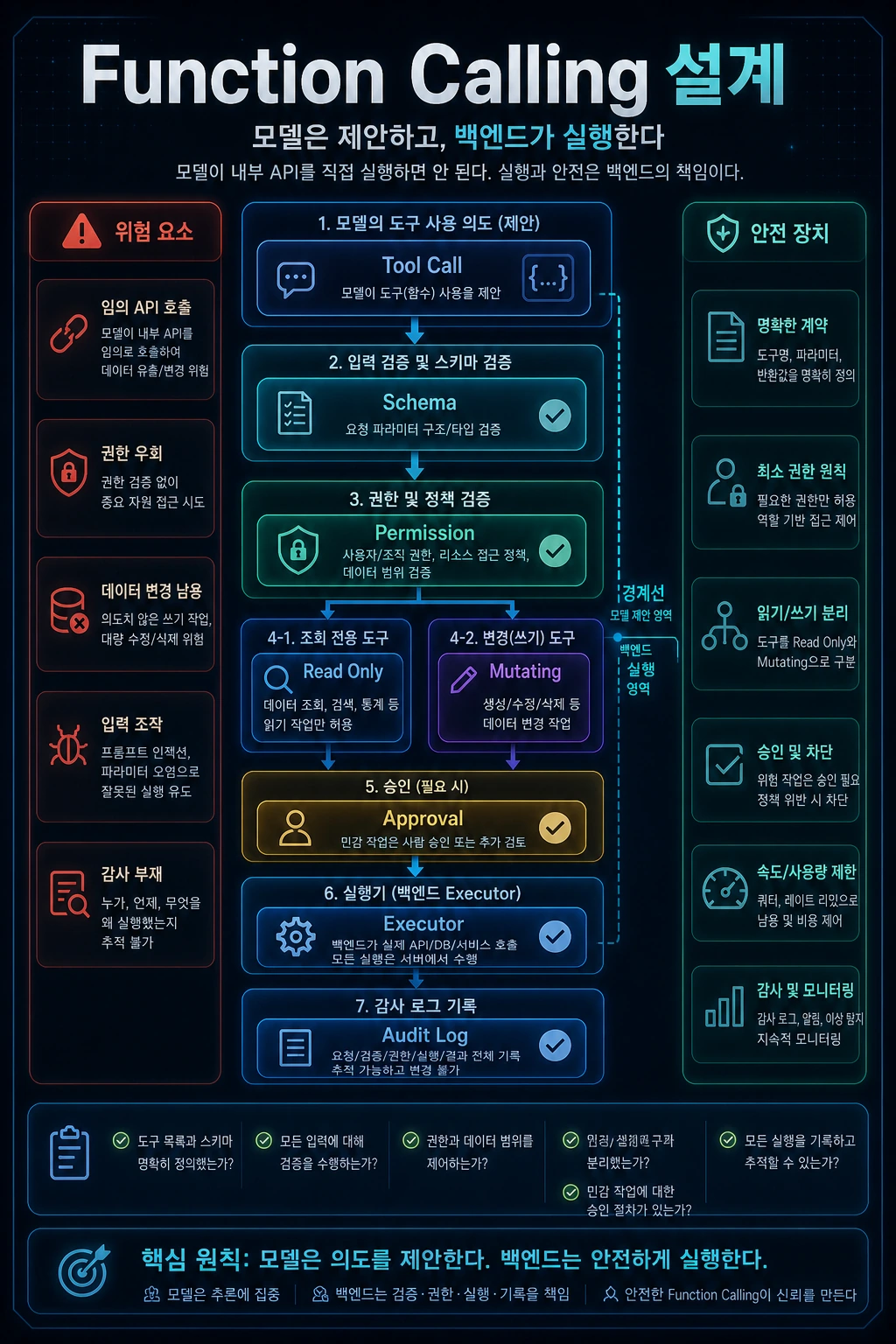
- Function Calling은 모델이 내부 API를 직접 실행하는 것이 아니라, 호출 의도를 구조화해서 백엔드에 전달하는 방식으로 이해해야 한다.
- 실제 실행 권한은 백엔드 tool executor가 가져야 한다.
- read-only tool과 mutating tool을 분리해야 한다.
- 상태 변경 tool에는 idempotency, audit log, human approval이 필요할 수 있다.
- tool schema는 내부 API 전체를 노출하지 말고 모델에게 필요한 최소 인터페이스만 제공해야 한다.
1. Function Calling을 어떻게 이해할 것인가
Function Calling은 모델이 함수를 “직접 실행”하는 기능으로 이해하면 위험합니다. 더 정확히는 모델이 어떤 함수를 어떤 인자로 호출해야 할지 구조화된 형태로 제안하는 기능입니다.
실제 실행은 백엔드가 해야 합니다.
# 예시입니다.User request→ LLM decides tool call→ Backend validates tool call→ Permission check→ Execute internal API→ Return tool result to model→ Generate final response
모델은 결정 보조자이고, 백엔드는 집행자입니다.
2. Tool Boundary란 무엇인가
Tool Boundary는 모델에게 노출되는 기능의 경계입니다.
나쁜 예:
# 예시입니다.execute_sql(query: string)
이 tool은 너무 강력합니다. 모델이 임의 SQL을 만들 수 있고, 권한과 안전성을 제어하기 어렵습니다.
좋은 예:
# 예시입니다.search_documents(query: string, scope: enum, limit: integer)get_document_summary(document_id: string)create_support_ticket(title: string, description: string, priority: enum)
모델에게 필요한 행동을 작은 도구로 제한해야 합니다.
3. Read Tool과 Write Tool 분리
| Tool 유형 | 예시 | 위험도 | 보호 장치 |
|---|---|---|---|
| Read | 문서 검색, 상태 조회 | 낮음–중간 | 권한 필터, rate limit |
| Write | 티켓 생성, 이메일 발송 | 중간–높음 | idempotency, approval |
| Destructive | 삭제, 환불, 권한 변경 | 높음 | 기본적으로 노출 금지 또는 강한 승인 |
초기 Function Calling은 read-only tool부터 시작하는 것이 안전합니다.
4. Tool Schema 설계
문서 검색 tool 예시:
// 예시 JSON 구조입니다.{ "name": "search_documents", "description": "사용자가 접근 가능한 문서에서 관련 내용을 검색한다.", "parameters": { "type": "object", "properties": { "query": { "type": "string", "description": "검색할 자연어 질의" }, "scope": { "type": "string", "enum": ["official_docs", "papers", "tech_blogs"] }, "limit": { "type": "integer", "minimum": 1, "maximum": 10 } }, "required": ["query", "scope", "limit"], "additionalProperties": false }}
설계 포인트는 다음과 같습니다.
# 예시입니다.[ ] enum으로 범위를 제한한다.[ ] limit 최댓값을 둔다.[ ] 내부 ID나 권한 조건은 서버가 결정한다.[ ] 사용자의 원문 입력을 그대로 내부 API에 넘기지 않는다.
5. 권한과 인증
권한 검사는 모델이 아니라 서버가 해야 합니다.
# 예시입니다.사용자 A가 질문→ 모델이 search_documents 호출 제안→ 서버가 사용자 A의 문서 권한 확인→ 권한 있는 scope만 검색→ 결과 반환
모델에게 “이 사용자가 접근 가능한 문서만 검색해”라고 말하는 것만으로는 부족합니다. 실제 필터는 백엔드에서 강제해야 합니다.
6. 실행 전 검증과 Human Approval
상태 변경 tool은 실행 전 검증이 필요합니다.
# 예시입니다.LLM tool call 생성→ schema validation→ business rule validation→ permission check→ risk classification→ human approval if needed→ execute
예를 들어 이메일 발송, 티켓 생성, 고객 상태 변경은 사람이 승인해야 할 수 있습니다.
// 예시 JSON 구조입니다.{ "tool": "create_support_ticket", "arguments": { "title": "Redis cache issue", "description": "사용자가 Redis cache miss 문제를 보고했습니다.", "priority": "medium" }, "requires_approval": true}
7. 감사 로그와 재현성
Function Calling은 반드시 감사 로그를 남겨야 합니다.
| 로그 항목 | 이유 |
|---|---|
| user_id | 누가 요청했는지 |
| tool_name | 어떤 tool이 호출됐는지 |
| tool_arguments | 어떤 인자가 사용됐는지 |
| validation_result | 검증 통과 여부 |
| execution_result | 실행 결과 |
| trace_id | 장애 분석 |
| prompt_version | 재현성 |
| model | 품질 분석 |
단, 민감정보는 마스킹해야 합니다.
8. 실패와 rollback
Tool 실행은 실패할 수 있습니다.
| 실패 유형 | 대응 |
|---|---|
| schema validation 실패 | 모델 재시도 또는 fallback |
| 권한 없음 | tool 실행 거부 |
| 내부 API timeout | retry 또는 사용자 안내 |
| 중복 요청 | idempotency key로 기존 결과 반환 |
| 잘못된 상태 변경 | rollback 또는 보상 트랜잭션 |
상태 변경 tool은 rollback 계획이 없으면 노출하지 않는 편이 안전합니다.
9. 실무 체크리스트
# 예시입니다.[ ] read tool과 write tool을 분리했는가?[ ] tool schema가 최소 권한 원칙을 따르는가?[ ] enum, max limit 등 입력 제한이 있는가?[ ] 권한 검사를 서버에서 강제하는가?[ ] 상태 변경 tool에 idempotency key가 있는가?[ ] 위험 작업에 human approval이 있는가?[ ] 모든 tool call이 audit log로 남는가?[ ] 실패 시 사용자에게 설명 가능한 응답이 있는가?
실패 사례: 내부 API를 그대로 tool로 공개한 경우
Function Calling에서 자주 보는 실수는 이미 존재하는 backend API를 거의 그대로 tool로 노출하는 것입니다. 예를 들어 POST /tickets, PATCH /users/:id, DELETE /documents/:id 같은 endpoint를 모델이 호출할 수 있게 만들면 구현은 빠릅니다. 하지만 이 API들은 사람 또는 서버가 명시적으로 호출한다는 전제로 설계되어 있습니다. 모델에게 그대로 주면 인자 범위, 권한, 승인, 재시도 의미가 너무 넓습니다.
특히 write API는 idempotency가 없으면 위험합니다. 모델이 timeout을 보고 같은 tool call을 다시 시도했는데 실제로는 첫 요청이 성공했다면 티켓이 두 개 생길 수 있습니다. 사용자에게 확인받아야 하는 작업도 tool description에 "주의해서 호출"이라고 쓰는 것만으로는 충분하지 않습니다. 최종 실행 전 서버가 approval state를 확인해야 합니다.
구현 예시: 모델용 command API 만들기
내부 API를 감싸는 좁은 command를 두면 boundary가 선명해집니다.
type CreateTicketCommand = { kind: "create_support_ticket"; idempotencyKey: string; title: string; summary: string; priority: "low" | "normal" | "high"; requiresHumanApproval: true;};
이 command는 내부 ticket API보다 의도적으로 작습니다. assignee, internal label, billing field 같은 값은 모델이 고르지 못하게 서버에서 채웁니다. 모델은 "티켓을 만들어야 한다"는 제안을 구조화하고, backend는 권한과 approval을 확인한 뒤 내부 API를 호출합니다.
공식 사실과 설계 해석 분리
공식 문서가 제공하는 사실은 "모델이 structured tool call을 만들 수 있다"는 수준입니다. 하지만 "어떤 내부 API를 tool로 노출할 것인가", "어떤 작업을 approval 뒤로 보낼 것인가", "어떤 field를 서버가 계산할 것인가"는 제품 설계 해석입니다. 이 둘을 섞으면 tool 지원 기능이 곧 운영 안전성이라고 착각하기 쉽습니다.
| 결정 | 공식 기능 | 제품 설계 책임 |
|---|---|---|
| schema | tool input 형식 지정 | field 최소화와 versioning |
| execution | tool call 수신 | 권한, 승인, idempotency |
| error | 실패 응답 전달 | 재시도 가능 여부와 사용자 문구 |
| audit | 호출 정보 확보 가능 | 누가, 왜, 무엇을 실행했는지 저장 |
이렇게 분리하면 Function Calling은 모델 기능이 아니라 backend boundary로 다룰 수 있습니다.
실무 적용 예시: 고객 지원 티켓 생성
고객 지원 챗봇이 대화 내용을 보고 티켓을 만들어야 한다고 가정해봅시다. 나쁜 설계는 모델에게 내부 ticket API의 모든 field를 채우게 하는 것입니다. 좋은 설계는 모델이 "티켓 생성 의도"만 구조화하고, 서버가 사용자 정보, 조직, SLA, 담당 queue, approval 상태를 채우는 방식입니다.
| 필드 | 모델이 채워도 되는가 | 이유 |
|---|---|---|
| title | 예 | 대화 요약에서 추출 가능 |
| summary | 예 | 사용자 문제 설명에 해당 |
| priority | 제한적으로 | enum과 서버 보정 필요 |
| assignee | 아니오 | 조직 정책과 근무 상태 필요 |
| customerTier | 아니오 | 내부 CRM 권한 필요 |
| idempotencyKey | 서버 생성 | 중복 생성 방지 |
실패 사례는 timeout 뒤 재시도입니다. 모델이 create_support_ticket을 호출했고 provider 응답이 늦어졌습니다. 사용자는 다시 요청하고, 모델은 같은 내용을 한 번 더 호출합니다. idempotency key가 없다면 티켓이 두 개 생깁니다. approval 상태가 없다면 사용자가 "초안만 만들어줘"라고 했는데 실제 티켓이 발송될 수도 있습니다.
따라서 write tool은 세 단계로 나누는 편이 안전합니다. 첫 번째는 모델이 command draft를 만들고, 두 번째는 서버가 validation과 idempotency key를 붙이고, 세 번째는 사용자 또는 policy가 승인한 뒤 내부 API를 실행합니다. 이 구조에서는 Function Calling 결과가 곧 side effect가 아니라, side effect 후보를 검증 가능한 command로 바꾸는 중간 산출물이 됩니다.
10. Q&A
Q1. 내부 API를 그대로 tool로 노출해도 되나요?
권장하지 않습니다. 모델용 tool은 내부 API보다 더 작고 제한적인 인터페이스여야 합니다.
Q2. 모델이 잘못된 tool을 고르면 어떻게 하나요?
서버가 tool call을 검증하고 거부해야 합니다. 모델 판단은 제안일 뿐입니다.
Q3. Function Calling은 Agent와 같은 건가요?
Agent를 구성하는 요소가 될 수 있지만 동일하지는 않습니다. Function Calling은 외부 기능 호출을 구조화하는 인터페이스입니다.
11. 참고자료와 불확실성
참고자료
- OpenAI Function Calling: https://platform.openai.com/docs/guides/function-calling
- OpenAI Structured Outputs: https://platform.openai.com/docs/guides/structured-outputs
- AWS Builders Library — Idempotent APIs: https://aws.amazon.com/builders-library/making-retries-safe-with-idempotent-APIs/
불확실성
- Function Calling의 세부 API와 지원 모델은 시점에 따라 달라질 수 있습니다.
- 실제 tool approval 기준은 조직의 보안·운영 정책에 맞춰야 합니다.
Where to draw the line between LLM and internal API
In this article, we outline what boundaries should be drawn when connecting LLM and internal API using function calling.
function calling allows models to interact with external systems. In addition to answering user questions, you can also query data in the database, create tickets, search documents, and run workflows.
But an important question arises here.
How much should we leave to the model? Which API will be exposed as a tool? Who will do the permission checking? How do you bounce back when you fail?
Analysis base date: 2026-05-12 Practice environment: OpenAI API, FastAPI, PostgreSQL Key references: OpenAI function calling Docs, Structured Outputs Docs, AWS Idempotency
Key takeaways
- function calling should be understood as a method in which the model structures the call intent and delivers it to the backend, rather than directly executing an internal API.
- The backend tool executor must have actual execution permission.
- Read-only tools and mutating tools must be separated.
- State change tools may require idempotency, audit logs, and human approval.
- The tool schema should not expose the entire internal API, but only provide the minimum interface required for the model.
1. How to understand function calling
function calling is dangerous when understood as the ability of a model to “directly execute” a function. More precisely, it is a function that suggests in a structured form which function the model should call with which arguments.
The actual execution must be done by the backend.
# This is an example.User request→ LLM decides tool call→ Backend validates tool call→ Permission check→ Execute internal API→ Return tool result to model→ Generate final response
The model is the decision assistant, and the backend is the executor.
2. What is Tool Boundary?
Tool Boundary is the boundary of functions exposed to the model.
Bad example:
# This is an example.execute_sql(query: string)
This tool is so powerful. Models can generate arbitrary SQL, and permissions and safety are difficult to control.
Good example:
# This is an example.search_documents(query: string, scope: enum, limit: integer)get_document_summary(document_id: string)create_support_ticket(title: string, description: string, priority: enum)
The actions required of the model should be limited to small tools.
3. Separation of Read Tool and Write Tool
| Tool type | example | risk | protection device |
|---|---|---|---|
| Read | Document search, status inquiry | low to medium | Permission filter, rate limit |
| Write | Create ticket, send email | medium to high | idempotency, approval |
| Destructive | Delete, refund, change permissions | height | Default ban or strong approval |
For initial function calling, it is safe to start with a read-only tool.
4. Tool schema design
Example document search tool:
// This is an example JSON structure.{ "name": "search_documents", "description": "Search for relevant content in documents accessible to the user.", "parameters": { "type": "object", "properties": { "query": { "type": "string", "description": "Natural language query to search" }, "scope": { "type": "string", "enum": ["official_docs", "papers", "tech_blogs"] }, "limit": { "type": "integer", "minimum": 1, "maximum": 10 } }, "required": ["query", "scope", "limit"], "additionalProperties": false }}
The design points are as follows:
# This is an example.[ ] Limit the scope with enum.[ ] limit Sets the maximum value.[ ] Internal ID or permission conditions are determined by the server.[ ] The user's original text input is not passed on to the internal API as is.
5. Authorization and authentication
Permission checking should be done by the server, not the model.
# This is an example.User A asks a questionto model suggests calling search_documentsto server checks user A's document permissionsto Search only authorized scopesto return result
It is not enough to tell the model, “Retrieve only documents accessible to this user.” The actual filter must be enforced on the backend.
6. Pre-execution Verification and Human Approval
State change tools require verification before execution.
# This is an example.Create LLM tool call→ schema validation→ business rule validation→ permission check→ risk classification→ human approval if needed→ execute
For example, sending emails, creating tickets, or changing customer status may require human approval.
// This is an example JSON structure.{ "tool": "create_support_ticket", "arguments": { "title": "Redis cache issue", "description": "Users reported Redis cache miss issues.", "priority": "medium" }, "requires_approval": true}
7. Audit logs and reproducibility
function calling must leave an audit log.
| log entry | reason |
|---|---|
| user_id | who requested it |
| tool_name | Which tool was called |
| tool_arguments | What arguments were used |
| validation_result | Verification passed or not |
| execution_result | execution result |
| trace_id | Failure analysis |
| prompt_version | Reproducibility |
| model | quality analysis |
However, sensitive information must be masked.
8. Failure and rollback
Tool execution may fail.
| failure type | react |
|---|---|
| schema validation failed | Retry model or fallback |
| No permission | refuse to run tool |
| Internal API timeout | retry or user guidance |
| duplicate request | Return existing results with idempotency key |
| Invalid state change | rollback or compensation transaction |
It is safer not to expose state change tools unless there is a rollback plan.
9. Practical checklist
# This is an example.[ ] Are the read tool and write tool separated?[ ] Does the tool schema follow the principle of least privilege?[ ] Are there input restrictions such as enum, max limit, etc.?[ ] Is permission checking enforced on the server?[ ] Does the status change tool have an idempotency key?[ ] Is there human approval for hazardous work?[ ] Are all tool calls left in the audit log?[ ] Is there an explainable response to the user in case of failure?
Failure case: When the internal API is exposed as a tool
A common mistake seen in function calling is exposing an already existing backend API almost as a tool. For example, if the model can call endpoints such asPOST /tickets,PATCH /users/:id, andDELETE /documents/:id, the implementation will be faster. However, these APIs are designed with the assumption that they are explicitly called by a person or server. If you give it to the model as is, the scope of arguments, permissions, approval, and retry implications are too broad.
In particular, the write API is dangerous without idempotency. If the model sees a timeout and tries the same tool call again, but the first request was actually successful, two tickets may be created. For tasks that require confirmation from the user, simply writing “call with caution” in the tool description is not enough. The server must check the approval state before final execution.
Implementation example: Creating a command API for a model
If you have a narrow command surrounding the internal API, the boundary becomes clearer.
type CreateTicketCommand = { kind: "create_support_ticket"; idempotencyKey: string; title: string; summary: string; priority: "low" | "normal" | "high"; requiresHumanApproval: true;};
This command is intentionally smaller than the internal ticket API. Values such as assignee, internal label, and billing field are filled in by the server, making the model uneven. The model structures the proposal, “I need to create a ticket,” and the backend checks permissions and approval and calls the internal API.
Separate design interpretation from formal facts
What the official documentation provides is that “the model can make structured tool calls.” However, “which internal APIs will be exposed as tools,” “which tasks will be sent after approval,” and “which fields will be calculated by the server” are product design interpretations. If you mix the two, it's easy to mistake tool support for operational safety.
| decision | official function | Product Design Responsibility |
|---|---|---|
| schema | Specify tool input format | Field minimization and versioning |
| execution | Receive tool call | authority, authorization, idempotency |
| error | Pass failure response | Retry availability and user phrase |
| audit | Call information can be obtained | Store who did what, why, and what |
With this separation, function calling can be treated as a backend boundary rather than a model feature.
Practical example: Creating a customer support ticket
Let's say your customer support chatbot needs to view the conversation and create a ticket. A bad design would be to have the model populate every field in the internal ticket API. A good design is for the model to structure only the “ticket creation intent” and the server to populate the user information, organization, SLA, responsible queue, and approval status.
| field | Can the model fill it? | reason |
|---|---|---|
| title | yes | Can be extracted from conversation summary |
| summary | yes | Corresponds to user problem description |
| priority | limitedly | Enum and server calibration required |
| assignee | no | Organizational policies and work status required. |
| customerTier | no | Internal CRM permission required |
| idempotencyKey | Create server | Avoid duplicate creation |
Failure case is retry after timeout. The model calledcreate_support_ticketand the provider response was delayed. The user makes the request again, and the model calls the same thing one more time. If you do not have an idempotency key, you will have two tickets. If there is no approval status, the user may say "just create a draft" but an actual ticket will be sent.
Therefore, it is safer to divide the write tool into three steps. First, the model creates a command draft, second, the server attaches validation and idempotency keys, and third, the user or policy approves and executes the internal API. In this structure, the result of function calling is not a side effect, but an intermediate product that turns side effect candidates into verifiable commands.
10. Q&A
Q1. Can I expose the internal API as a tool?
Not recommended. Tools for models should have a smaller and more limited interface than the internal API.
Q2. What if I select the wrong tool for the model?
The server must verify and reject the tool call. Model judgments are suggestions only.
Q3. Is function calling the same as Agent?
They can be components of an Agent, but they are not the same. function calling is an interface that structures external function calls.
11. References and uncertainty
References
- OpenAI function calling:https://platform.openai.com/docs/guides/function-calling
- OpenAI Structured Outputs:https://platform.openai.com/docs/guides/structured-outputs
- AWS Builders Library — Idempotent APIs:https://aws.amazon.com/builders-library/making-retries-safe-with-idempotent-APIs/
uncertainty
- function calling's detailed API and support model may vary depending on the time.
- Actual tool approval criteria must be aligned with the organization's security and operational policies.

댓글
GitHub 계정으로 로그인하면 댓글을 남길 수 있습니다. 댓글은 GitHub Discussions를 통해 운영됩니다.