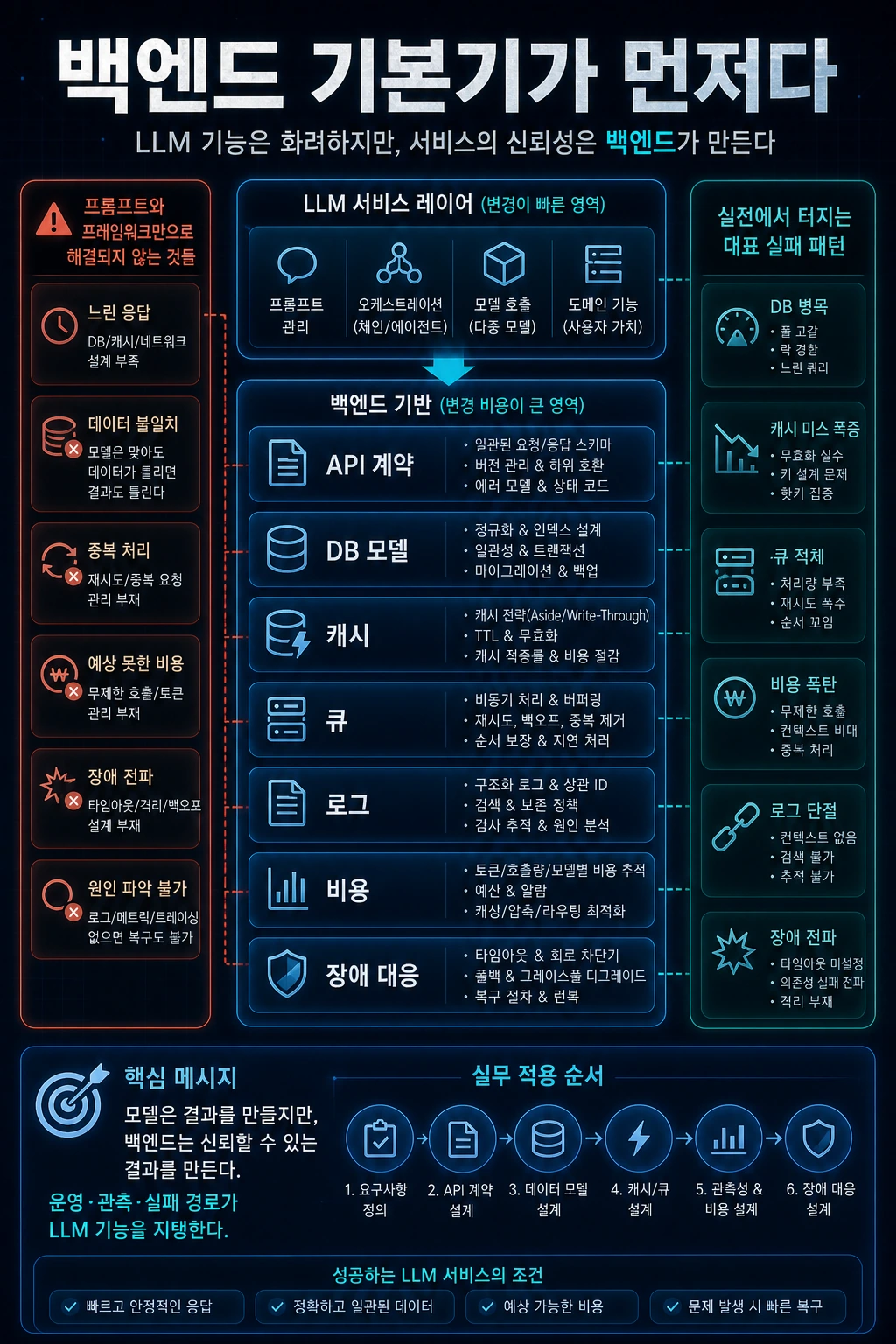
API, DB, 캐시, 큐, 운영이 AI 기능을 지탱한다
이 글에서는 LLM 서비스를 만들 때 왜 프롬프트나 프레임워크보다 백엔드 기본기가 먼저 필요한지 정리합니다.
LLM은 강력한 계층입니다. 하지만 서비스 안에 들어오는 순간 단독 기술이 아니라 백엔드 시스템의 일부가 됩니다. 사용자의 요청을 받고, 권한을 확인하고, 데이터를 검색하고, 모델을 호출하고, 응답을 검증하고, 로그와 비용을 남겨야 합니다.
이 과정에서 백엔드 기본기가 없으면 LLM 기능은 빠르게 불안정해집니다.
분석 기준일: 2026-05-12
실습 기준 환경: FastAPI, PostgreSQL, Redis, Queue, OpenAI API
주요 참고자료: Google SRE, OpenAPI, Redis Docs, AWS Builders Library, OpenAI Docs
핵심 요약
- LLM 기능은 API, DB, 캐시, 큐, 로그 위에서 동작한다.
- PoC에서는 모델 호출만으로 충분하지만 프로덕션에서는 실패 경로가 더 중요하다.
- 백엔드 기본기가 없으면 비용, 지연, 품질, 장애를 설명할 수 없다.
- LLM 프레임워크는 구조를 대신 설계해주지 않는다.
- 먼저 만들 것은 챗봇이 아니라 운영 가능한 서비스 뼈대다.
1. LLM 기능은 혼자 동작하지 않는다
LLM API 호출 자체는 어렵지 않습니다. 문제는 호출 전후에 있습니다.
# 예시입니다.요청 수신→ 사용자 인증→ 요청 validation→ rate limit 확인→ 문서 검색→ prompt 구성→ 모델 호출→ 응답 schema 검증→ 결과 저장→ 비용 기록→ trace 연결
이 중 어느 하나라도 빠지면 운영 중 문제가 생깁니다. 특히 LLM은 응답 시간이 길고, 비용이 요청마다 달라지고, 출력이 비결정적입니다. 그래서 일반 API보다 더 많은 운영 장치가 필요합니다.
2. PoC에서 잘 되던 기능이 무너지는 이유
PoC 단계에서는 happy path만 보면 됩니다. 하지만 프로덕션에서는 예외가 기본값입니다.
| 문제 상황 | PoC 대응 | Production 대응 |
|---|---|---|
| 모델 API 지연 | 기다린다 | timeout, retry, fallback |
| 응답 형식 오류 | 수동 수정 | schema validation, 재시도 정책 |
| 같은 요청 반복 | 그대로 호출 | cache, deduplication |
| 긴 문서 색인 | 동기 처리 | queue, worker, status API |
| 품질 저하 | 사람이 확인 | eval, golden set, release gate |
| 장애 분석 | 로그 검색 | trace ID, span, dashboard |
프로덕션 전환은 기능을 더 붙이는 일이 아니라, 실패를 시스템 안에 넣는 일입니다.
3. API 계약이 먼저다
LLM 서비스에서도 API 계약은 여전히 중요합니다. 사용자가 질문을 보내는 API는 단순해 보이지만, 운영을 고려하면 훨씬 많은 정보를 다뤄야 합니다.
// 예시 JSON 구조입니다.{ "question": "Redis cache aside는 언제 쓰나요?", "document_scope": "official-docs", "answer_format": "markdown", "trace_id": "generated-by-server"}
응답도 마찬가지입니다.
// 예시 JSON 구조입니다.{ "answer": "...", "citations": [ { "title": "Redis Docs", "url": "...", "score": 0.87 } ], "usage": { "input_tokens": 3200, "output_tokens": 600 }, "trace_id": "req_abc123"}
API 계약이 없으면 프론트엔드, 백엔드, 평가 시스템, 로그 시스템이 서로 다른 방식으로 데이터를 해석하게 됩니다.
4. DB와 캐시는 운영의 기준점이다
LLM 서비스에서 저장해야 할 데이터는 생각보다 많습니다.
| 데이터 | 저장 이유 |
|---|---|
| 사용자 질문 | 재현, 분석, 품질 개선 |
| 모델 응답 | 이력 조회, 회귀 비교 |
| 문서 chunk | RAG 검색 |
| prompt version | 품질 변화 추적 |
| token usage | 비용 분석 |
| eval result | 릴리스 판단 |
캐시는 비용과 지연을 줄이기 위한 장치입니다. 하지만 캐시는 정답 저장소가 아닙니다. TTL, invalidation, key design, 개인정보 포함 여부를 반드시 설계해야 합니다.
5. 큐와 멱등성이 필요한 순간
LLM 서비스에는 오래 걸리는 작업이 많습니다.
# 예시입니다.PDF 파싱문서 chunkingembedding 생성벡터 DB 저장대량 요약주간 리포트 생성
이 작업을 API 요청 안에서 동기 처리하면 사용자는 오래 기다려야 하고, 서버는 쉽게 포화됩니다. 그래서 큐로 분리해야 합니다.
하지만 큐를 쓰면 새로운 문제가 생깁니다. 메시지는 중복될 수 있고, 재시도될 수 있고, 순서가 바뀔 수 있습니다. 따라서 idempotency key와 작업 상태 테이블이 필요합니다.
6. 로그와 지표가 없으면 개선할 수 없다
LLM 서비스에서 반드시 남겨야 할 지표는 다음과 같습니다.
| 지표 | 의미 |
|---|---|
request_count | 트래픽 |
latency_p95, latency_p99 | 사용자 체감 지연 |
model_error_rate | 모델 호출 실패율 |
schema_validation_fail_rate | 출력 계약 실패율 |
cache_hit_rate | 캐시 효율 |
tokens_per_request | 비용 단위 |
eval_pass_rate | 품질 기준 통과율 |
모델 품질은 느낌으로 개선할 수 없습니다. 비용과 지연도 마찬가지입니다. 측정할 수 있어야 개선할 수 있습니다.
7. 백엔드 기본기 학습 순서
# 예시입니다.1. API 계약과 error response2. PostgreSQL 데이터 모델3. Redis cache aside4. Queue와 worker5. retry, timeout, idempotency6. structured logging7. trace ID propagation8. health check와 readiness9. metrics dashboard10. 테스트와 릴리스 기준
이 순서가 잡혀 있으면 LLM 기능을 붙일 때도 훨씬 안정적으로 설계할 수 있습니다.
8. 실무 체크리스트
# 예시입니다.[ ] LLM 호출 전 request validation이 있는가?[ ] LLM 응답 후 schema validation이 있는가?[ ] 실패 응답 형식이 통일되어 있는가?[ ] 요청마다 trace_id가 있는가?[ ] token usage와 비용을 기록하는가?[ ] 같은 요청을 반복 호출하지 않도록 cache 또는 deduplication이 있는가?[ ] 오래 걸리는 작업은 queue로 분리했는가?[ ] 재시도 가능한 작업은 idempotent한가?[ ] 장애 상황을 dashboard에서 볼 수 있는가?
9. Q&A
Q1. LLM 프레임워크를 쓰면 이런 문제를 해결해주지 않나요?
일부 편의 기능은 제공합니다. 하지만 API 계약, 권한, 데이터 모델, 조직의 릴리스 기준은 프레임워크가 대신 정해주지 않습니다.
Q2. 캐시는 모든 LLM 응답에 적용해도 되나요?
아닙니다. 사용자별 개인정보, 권한이 다른 문서, 최신성이 중요한 답변은 캐시하면 위험할 수 있습니다. 캐시 가능 여부를 먼저 분류해야 합니다.
Q3. 백엔드 기본기를 공부하면 AI 개발 속도가 느려지지 않나요?
초기에는 느려 보일 수 있습니다. 하지만 장애, 재작업, 품질 회귀를 줄이면 전체 속도는 빨라집니다.
10. 참고자료와 불확실성
참고자료
- Google SRE: Monitoring Distributed Systems: https://sre.google/sre-book/monitoring-distributed-systems/
- OpenAPI Specification: https://swagger.io/specification/
- Redis Query Caching: https://redis.io/tutorials/howtos/solutions/microservices/caching/
- AWS Builders Library: Making retries safe with idempotent APIs: https://aws.amazon.com/builders-library/making-retries-safe-with-idempotent-APIs/
- OpenAI Rate Limits: https://platform.openai.com/docs/guides/rate-limits
불확실성
- 서비스마다 캐시 가능한 데이터와 보안 기준이 다릅니다.
- LLM provider별 rate limit, timeout, retry 권장 정책은 달라질 수 있습니다.
- 이 글의 예시는 학습용이며 실제 서비스에서는 개인정보와 보안 정책 검토가 필요합니다.
실무 예시: PoC 챗봇을 API 서비스로 옮길 때
PoC에서는 prompt와 모델 호출만 있어도 데모가 됩니다. 운영 서비스에서는 요청 ID, 사용자 권한, rate limit, timeout, 재시도, 저장 정책이 먼저 필요합니다. 예를 들어 문서 요약 API를 만든다면 모델 호출 함수보다 POST /summaries, 작업 상태 테이블, 실패 응답, 중복 요청 처리가 먼저 설계되어야 합니다.
| PoC에서 생략하기 쉬운 것 | 운영에서 필요한 이유 |
|---|---|
| request_id | 장애 신고 추적 |
| idempotency key | 중복 요약 생성 방지 |
| queue | 긴 문서 처리와 timeout 분리 |
| cache policy | 비용과 개인정보 관리 |
| audit log | 누가 어떤 문서를 처리했는지 확인 |
실패 사례는 LLM framework가 모든 백엔드 문제를 해결해줄 것이라고 보는 태도입니다. framework는 chain을 쉽게 만들 수 있지만, 사용자별 권한, DB transaction, rate limit, 장애 복구는 애플리케이션 책임입니다. LLM 기능도 결국 API 제품입니다. 백엔드 기본기가 약하면 모델 품질과 무관하게 서비스가 불안정해집니다.
API, DB, cache, queue, and operations support AI functions
In this article, we explain why backend basics are needed before prompts or frameworks when creating an LLM service.
LLM is a strong class. However, the moment it enters the service, it becomes part of the backend system rather than a standalone technology. You need to receive the user's request, check permissions, retrieve data, call the model, validate the response, and leave logs and costs.
Without backend fundamentals in this process, LLM functionality quickly becomes unstable.
Analysis date: 2026-05-12 Practice environment: FastAPI, PostgreSQL, Redis, Queue, OpenAI API Key references: Google SRE, OpenAPI, Redis Docs, AWS Builders Library, OpenAI Docs
Key takeaways
- The LLM function operates on API, DB, cache, queue, and log.
- In PoC, a model call is enough, but in production, the failure path is more important.
- Without backend fundamentals, cost, delay, quality, and failure cannot be accounted for.
- The LLM framework does not design the structure for you.
- The first thing to create is not a chatbot, but an operational service framework.
1. The LLM function does not work alone
The LLM API call itself is not difficult. The problem lies before and after the call.
# This is an example.Request receivedto user authenticationto request validationCheck to rate limitto document searchto prompt configurationto model callto response schema validationto save resultsto record expensesto trace connection
If any one of these is missing, problems will arise during operation. In particular, LLM has long response times, costs vary from request to request, and output is non-deterministic. So it requires more operating machinery than a regular API.
2. Why functions that worked well in PoC fail
At the PoC stage, you only need to look at the happy path. But in production, exceptions are the default.
| problem situation | PoC support | Production response |
|---|---|---|
| Model API Delay | wait | timeout, retry, fallback |
| response format error | manual fix | schema validation, retry policy |
| repeat the same request | call it as is | cache, deduplication |
| long document index | synchronous processing | queue, worker, status API |
| poor quality | person check | eval, golden set, release gate |
| Failure analysis | Log Search | trace ID, span, dashboard |
Transitioning to production is not about adding more features, but about introducing failure into the system.
3. API contract comes first
API contracts are still important in LLM services as well. The API where users send questions may seem simple, but when it comes to operation, it has to handle a lot more information.
// This is an example JSON structure.{ "question": "When do you use Redis cache aside?", "document_scope": "official-docs", "answer_format": "markdown", "trace_id": "generated-by-server"}
The same goes for responses.
// This is an example JSON structure.{ "answer": "...", "citations": [ { "title": "Redis Docs", "url": "...", "score": 0.87 } ], "usage": { "input_tokens": 3200, "output_tokens": 600 }, "trace_id": "req_abc123"}
Without an API contract, your frontend, backend, evaluation system, and log system will interpret data in different ways.
4. DB and cache are the reference points of operation
There is more data that needs to be stored in LLM services than you might think.
| data | Reason for saving |
|---|---|
| user questions | Reproduce, analyze and improve quality |
| model response | History inquiry, regression comparison |
| document chunk | RAG Search |
| prompt version | Quality change tracking |
| token usage | cost analysis |
| eval result | release judgment |
Cache is a device to reduce cost and delay. But the cache is not a store of answers. TTL, invalidation, key design, and whether or not personal information is included must be designed.
5. When you need queues and idempotency
There are many tasks involved in LLM services that take a long time.
# This is an example.PDF parsingdocument chunkingCreate embeddingVector DB storageBulk summaryCreate weekly report
If you do this synchronously within the API request, your users will have to wait a long time and your server will easily become saturated. So we need to separate them into queues.
But using queues creates new problems. Messages can be duplicated, retried, and out of order. So we need an idempotency key and a task state table.
6. You can’t improve without logs and metrics
The indicators that must be left behind in LLM services are as follows:
| characteristic | meaning |
|---|---|
request_count | traffic |
latency_p95,latency_p99 | User perceived delay |
model_error_rate | Model call failure rate |
schema_validation_fail_rate | Output contract failure rate |
cache_hit_rate | cache efficiency |
tokens_per_request | cost unit |
eval_pass_rate | Quality standards pass rate |
Model quality cannot be improved by feel. The same goes for costs and delays. If you can measure something, you can improve it.
7. Backend basics learning sequence
# This is an example.1. API contract and error response2. PostgreSQL data model3. Redis cache aside4. Queue and workers5. retry, timeout, idempotency6. structured logging7. trace ID propagation8. Health check and readiness9. metrics dashboard10. Testing and release criteria
If this order is established, the design can be designed much more stably even when adding the LLM function.
8. Practical checklist
# This is an example.[ ] Is there request validation before calling LLM?[ ] Is there schema validation after LLM response?[ ] Is the failure response format unified?[ ] Is there a trace_id for each request?[ ] Are token usage and costs recorded?[ ] Is there a cache or deduplication to avoid calling the same request repeatedly?[ ] Are long-running tasks separated into queues?[ ] Is a retryable operation idempotent?[ ] Can I see the failure status on the dashboard?
9. Q&A
Q1. Wouldn’t using the LLM framework solve this problem?
Some convenience features are provided. However, the framework does not determine API contracts, permissions, data models, and release standards for your organization.
Q2. Can caching be applied to all LLM responses?
no. Caching personal information for each user, documents with different permissions, and answers where recency is important can be dangerous. Cacheability must be classified first.
Q3. Wouldn’t studying backend basics slow down AI development?
It may seem slow at first. However, reducing failures, rework, and quality regressions increases overall speed.
10. References and uncertainty
References
- Google SRE: Monitoring Distributed Systems:https://sre.google/sre-book/monitoring-distributed-systems/
- OpenAPI Specification:https://swagger.io/specification/
- Redis Query Caching:https://redis.io/tutorials/howtos/solutions/microservices/caching/
- AWS Builders Library: Making retries safe with idempotent APIs:https://aws.amazon.com/builders-library/making-retries-safe-with-idempotent-APIs/
- OpenAI Rate Limits:https://platform.openai.com/docs/guides/rate-limits
uncertainty
- Each service has different cacheable data and security criteria.
- Recommended rate limit, timeout, and retry policies may vary by LLM provider.
- The examples in this article are for learning purposes only and personal information and security policies must be reviewed in actual services.
Practical example: Moving a PoC chatbot to an API service
In PoC, a demo can be done with just a prompt and a model call. The operational service first requires request ID, user permissions, rate limit, timeout, retry, and storage policy. For example, if you are creating a document summary API,POST /summaries, task state table, failure response, and duplicate request handling should be designed before model call functions.
| Things that are easy to omit in PoC | Why it is needed in operations |
|---|---|
| request_id | Disability Report Tracking |
| idempotency key | Avoid creating duplicate summaries |
| queue | Separate long document processing and timeout |
| cache policy | Cost and personal information management |
| audit log | See who processed what documents |
A case of failure is the attitude that the LLM framework will solve all back-end problems. The framework makes it easy to create chains, but user-specific permissions, DB transactions, rate limits, and failure recovery are the responsibility of the application. The LLM feature is also an API product after all. If the backend fundamentals are weak, the service becomes unstable regardless of model quality.

댓글
GitHub 계정으로 로그인하면 댓글을 남길 수 있습니다. 댓글은 GitHub Discussions를 통해 운영됩니다.