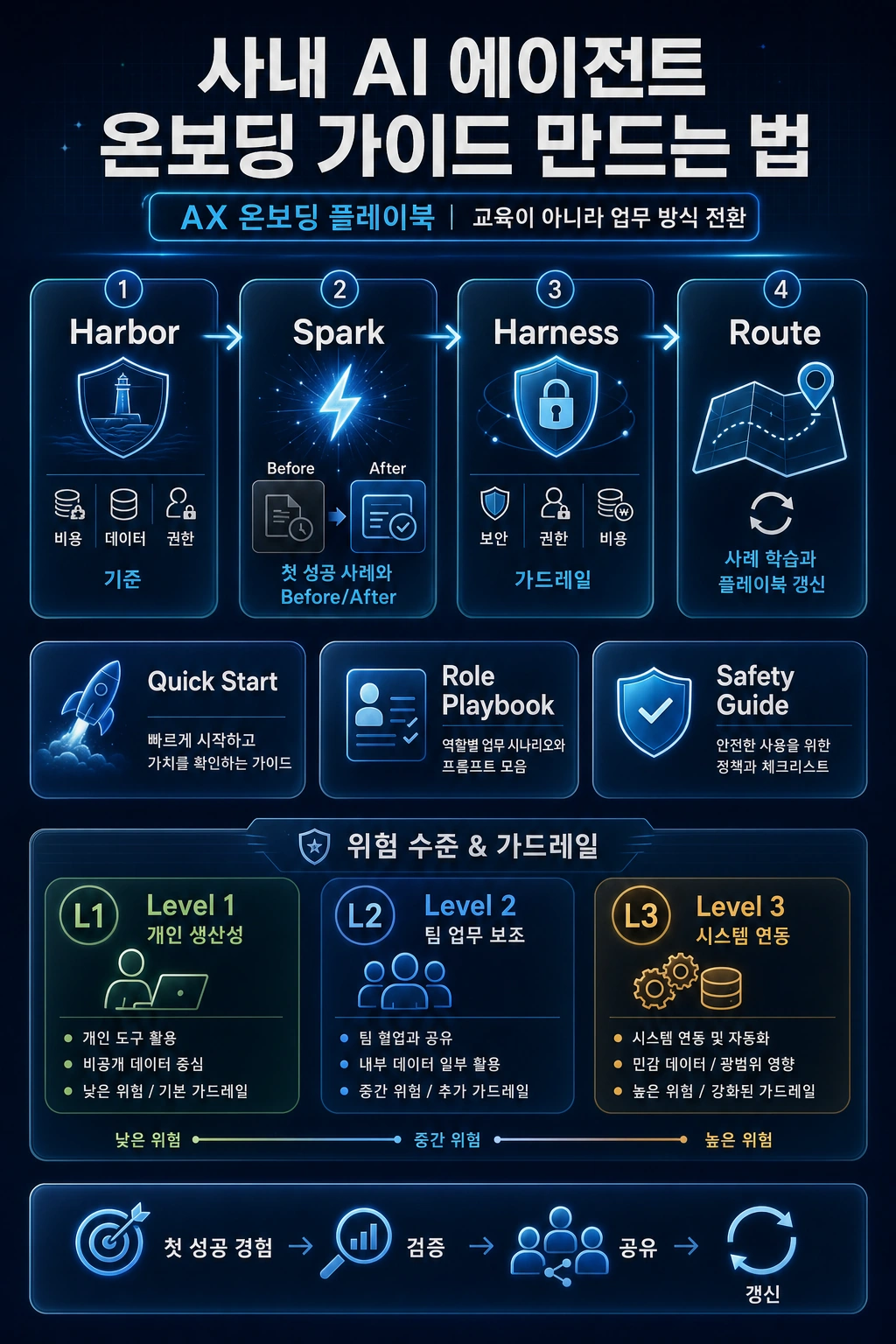
어느 날 사내에서 AI 에이전트 온보딩 가이드를 맡게 되었다고 해봅시다. 처음에는 간단해 보입니다. 승인된 도구 목록을 정리하고, 좋은 프롬프트 예시를 모으고, 보안 주의사항을 붙이면 될 것 같습니다.
그런데 실제로는 곧 다른 문제가 터집니다.
이 자동화를 하려면 관리자 권한이 필요합니다.API 키는 어디서 발급받나요?고객 문의 원문을 넣어도 되나요?운영 로그를 AI에게 읽혀도 되나요?AI가 만든 코드를 바로 배포해도 되나요?비용은 어느 팀 예산으로 처리하나요?
이 질문이 나오기 시작하면 온보딩은 더 이상 "사용법 교육"이 아닙니다. 조직이 AI에게 어떤 일을 맡기고, 어떤 데이터는 막고, 어떤 결과는 사람이 검증할지 정하는 운영 설계가 됩니다.
AI 에이전트 온보딩 가이드는 프롬프트 모음집으로 끝나면 안 됩니다. 핵심은 다음 질문에 답하는 것입니다.
AI 에이전트에게 어떤 일을 맡길 수 있는가?어떤 데이터는 넣으면 안 되는가?어떤 실행은 승인 받아야 하는가?AI 결과를 사람이 어떻게 검증할 것인가?팀 업무 흐름을 어떻게 바꿀 것인가?
| 기준 | 내용 |
|---|---|
| 분석 기준일 | 2026-05-13 |
| 분석 범위 | 사내 AX 도입, AI 에이전트 온보딩, 보안/권한/비용 가드레일, 직군별 실무 적용 |
| 주요 참고자료 | OpenAI Agents SDK, OpenAI agent 구축 가이드, NIST AI RMF, Microsoft Work Trend Index, Google Cloud GenAI 보안 가이드, Atlassian AI Demo Playbook |
| 적용 대상 | AX 담당자, 개발팀 리더, 플랫폼/보안 담당자, 사내 AI 도입 프로그램 운영자 |
핵심 요약
- 사내 AI 에이전트 온보딩 가이드는 도구 사용법 문서가 아니라 업무 전환 플레이북이어야 합니다.
- AI 에이전트는 일반 챗봇보다 더 많은 도구와 권한을 다룰 수 있으므로, 권한/데이터/비용/검증 기준을 함께 설계해야 합니다.
- 도입 흐름은
Harbor -> Spark -> Harness -> Route로 나눌 수 있습니다. 먼저 공식 운영 경계를 만들고, 작은 성공 사례를 보여주고, 안전한 가드레일을 붙인 뒤, 계속 갱신되는 표준으로 운영합니다. - 온보딩 문서는
Quick Start Guide,Role-based Playbook,Governance & Safety Guide의 3종 세트로 분리하는 편이 좋습니다. - 운영 지표는 계정 수나 프롬프트 수보다 반복 업무 절감, 재사용 가능한 워크플로우, 승인된 자동화 비율, 품질 개선으로 봐야 합니다.
AI 에이전트 온보딩은 왜 필요한가
처음 AI 도구를 도입하면 대부분 이렇게 시작합니다.
ChatGPT 써보세요.Claude 써보세요.Copilot 써보세요.Cursor 써보세요.Claude Code 써보세요.
이 방식만으로는 조직 전체 사용률이 잘 올라가지 않습니다. 사람들은 도구 이름보다 자기 업무에서 어떻게 쓰는지 알고 싶어합니다.
개발자는 PR 리뷰와 테스트 코드 생성에 관심이 있습니다. QA는 테스트 케이스와 재현 절차에 관심이 있습니다. 기획자는 요구사항 정리와 정책 문서 초안에 관심이 있고, 운영/CS는 고객 문의 분류와 답변 초안에 관심이 있습니다.
| 기존 교육 방식 | 온보딩 플레이북 방식 |
|---|---|
| 도구 기능 설명 | 업무 흐름 변화 설명 |
| 프롬프트 예시 제공 | 직군별 사용 사례 제공 |
| 일회성 교육 | 반복 가능한 실습 프로그램 |
| 개인 역량에 의존 | 팀별 챔피언과 사례 공유 |
| 보안 기준 모호 | 허용/금지 데이터 기준 명확화 |
| 사용량 중심 | 업무 시간 절감과 품질 개선 중심 |
Microsoft 2026 Work Trend Index는 AI와 에이전트가 실행을 맡을수록 사람이 일을 지휘하고 판단하는 역할이 커진다고 설명합니다. 이 글에서의 해석은 분명합니다. 사내 온보딩은 개인에게 "AI를 잘 써보라"고 말하는 문서가 아니라, 조직이 AI를 안전하고 반복 가능하게 흡수하기 위한 운영 문서가 되어야 합니다.
AI 에이전트와 일반 챗봇의 차이
온보딩 초반에는 이 차이를 짧고 명확하게 설명해야 합니다.
일반 챗봇은 주로 질문에 답합니다. AI 에이전트는 목표를 받고, 필요한 정보를 찾고, 도구를 호출하고, 여러 단계를 거쳐 결과를 만듭니다.
OpenAI Agents SDK 문서는 에이전트를 instructions, tools, handoffs, guardrails, structured outputs 같은 런타임 요소로 구성할 수 있는 LLM 실행 단위로 설명합니다. OpenAI의 agent 구축 가이드도 agent가 복잡한 의사결정, 유지하기 어려운 규칙, 비정형 데이터가 많은 워크플로우에 적합하다고 설명합니다.
| 구분 | 일반 챗봇 | AI 에이전트 |
|---|---|---|
| 기본 동작 | 질문에 답변 | 목표를 수행 |
| 입력 | 프롬프트 | 목표, 자료, 도구, 제약조건 |
| 실행 방식 | 단일 응답 중심 | 다단계 작업 중심 |
| 도구 사용 | 제한적 | API, 파일, 브라우저, 코드, 검색 등 |
| 위험 요소 | 부정확한 답변 | 잘못된 도구 실행, 권한 오남용, 비용 증가 |
| 필요한 관리 | 프롬프트 가이드 | 권한, 보안, 로그, 비용, 검증 기준 |
온보딩 가이드에는 다음 문장을 넣어야 합니다.
AI 에이전트는 답변 도구가 아니라 실행 도구입니다.따라서 실행 권한이 커질수록 검증 기준과 가드레일도 함께 커져야 합니다.
AX 도입 방법론: Harbor, Spark, Harness, Route
사내 AX 도입은 교육 프로젝트가 아니라 조직 운영체계 전환 프로젝트입니다. 이 글에서는 네 단계로 나눕니다.
- Harbor
공식 운영 경계 - Spark
첫 성공 사례 - Harness
가드레일과 실행 표준 - Route
지속 갱신되는 플레이북
Harbor: 경영진이 항구를 만든다
AI 사용이 개인의 몰래 쓰기 수준에 머물면 조직 전환은 일어나지 않습니다. 먼저 회사가 공식적으로 정해야 합니다.
| 결정 항목 | 질문 |
|---|---|
| 비용 | 어떤 AI 도구를 회사 비용으로 지원할 것인가 |
| 데이터 | 어떤 데이터에 AI를 붙일 수 있는가 |
| 권한 | 어떤 업무에서 도구 호출이나 자동화를 허용할 것인가 |
| 책임 | AX 운영 담당자는 누구인가 |
| 보안 | 민감정보, 고객정보, 소스코드 기준은 무엇인가 |
| 지표 | AI 사용의 성과를 무엇으로 볼 것인가 |
Harbor의 목적은 통제가 아닙니다. 개인이 눈치 보며 쓰는 상태를 공식 운영 경계 안으로 끌어오는 것입니다.
Spark: 동경을 만든다
사람들이 AI를 쓰게 하려면 LLM 원리부터 설명할 필요는 없습니다. 더 강한 것은 옆 팀의 실제 사례입니다.
옆 팀 사람이 AI로 매주 2시간 걸리던 일을 20분으로 줄였다.
Atlassian AI Use Case Demo Playbook은 AI 도입을 장려하는 방법 중 하나로 구체적인 사용 사례 데모를 제안합니다. 특히 실제 문제를 해결하는 라이브 데모는 동료가 "나도 저렇게 쓸 수 있겠다"고 느끼게 만듭니다.
온보딩 가이드에는 도구 설명보다 Before/After 사례가 많아야 합니다.
| Before | After |
|---|---|
| 회의록을 사람이 읽고 결정사항을 정리 | AI가 결정사항/담당자/마감일 초안을 만들고 사람이 검수 |
| PR diff를 리뷰어가 처음부터 훑음 | AI가 변경 요약/위험 포인트/테스트 후보를 먼저 정리 |
| 고객 문의를 운영자가 수동 분류 | AI가 유형/우선순위/답변 초안을 만들고 운영자가 확정 |
| 주간 보고를 각자 다른 형식으로 작성 | AI가 공통 템플릿으로 리스크/결정사항/다음 액션을 정리 |
Harness: 자유를 가속하는 가드레일을 만든다
AI 사용이 잘 되기 시작하면 권한 요청이 늘어납니다. 이때 전부 막으면 확산이 죽고, 전부 열어주면 사고가 납니다.
그래서 필요한 것이 Harness입니다.
Harness는 AI 사용을 막는 통제가 아니라, 안전하게 더 많이 쓰게 만드는 가드레일입니다. NIST AI RMF Core는 AI 리스크 관리를 Govern, Map, Measure, Manage 기능으로 나눕니다. 사내 AI 에이전트도 같은 관점으로 봐야 합니다.
| Harness 영역 | 필요한 장치 |
|---|---|
| 데이터 | 입력 금지/조건부 허용 데이터 표 |
| 권한 | 파일, 브라우저, API, DB, 배포 권한 레벨 |
| 비용 | 모델별 비용 기준, 반복 실행 제한, 팀별 한도 |
| 검증 | 사람이 확인해야 하는 항목, 테스트 기준 |
| 로그 | 누가 어떤 도구로 어떤 작업을 실행했는지 |
| 사고 대응 | 잘못된 입력/출력/도구 실행이 발생했을 때의 절차 |
Route: 표준은 계속 갈아엎는다
AI 도구와 모델은 빠르게 바뀝니다. 오늘의 모범 사례가 다음 달에는 낡은 방식이 될 수 있습니다. 그래서 온보딩 가이드는 완성 문서가 아니라 살아있는 문서여야 합니다.
Route 단계의 핵심은 표준을 고정하는 것이 아니라, 성공 사례와 실패 사례가 계속 반영되는 루프를 만드는 것입니다.
새 사용 사례 수집-> 위험도 분류-> 팀별 실습에 반영-> 실패 사례와 가드레일 업데이트-> 다음 온보딩 자료에 반영
온보딩 가이드는 3종 세트로 나눈다
한 문서에 모든 내용을 넣으면 아무도 끝까지 읽지 않습니다. 사내 온보딩 가이드는 세 문서로 나누는 편이 좋습니다.
| 문서 | 대상 | 목적 |
|---|---|---|
| Quick Start Guide | 전 직원 | 30분 안에 첫 성공 경험 만들기 |
| Role-based Playbook | 직군별 사용자 | 내 업무에 바로 적용할 사례 제공 |
| Governance & Safety Guide | 리더, AX 담당자, 보안 담당자 | 권한, 데이터, 비용, 감사 기준 정리 |
Quick Start Guide
입문 문서의 성공 기준은 설명량이 아니라 첫 업무 결과물입니다.
목표:처음 쓰는 사람이 30분 안에자기 업무 하나를 AI 에이전트로 처리해보게 만든다.
| 섹션 | 내용 |
|---|---|
| AI 에이전트란? | 챗봇과의 차이 |
| 사용 가능한 도구 | 사내 승인 도구 목록 |
| 계정 신청 | 접근 방법 |
| 첫 실습 | 회의록 요약, 문서 정리, 코드 설명 등 |
| 금지 데이터 | 넣으면 안 되는 정보 |
| 결과 검증 | 사람이 확인할 항목 |
Role-based Playbook
Role-based Playbook은 직군별로 나눠야 합니다. 같은 AI 도구라도 직군마다 첫 성공 경험이 다릅니다.
| 직군 | 대표 사용 사례 |
|---|---|
| 개발 | 코드 설명, PR 요약, 테스트 케이스 생성, 리팩터링 초안 |
| QA | 테스트 시나리오, 엣지 케이스, 재현 절차 정리 |
| 기획 | 요구사항 정리, 사용자 스토리, 정책 문서 초안 |
| 디자인 | 사용자 가이드, 화면 문구, 접근성 체크 |
| 운영/CS | 고객 문의 분류, 답변 초안, 이슈 요약 |
| 데이터/분석 | 지표 정의, SQL 초안, 리포트 요약 |
| 리더 | 주간 리포트, 의사결정 리스크, 회의 요약 |
Governance & Safety Guide
이 문서는 길게 만들 필요가 없습니다. 하지만 모호하면 안 됩니다.
| 항목 | 반드시 정리할 내용 |
|---|---|
| 데이터 등급 | 공개/내부/민감/고객/기밀 |
| 도구 권한 | 파일, 브라우저, 코드, API, DB 접근 |
| 비용 | 팀별 한도, 모델별 비용, 반복 실행 주의 |
| 로그 | 어떤 사용 기록을 남길 것인가 |
| 승인 | 어떤 요청은 별도 승인이 필요한가 |
| 사고 대응 | 잘못된 입력이나 출력 발생 시 절차 |
OpenAI Enterprise Privacy는 기업용 제품과 API Platform에서 비즈니스 데이터의 소유와 통제, 모델 학습 사용 여부, 조직 내 접근 제어를 설명합니다. 다만 사내 가이드는 특정 벤더 정책만 믿으면 안 됩니다. 회사가 실제로 쓰는 도구별 데이터 처리 기준을 별도 표로 정리해야 합니다.
첫 성공 경험을 설계한다
온보딩에서 가장 중요한 것은 첫 성공 경험입니다. 처음부터 거창한 자동화를 시키면 실패합니다. 15–30분 안에 끝나는 작은 실습이 필요합니다.
| 대상 | 첫 실습 | 기대 효과 |
|---|---|---|
| 전 직원 | 긴 문서 요약 후 액션 아이템 추출 | 즉시 체감 |
| 개발자 | PR diff 요약과 리뷰 포인트 생성 | 코드 리뷰 시간 절감 |
| QA | 요구사항 기반 테스트 케이스 생성 | 누락 케이스 발견 |
| 기획자 | 회의록을 정책 문서 초안으로 변환 | 문서화 속도 향상 |
| 디자이너 | 화면 설명을 사용자 가이드로 변환 | 반복 문서 작업 감소 |
| CS | 고객 문의를 유형별로 분류 | 응대 품질 균일화 |
| 리더 | 주간 업무 내용을 리스크/결정사항으로 요약 | 의사결정 보조 |
여기서 중요한 것은 실습 주제가 "AI 기능 체험"이 아니라 "내 업무 하나 해결"이어야 한다는 점입니다.
| 나쁜 실습 | 좋은 실습 |
|---|---|
| AI에게 자기소개서를 써보게 하기 | 이번 주 회의록에서 결정사항, 담당자, 마감일을 표로 정리하게 하기 |
| AI에게 아무 글이나 요약하게 하기 | 실제 팀 문서에서 다음 액션과 누락된 의사결정을 추출하게 하기 |
| 프롬프트 엔지니어링 용어 설명 | 팀에서 매주 반복하는 업무를 하나 줄여보게 하기 |
사용 사례는 직군별 카드로 만든다
좋은 유스케이스 카드는 프롬프트보다 업무 흐름을 보여줍니다. 개발자를 위한 카드는 이렇게 만들 수 있습니다.
# 유스케이스 카드: PR 변경사항 요약 ## 대상개발자, 테크리드 ## 기존 방식PR diff 확인 -> 변경 파일 읽기 -> 리뷰 포인트 작성 -> 테스트 필요 항목 정리 ## AI 적용 방식PR diff와 관련 이슈를 입력 -> 변경 요약 -> 위험 포인트 -> 테스트 추천 생성 ## 입력 자료- PR diff- 관련 Jira/GitHub Issue- 변경된 파일 일부- 기존 테스트 코드 ## 출력 형식- 5줄 요약- 주요 변경점- 위험 포인트- 테스트 필요 항목- 리뷰 질문 ## 주의사항- 비밀키, 토큰, 고객정보가 diff에 포함되어 있지 않은지 확인- AI 결과를 그대로 approve하지 않기- 최종 merge 판단은 사람이 하기
QA 카드라면 입력과 검증 기준이 달라집니다.
# 유스케이스 카드: 요구사항 기반 테스트 케이스 생성 ## 대상QA, 기획자, 개발자 ## 기존 방식요구사항 문서 읽기 -> 정상 흐름 정리 -> 예외 케이스 수동 도출 ## AI 적용 방식요구사항과 화면 정책을 입력 -> 정상/예외/경계값 테스트 초안 생성 ## 출력 형식- 테스트 목적- 사전 조건- 테스트 데이터- 절차- 기대 결과- 우선순위 ## 검증 기준- 비즈니스 정책과 충돌하는 케이스가 없는가- 보안/권한 관련 케이스가 빠지지 않았는가- 사람이 실제로 실행 가능한 절차인가
AI 에이전트 사용은 3단계로 분류한다
회의록 요약과 운영 DB 접근 자동화는 위험도가 완전히 다릅니다. AI 사용을 모두 같은 수준으로 관리하면 안 됩니다.
| 레벨 | 사용 유형 | 예시 | 승인 기준 |
|---|---|---|---|
| Level 1 | 개인 생산성 | 요약, 번역, 초안, 회의록, 코드 설명 | 즉시 허용 |
| Level 2 | 팀 업무 보조 | QA 시나리오, PR 요약, 리포트 자동화, 로그 분석 | 팀 리더 또는 담당자 검토 |
| Level 3 | 시스템 연동/자동 실행 | DB 조회, API 호출, 배포 스크립트, 고객정보 처리 | 보안/개발/AX 담당 검토 |
Google Cloud의 생성형 AI 보안 가이드는 생성형 AI 워크로드를 인프라, 데이터 관리, 애플리케이션 통제 관점에서 다룹니다. Google Cloud Production-Ready AI Learning Path도 agent를 개발, 보안, 배포, 평가, production pattern으로 나누어 다룹니다.
사내 가이드도 같은 방식이어야 합니다. "AI를 쓰라"가 아니라 "어떤 레벨의 업무인지 먼저 분류하라"가 출발점입니다.
보안/데이터/권한 기준은 1페이지로 만든다
보안 문서가 너무 길면 아무도 읽지 않습니다. 온보딩 가이드에는 1페이지짜리 "넣어도 되는 것 / 넣으면 안 되는 것" 표가 있어야 합니다.
입력 금지 데이터
먼저 금지 데이터는 체크리스트로 바로 보여줘야 합니다.
AI 에이전트에 입력하면 안 되는 것 [ ] 고객 개인정보[ ] 주민등록번호, 계좌번호, 카드번호[ ] 인증 토큰, API Key, Secret Key[ ] 비공개 계약서 원문[ ] 접근 권한이 없는 타 팀 문서[ ] 운영 DB 원본 데이터[ ] 보안 취약점 세부 정보[ ] 외부 공개 금지 소스코드
조건부 허용 데이터
익명화와 마스킹 기준은 사용자가 바로 판단할 수 있게 적어야 합니다.
조건부로 사용 가능한 것 [ ] 익명화된 로그[ ] 마스킹된 고객 문의[ ] 공개 가능한 코드 일부[ ] 내부 정책 요약본[ ] 테스트용 더미 데이터[ ] 샘플 API 응답
권한 요청 기준
AI 에이전트가 도구를 호출하기 시작하면 권한 관리가 중요해집니다.
| 권한 유형 | 예시 | 기본 정책 |
|---|---|---|
| 파일 읽기 | 문서 요약, 코드 분석 | 제한적으로 허용 |
| 파일 수정 | 코드 변경, 문서 수정 | diff 확인 후 허용 |
| 브라우저 접근 | 웹 검색, 화면 캡처 | 공개 정보 중심 |
| API 호출 | 내부 시스템 조회 | 승인 필요 |
| DB 접근 | 운영 데이터 조회 | 기본 금지 |
| 배포 실행 | 스크립트 실행, CI/CD 호출 | 고위험 승인 필요 |
4주 온보딩 프로그램으로 운영한다
문서만 배포하면 사용률은 잘 올라가지 않습니다. 온보딩은 문서가 아니라 프로그램으로 운영해야 합니다.
| 주차 | 목표 | 진행 내용 | 산출물 |
|---|---|---|---|
| 1주차 | 기본 사용 경험 | 계정 설정, 첫 실습, 금지 데이터 교육 | 개인 실습 결과 |
| 2주차 | 직군별 업무 적용 | 팀별 대표 업무 1개를 AI로 처리 | Before/After 사례 |
| 3주차 | 에이전트형 업무 확장 | 도구 사용, 문서/코드/로그 기반 작업 | 팀별 workflow template |
| 4주차 | 공유와 표준화 | 사례 발표, 실패 사례 정리, 가이드 업데이트 | 사내 플레이북 v1 |
이 방식의 장점은 분명합니다.
- 사람들이 실제로 써봅니다.
- 성공 사례가 생깁니다.
- 실패 사례도 문서에 반영됩니다.
- 가이드는 살아있는 문서가 됩니다.
실전 템플릿
온보딩 가이드의 마지막에는 바로 복사해서 쓸 수 있는 템플릿을 넣어야 합니다.
AI 에이전트 요청 템플릿
# AI 에이전트 요청 템플릿 ## 1. 목표무엇을 끝내야 하는가? ## 2. 배경왜 이 작업이 필요한가? ## 3. 입력 자료AI가 참고해야 할 문서, 로그, 코드, 이슈, 정책은 무엇인가? ## 4. 제약조건하면 안 되는 것, 지켜야 할 규칙, 형식은 무엇인가? ## 5. 출력 형식표, Markdown, JSON, 체크리스트, 코드, 이메일 초안 중 무엇으로 받을 것인가? ## 6. 검증 기준사람이 무엇을 확인해야 완료로 볼 수 있는가?
요청 품질은 결과 품질을 크게 바꿉니다.
| 나쁜 요청 | 좋은 요청 |
|---|---|
| 이 코드 고쳐줘 | 아래 Node.js API 코드에서 인증 실패 시 500이 아니라 401을 반환하도록 수정안을 제안해줘. 기존 응답 스키마는 유지하고, 변경 파일 후보와 테스트 케이스를 함께 제안해줘. |
| 문서 정리해줘 | 아래 회의록에서 결정사항, 담당자, 마감일, 미확정 쟁점을 표로 정리해줘. 사실이 불확실한 항목은 "확인 필요"로 표시해줘. |
| 자동화해줘 | 현재 수작업 절차, 입력 데이터, 권한 필요 여부, 실패 시 되돌리는 방법을 먼저 정리한 뒤 자동화 가능 범위를 Level 1/2/3으로 분류해줘. |
AX 자동화 요청서
Level 2 이상 업무에는 요청서를 받는 편이 좋습니다.
# AX 자동화 요청서 ## 1. 해결하려는 문제- 현재 어떤 업무가 반복되는가?- 한 번 처리하는 데 얼마나 걸리는가?- 월 몇 회 발생하는가? ## 2. 현재 업무 흐름Before:1.2.3. ## 3. AI 적용 후 기대 흐름After:1.2.3. ## 4. 사용하는 데이터- 공개 데이터:- 내부 일반 데이터:- 민감 데이터:- 고객/개인정보:- 소스코드/비밀키 포함 여부: ## 5. 필요한 권한- 파일 접근:- API 접근:- DB 접근:- 외부 서비스 연동:- 관리자 권한 필요 여부: ## 6. 결과물- 문서- 코드- 리포트- 알림- 웹서비스- 자동 실행 스크립트 ## 7. 위험도 분류- Level 1: 개인 생산성- Level 2: 팀 업무 자동화- Level 3: 시스템/데이터 연동 ## 8. 검증 기준- 사람이 확인할 항목:- 실패 시 되돌리는 방법:- 로그 또는 증거:
개인 사용 전 체크리스트
# AI 에이전트 사용 전 체크리스트 ## 입력 데이터[ ] 고객 개인정보가 포함되어 있지 않은가?[ ] API Key, Secret, Token이 포함되어 있지 않은가?[ ] 외부 공개가 불가능한 계약/정책/소스코드가 포함되어 있지 않은가?[ ] 필요한 경우 익명화 또는 마스킹했는가? ## 작업 범위[ ] AI에게 맡길 작업이 명확한가?[ ] 사람이 최종 판단할 항목이 분리되어 있는가?[ ] 결과물 형식을 지정했는가?[ ] 실패했을 때 되돌릴 수 있는가? ## 검증[ ] AI가 생성한 사실을 확인했는가?[ ] AI가 생성한 코드를 테스트했는가?[ ] 보안/권한 영향이 있는지 확인했는가?[ ] 비용이 과도하게 발생하지 않는가? ## 공유[ ] 이 사용 사례를 팀에서 재사용할 수 있는가?[ ] 프롬프트가 아니라 업무 흐름으로 정리했는가?[ ] 성공/실패 사례를 사내 채널에 남겼는가?
운영 지표는 사용량보다 업무 변화로 본다
AI 에이전트를 적극 사용하게 만들려면 지표도 잘 잡아야 합니다. 많은 조직이 처음에는 사용량을 봅니다.
계정 발급 수월간 프롬프트 수AI 도구 접속자 수
하지만 이것만으로는 실제 효과를 알기 어렵습니다. 더 중요한 지표는 업무 흐름의 변화입니다.
| 나쁜 지표 | 좋은 지표 |
|---|---|
| AI 계정 발급 수 | 반복 업무 절감 시간 |
| 프롬프트 공유 수 | 재사용 가능한 워크플로우 수 |
| 교육 참석자 수 | 실제 적용 사례 수 |
| 월간 사용량 | 비용 대비 절감 효과 |
| 챗봇 호출 수 | 산출물 품질 개선률 |
| 자동화 개수 | 안전하게 승인된 Level 1/2 업무 비율 |
온보딩 가이드의 목표는 사용량을 늘리는 것이 아니라 아래 질문에 답하는 것이어야 합니다.
이 팀은 AI 에이전트를 통해 어떤 업무 흐름을 바꿨는가?그 변화는 안전한가?반복 가능한가?다른 팀도 가져다 쓸 수 있는가?
바로 시작하는 운영 순서
처음부터 거대한 AX 조직을 만들 필요는 없습니다. 시작은 작아도 됩니다.
1. 각 팀에서 매주 반복하는 업무 3개를 수집한다.2. 각 업무를 Level 1/2/3으로 분류한다.3. Level 1 업무 하나로 30분 실습을 만든다.4. Before/After 사례를 카드로 남긴다.5. 금지 데이터와 권한 기준을 1페이지로 붙인다.6. 4주 뒤 실제 사례와 실패 사례를 반영해 플레이북을 갱신한다.
AX는 AI를 많이 쓰게 하는 프로젝트가 아닙니다. 사람이 더 중요한 문제에 시간을 쓰도록, 반복 가능한 업무 흐름을 다시 설계하는 프로젝트입니다.
프롬프트 모음집이 아니라 업무 플레이북, 도구 소개가 아니라 첫 성공 경험, 무조건 허용이 아니라 위험도 기반 가드레일. 이 세 가지를 지키면 사내 AI 에이전트 온보딩은 교육 자료를 넘어 조직의 실행 방식을 바꾸는 운영 체계가 됩니다.
요약 카드
| 항목 | 내용 |
|---|---|
| 한 줄 요약 | AI 에이전트 온보딩은 사용법 교육이 아니라 업무 흐름 전환 플레이북이다. |
| 추천 대상 | AX 담당자, 사내 AI 도입 담당자, 개발팀 리더, 보안/플랫폼 담당자 |
| 가장 중요한 구조 | Quick Start Guide + Role-based Playbook + Governance & Safety Guide |
| 가장 큰 리스크 | 보안 기준 없이 권한/API/DB 접근을 열어주는 것 |
| 가장 중요한 장치 | 직군별 첫 성공 경험과 Before/After 사례 |
| 지금 바로 할 일 | 팀별 반복 업무 3개를 수집하고 유스케이스 카드로 정리하기 |
참고자료
Let’s say one day you are tasked with guiding AI agent onboarding within the company. It seems simple at first. I think all you need to do is compile a list of approved tools, gather good examples of prompts, and add security precautions.
But in reality, another problem soon arises.
This automation requires administrator privileges.Where do I get an API key?Can I include the original text of the customer inquiry?Can operation logs be read by AI?Can I immediately distribute code created by AI?Which team budget covers expenses?
When this question starts to come up, onboarding is no longer just “how-to” training. It becomes the operational design that determines which tasks the organization will entrust to AI, which data will be blocked, and which results will be verified by humans.
An AI agent onboarding guide shouldn't just be a collection of prompts. The key is to answer the following questions:
What tasks can be entrusted to AI agents?What data should not be included?Which practices must be approved?How will humans verify AI results?How will you change your team's workflow?
| standard | detail |
|---|---|
| Analysis base date | 2026-05-13 |
| Analysis scope | In-house AX introduction, AI agent onboarding, security/authority/cost guardrail, practical application by job category |
| Key references | OpenAI Agents SDK, OpenAI agent construction guide, NIST AI RMF, Microsoft Work Trend Index, Google Cloud GenAI security guide, Atlassian AI Demo Playbook |
| Applicable to | AX representative, development team leader, platform/security representative, in-house AI introduction program operator |
Key takeaways
- Your in-house AI agent onboarding guide should be a task transformation playbook, not a how-to document.
- AI agents can handle more tools and permissions than regular chatbots, so permissions/data/cost/verification criteria must be designed together.
- The introduction flow can be divided into
Harbor -> Spark -> Harness -> Route. First create formal operating boundaries, demonstrate small success stories, add secure guardrails, and then operate with continuously updated standards. - It is better to separate onboarding documents into three sets:
Quick Start Guide,Role-based Playbook, andGovernance & Safety Guide. - Operational metrics should be viewed in terms of reduced repetitive work, reusable workflows, approved automation rates, and quality improvements rather than number of accounts or prompts.
Why is AI agent onboarding necessary?
This is how most AI tools start when introduced for the first time.
Try ChatGPT.Try Claude.Try using Copilot.Try using Cursor.Try Claude Code.
This approach alone will not increase overall organization utilization. People want to know how to use a tool in their work rather than the name of the tool.
Developers are interested in PR reviews and test code generation. QA is concerned with test cases and reproducibility. Planners are interested in organizing requirements and drafting policy documents, while Operations/CS is interested in triaging customer inquiries and drafting responses.
| Traditional training methods | Onboarding Playbook Approach |
|---|---|
| Tool Function Description | Description of work flow changes |
| Provide example prompts | Provides use cases for each occupation |
| one-time training | Repeatable hands-on program |
| Rely on personal capabilities | Share stories with team champions |
| Security standards are ambiguous | Clarification of allowable/prohibited data standards |
| Usage-driven | Focus on reducing work time and improving quality |
Microsoft 2026 Work Trend Index explains that as AI and agents take over execution, the role of humans in directing and judging work increases. The interpretation in this article is clear. Internal onboarding should not be a document telling individuals to “try AI well,” but rather an operational document for the organization to absorb AI safely and repeatably.
Differences between AI agents and regular chatbots
This difference should be explained briefly and clearly at the beginning of onboarding.
Regular chatbots mainly answer questions. An AI agent receives a goal, finds the necessary information, calls a tool, and goes through several steps to produce a result.
OpenAI Agents SDK Documentation describes agents as LLM execution units that can be composed of runtime elements such as instructions, tools, handoffs, guardrails, and Structured Outputs. [OpenAI's agent construction guide] (https://openai.com/business/guides-and-resources/a-practical-guide-to-building-ai-agents/) also explains that agents are suitable for workflows with complex decisions, rules that are difficult to maintain, and a lot of unstructured data.
| division | General chatbot | AI agent |
|---|---|---|
| default behavior | answer your questions | carry out the goal |
| input | prompt | Goals, data, tools, constraints |
| How it runs | Single response center | Multi-step task-oriented |
| Use tools | limited | API, files, browser, code, search, etc. |
| risk factors | incorrect answer | Running the wrong tools, misusing privileges, and increasing costs |
| care needed | prompt guide | Permissions, security, logs, costs, verification criteria |
Your onboarding guide should include the following sentences:
AI agents are action tools, not answer tools.Therefore, as execution authority grows, verification standards and guardrails must also grow.
AX introduction methodology: Harbor, Spark, Harness, Route
The introduction of AX within the company is not a training project but an organizational operating system conversion project. This article divides it into four steps.
- Harbor
Official Operating Boundary - Spark
First success story - Harness
Guardrails and performance standards - Route
Continuously updated playbook
Harbor: Management creates the harbor
Organizational transformation will not occur if AI use remains at the level of individual stealth. First, the company must make it official.
| decision item | question |
|---|---|
| expense | Which AI tools will be supported at company expense? |
| data | What data can AI be applied to? |
| authority | Which tasks will allow tool calls or automation? |
| responsibility | Who is in charge of AX operations? |
| security | What are the standards for sensitive information, customer information, and source code? |
| characteristic | What will be the results of using AI? |
The purpose of Harbor is not control. The idea is to bring the state of personal use within the boundaries of official operation.
Spark: creates longing
To get people to use AI, you don't need to explain the LLM principles first. Even stronger is the actual example of the team next door.
A person on the next team used AI to reduce work that used to take 2 hours to 20 minutes each week.
Atlassian AI Use Case Demo Playbook suggests concrete use case demos as one way to encourage AI adoption. Live demos, especially ones that solve real-world problems, make colleagues think, "I could write like that."
Your onboarding guide should have more Before/After examples than tooltips.
| Before | After |
|---|---|
| Have people read the meeting minutes and organize decisions | AI drafts decisions/persons in charge/deadlines and human reviews |
| Reviewer goes through PR diff from the beginning | AI organizes change summaries/risk points/test candidates first |
| Operators manually classify customer inquiries | AI drafts type/priority/answer and operator confirms |
| Prepare weekly reports in different formats | AI organizes risks/decisions/next actions into a common template |
Harness: Creating guardrails that accelerate freedom
As AI usage begins to take off, permission requests will increase. At this time, if you block everything, the spread will die, but if you open everything, an accident will occur.
So what you need is a Harness.
Harness is not a control that prevents the use of AI, but a guardrail that safely allows more use. NIST AI RMF Core divides AI risk management into Govern, Map, Measure, and Manage functions. In-house AI agents should be viewed in the same way.
| Harness area | device needed |
|---|---|
| data | Input Prohibited/Conditionally Allowed Data Table |
| authority | File, browser, API, DB, distribution permission level |
| expense | Cost basis per model, repeat execution limit, limit per team |
| verification | What people need to check, testing criteria |
| log | Who performed what tasks with what tools |
| incident response | Procedure when incorrect input/output/tool execution occurs |
Route: Standards keep changing
AI tools and models change rapidly. Today's best practice may be outdated next month. That’s why your onboarding guide should be a living document, not a finished document.
The point of the Route phase is not to fix standards, but to create a loop in which successes and failures are continually reflected.
Collect new use casesto risk classificationto be reflected in each team’s practiceto failure cases and guardrail updatesto be reflected in the following onboarding materials
The onboarding guide is divided into three sets.
If you put everything in one document, no one will read it to the end. It's best to split your internal onboarding guide into three documents:
| document | Target | purpose |
|---|---|---|
| Quick Start Guide | former employee | Create your first success in 30 minutes |
| Role-based Playbook | Users by Occupation | Provides examples that can be applied directly to my work |
| Governance & Safety Guide | Leader, AX representative, security officer | Organize permissions, data, costs, and audit standards |
Quick Start Guide
The success criterion for an introductory document is not the amount of explanation, but the first work product.
target:First-time user within 30 minutesIt makes you handle one of your tasks with an AI agent.
| section | detail |
|---|---|
| What is an AI agent? | Differences from chatbots |
| available tools | List of in-house approval tools |
| Apply for an account | approach |
| first practice | Meeting minutes summary, document organization, code explanation, etc. |
| prohibited data | Information that should not be entered |
| Results Verification | What people will check |
Role-based Playbook
Role-based Playbook must be divided by job category. Even with the same AI tool, the first success experience is different for each job.
| Occupation | Representative use cases |
|---|---|
| development | Code descriptions, PR summaries, test case creation, refactoring drafts |
| QA | Summary of test scenarios, edge cases, and reproducibility procedures |
| planning | Draft requirements, user stories, and policy documents |
| design | User guide, screen text, accessibility check |
| Operations/CS | Categorize customer inquiries, draft responses, and issue summaries |
| Data/Analysis | Indicator definition, SQL draft, report summary |
| leader | Weekly reports, decision risks, meeting summaries |
Governance & Safety Guide
This document doesn't need to be long. But it shouldn't be ambiguous.
| item | Things that must be organized |
|---|---|
| data grade | Public/Internal/Sensitive/Customer/Confidential |
| tool permissions | File, browser, code, API, DB access |
| expense | Pay attention to team limits, cost per model, and repeat execution. |
| log | What usage records will be left behind? |
| approval | Which requests require separate approval? |
| incident response | Procedure when incorrect input or output occurs |
OpenAI Enterprise Privacy explains the ownership and control of business data in enterprise products and API Platform, whether model learning is used, and access control within the organization. However, in-house guides should not rely solely on specific vendor policies. Data processing standards for each tool actually used by the company must be organized in a separate table.
Design your first success experience
The most important thing about onboarding is experiencing your first success. If you try to automate something grandiose from the beginning, it will fail. It requires small exercises that can be completed in 15 to 30 minutes.
| Target | first practice | expected effect |
|---|---|---|
| former employee | Extract action items after summarizing long documents | Feel it immediately |
| developer | Create PR diff summary and review points | Save code review time |
| QA | Requirements-based test case creation | Missing case discovered |
| planner | Convert meeting minutes into draft policy documents | Speed up documentation |
| designer | Convert screen descriptions into user guides | Reduce repetitive document tasks |
| CS | Categorize customer inquiries by type | Uniform response quality |
| leader | Summarize weekly work details into risks/decisions | decision aid |
The important thing here is that the subject of the practice should be “Solving one of my tasks,” not “Experience AI functions.”
| bad practice | good practice |
|---|---|
| Let AI write a self-introduction | Have this week's meeting minutes tabulate decisions, personnel, and deadlines. |
| Let AI summarize any text | Extract next actions and missing decisions from real team documents |
| Prompt Engineering Glossary | Have your team reduce one task they repeat each week |
Use cases are created with cards for each occupation.
Good use case cards show workflow rather than prompts. Cards for developers can be created like this:
# Use case card: Summary of PR changes ## TargetDeveloper, Tech Lead ## Conventional methodCheck PR diff to Read changed files to Write review points to Organize items needed for testing ## AI application methodEnter PR diffs and related issues to Change Summary to Risk Points to Generate Test Recommendations ## Input data- PR diff- Related Jira/GitHub Issues- Some changed files- Existing test code ## Output format- 5 line summary- Major changes- Danger Points- Items required for testing- Review Questions ## caution- Check that secret keys, tokens, and customer information are not included in the diff.- Do not approve AI results as is- The final merge decision is made by a human.
For QA cards, the input and verification criteria are different.
# Use case card: Requirements-based test case creation ## TargetQA, planner, developer ## Conventional methodReading requirements documents to organizing normal flow to manually deriving exception cases ## AI application methodEnter requirements and screen policies to create normal/exception/boundary test drafts ## Output format- Test purpose- Prerequisites- test data- procedure- Expected results- Priority ## Verification criteria- Are there any cases that conflict with business policies?- Were any security/permission related cases left out?- Is the procedure actually executable by humans?
AI agent use is classified into three stages:
Summarizing meeting minutes and automating access to operational databases have completely different risks. All uses of AI should not be managed at the same level.
| level | type of use | example | Approval Criteria |
|---|---|---|---|
| Level 1 | personal productivity | Abstracts, translations, drafts, minutes, code comments | Allow immediately |
| Level 2 | Team work assistance | QA scenario, PR summary, report automation, log analysis | Team leader or representative review |
| Level 3 | System linkage/automatic execution | DB inquiry, API call, distribution script, customer information processing | Security/Development/AX Review |
Google Cloud's Generative AI Security Guide covers generative AI workloads from the perspectives of infrastructure, data management, and application control. Google Cloud Production-Ready AI Learning Path also divides agents into development, security, deployment, evaluation, and production patterns.
Your in-house guides should be the same way. The starting point is not “Use AI,” but “First classify what level of work it is.”
Security/data/permission standards should be written on 1 page.
If your security document is too long, no one will read it. Your onboarding guide should have a one-page “what you can/don’t include” table.
Data prohibited from entering
First, prohibited data must be displayed directly in a checklist.
What you should not input into an AI agent [ ] Customer personal information[ ] Resident registration number, account number, card number[ ] Authentication token, API Key, Secret Key[ ] Original text of non-disclosure agreement[ ] Documents from other teams that you do not have access to[ ] Operation DB original data[ ] Security vulnerability details[ ] Source code prohibited from being disclosed externally
Conditionally accepted data
Anonymization and masking standards must be written down so that users can immediately judge them.
Conditionally available [ ] Anonymized logs[ ] Masked customer inquiry[ ] Part of code that can be made public[ ] Summary of internal policies[ ] Dummy data for testing[ ] Sample API response
Permission request criteria
Once AI agents start calling tools, permission management becomes important.
| Permission Type | example | default policy |
|---|---|---|
| read file | Document summary, code analysis | limited permission |
| edit file | Code changes, documentation modifications | Allow after checking diff |
| Browser Access | Web browsing, screen capture | public information focus |
| API call | Internal system inquiry | Approval required |
| DB access | Operational data inquiry | default ban |
| Run Deployment | Run script, call CI/CD | High risk approval required |
Operates as a 4-week onboarding program
If you only distribute documents, the usage rate will not increase. Onboarding should be a program, not a document.
| parking | target | What's going on | output |
|---|---|---|---|
| Week 1 | Basic user experience | Account setup, first practice, banned data training | Individual practice results |
| Week 2 | Application to work by job group | One representative task per team is processed with AI | Before/After cases |
| Week 3 | Agent-type business expansion | Use tools, work based on documents/code/logs | Team workflow template |
| Week 4 | Sharing and standardization | Case presentation, failure case summary, guide update | In-House Playbook v1 |
The advantages of this approach are clear.
- People actually use it.
- There are success stories.
- Failure cases are also reflected in the documentation.
- The guide becomes a living document.
Practical template
At the end of your onboarding guide, you should include a template that you can copy and use right away.
AI agent request template
# AI agent request template ## 1. GoalWhat needs to be done? ## 2. BackgroundWhy is this necessary? ## 3. Input dataWhat documents, logs, code, issues, and policies should AI refer to? ## 4. ConstraintsWhat should not be done, what rules should be followed, and what are the formalities? ## 5. Output formatWill you receive it as a table, Markdown, JSON, checklist, code, or email draft? ## 6. Verification criteriaWhat must a person confirm to be considered complete?
The quality of the request significantly changes the quality of the result.
| bad request | good request |
|---|---|
| Please fix this code | Please suggest a modification in the Node.js API code below to return 401 instead of 500 when authentication fails. Maintain the existing response schema and suggest change file candidates and test cases. |
| Organize the documents | In the meeting minutes below, organize the decisions, people in charge, deadlines, and unconfirmed issues in a table. Mark items where the facts are unclear as “requires confirmation.” |
| Automate it | First organize the current manual procedures, input data, whether permission is required, and how to revert in case of failure, and then classify the scope of automation into Level 1/2/3. |
AX Automation Request Form
For work above Level 2, it is better to receive a request form.
# AX Automation Request ## 1. Problem you are trying to solve-What tasks are currently repeated?- How long does it take to process once?- How many times per month does it occur? ## 2. Current work flowBefore:1.2.3. ## 3. Expected flow after applying AIAfter:1.2.3. ## 4. Data used- Public data:- Internal general data:- Sensitive data:- Customer/Personal Information:- Whether source code/private key is included: ## 5. Required permissions- File access:- API access:- DB access:- External service integration:- Requires administrator privileges: ## 6. Result- document- code- Report- alarm- Web service- Auto-run script ## 7. Risk classification- Level 1: Personal productivity- Level 2: Team work automation- Level 3: System/data linkage ## 8. Verification criteria- Items for humans to check:- How to revert in case of failure:- Logs or evidence:
Checklist before personal use
# Checklist before using AI agent ## Input data[ ] Does it contain customer personal information?[ ] Are the API Key, Secret, and Token included?[ ] Does it contain any contracts/policies/source code that cannot be disclosed externally?[ ] Has it been anonymized or masked where necessary? ## Scope of work[ ] Is the task to be entrusted to AI clear?[ ] Are the items for human final judgment separate?[ ] Did you specify the output format?[ ] Is it possible to turn back in case of failure? ## verification[ ] Have you confirmed the facts created by AI?[ ] Has the AI-generated code been tested?[ ] Have you checked for security/permissions impacts?[ ] Are there excessive costs? ## share[ ] Can this use case be reused by my team?[ ] Was it organized into a workflow rather than a prompt?[ ] Are success/failure stories posted on internal channels?
Operational indicators are viewed as changes in business rather than usage.
To encourage active use of AI agents, you must also have good metrics. Many organizations first look at usage.
Number of accounts issuedNumber of prompts per monthNumber of users accessing AI tools
However, it is difficult to know the actual effect from this alone. A more important indicator is the change in workflow.
| bad indicator | good indicator |
|---|---|
| Number of AI accounts issued | Save time on repetitive tasks |
| Prompt Share Count | Number of reusable workflows |
| Number of training attendees | Number of actual application cases |
| monthly usage | Cost-effective savings |
| Chatbot calls | Output quality improvement rate |
| Number of automation | Safely approved Level 1/2 duty ratio |
The goal of your onboarding guide should not be to increase usage, but to answer the questions below:
How has this team changed their workflow with AI agents?Is the change safe?Is it repeatable?Can other teams also use it?
Order of operation starting immediately
There is no need to create a huge AX organization from scratch. You can start small.
1. Collect three tasks that each team repeats every week.2. Classify each task into Level 1/2/3.3. Create a 30-minute practice with one Level 1 task.4. Leave before/after cases on a card.5. Include prohibited data and permission standards on one page.6. After 4 weeks, update the playbook to reflect actual cases and failure cases.
AX is not a project that uses a lot of AI. A project to redesign repeatable workflows so people can spend their time on more important issues.
Not a collection of prompts but a business playbook, not a tool introduction but a first success experience, and risk-based guardrails rather than unconditional permission. If you stick to these three things, onboarding in-house AI agents goes beyond training material and becomes an operating system that changes the way your organization runs.
summary card
| item | detail |
|---|---|
| one line summary | AI agent onboarding is not a how-to training, but a workflow transformation playbook. |
| Recommended for | AX manager, in-house AI introduction manager, development team leader, security/platform manager |
| the most important structure | Quick Start Guide + Role-based Playbook + Governance & Safety Guide |
| biggest risk | Opening permissions/API/DB access without security standards |
| the most important device | First success experiences and before/after cases for each job group |
| What to do right now | Collect 3 repetitive tasks for each team and organize them into use case cards |

댓글
GitHub 계정으로 로그인하면 댓글을 남길 수 있습니다. 댓글은 GitHub Discussions를 통해 운영됩니다.