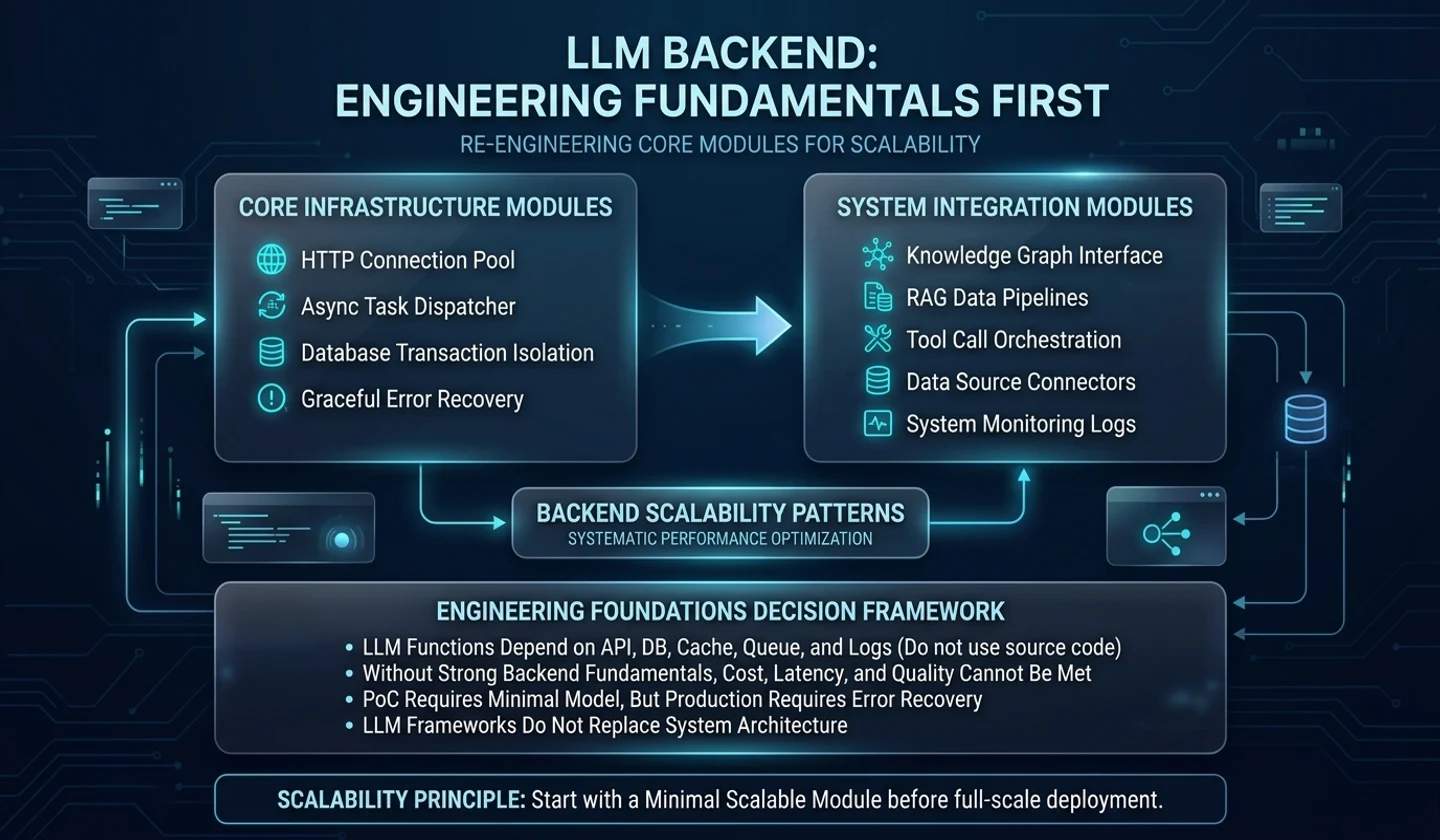
API, DB, cache, queue, and operations support AI functions
In this article, we explain why backend basics are needed before prompts or frameworks when creating an LLM service.
LLM is a strong class. However, the moment it enters the service, it becomes part of the backend system rather than a standalone technology. You need to receive the user's request, check permissions, retrieve data, call the model, validate the response, and leave logs and costs.
Without backend fundamentals in this process, LLM functionality quickly becomes unstable.
Analysis date: 2026-05-12 Practice environment: FastAPI, PostgreSQL, Redis, Queue, OpenAI API Key references: Google SRE, OpenAPI, Redis Docs, AWS Builders Library, OpenAI Docs
Key takeaways
- The LLM function operates on API, DB, cache, queue, and log.
- In PoC, a model call is enough, but in production, the failure path is more important.
- Without backend fundamentals, cost, delay, quality, and failure cannot be accounted for.
- The LLM framework does not design the structure for you.
- The first thing to create is not a chatbot, but an operational service framework.
1. The LLM function does not work alone
The LLM API call itself is not difficult. The problem lies before and after the call.
# This is an example.Request receivedto user authenticationto request validationCheck to rate limitto document searchto prompt configurationto model callto response schema validationto save resultsto record expensesto trace connectionIf any one of these is missing, problems will arise during operation. In particular, LLM has long response times, costs vary from request to request, and output is non-deterministic. So it requires more operating machinery than a regular API.
2. Why functions that worked well in PoC fail
At the PoC stage, you only need to look at the happy path. But in production, exceptions are the default.
| problem situation | PoC support | Production response |
|---|---|---|
| Model API Delay | wait | timeout, retry, fallback |
| response format error | manual fix | schema validation, retry policy |
| repeat the same request | call it as is | cache, deduplication |
| long document index | synchronous processing | queue, worker, status API |
| poor quality | person check | eval, golden set, release gate |
| Failure analysis | Log Search | trace ID, span, dashboard |
Transitioning to production is not about adding more features, but about introducing failure into the system.
3. API contract comes first
API contracts are still important in LLM services as well. The API where users send questions may seem simple, but when it comes to operation, it has to handle a lot more information.
// This is an example JSON structure.{ "question": "When do you use Redis cache aside?", "document_scope": "official-docs", "answer_format": "markdown", "trace_id": "generated-by-server"}The same goes for responses.
// This is an example JSON structure.{ "answer": "...", "citations": [ { "title": "Redis Docs", "url": "...", "score": 0.87 } ], "usage": { "input_tokens": 3200, "output_tokens": 600 }, "trace_id": "req_abc123"}Without an API contract, your frontend, backend, evaluation system, and log system will interpret data in different ways.
4. DB and cache are the reference points of operation
There is more data that needs to be stored in LLM services than you might think.
| data | Reason for saving |
|---|---|
| user questions | Reproduce, analyze and improve quality |
| model response | History inquiry, regression comparison |
| document chunk | RAG Search |
| prompt version | Quality change tracking |
| token usage | cost analysis |
| eval result | release judgment |
Cache is a device to reduce cost and delay. But the cache is not a store of answers. TTL, invalidation, key design, and whether or not personal information is included must be designed.
5. When you need queues and idempotency
There are many tasks involved in LLM services that take a long time.
# This is an example.PDF parsingdocument chunkingCreate embeddingVector DB storageBulk summaryCreate weekly reportIf you do this synchronously within the API request, your users will have to wait a long time and your server will easily become saturated. So we need to separate them into queues.
But using queues creates new problems. Messages can be duplicated, retried, and out of order. So we need an idempotency key and a task state table.
6. You can’t improve without logs and metrics
The indicators that must be left behind in LLM services are as follows:
| characteristic | meaning |
|---|---|
request_count | traffic |
latency_p95,latency_p99 | User perceived delay |
model_error_rate | Model call failure rate |
schema_validation_fail_rate | Output contract failure rate |
cache_hit_rate | cache efficiency |
tokens_per_request | cost unit |
eval_pass_rate | Quality standards pass rate |
Model quality cannot be improved by feel. The same goes for costs and delays. If you can measure something, you can improve it.
7. Backend basics learning sequence
# This is an example.1. API contract and error response2. PostgreSQL data model3. Redis cache aside4. Queue and workers5. retry, timeout, idempotency6. structured logging7. trace ID propagation8. Health check and readiness9. metrics dashboard10. Testing and release criteriaIf this order is established, the design can be designed much more stably even when adding the LLM function.
8. Practical checklist
# This is an example.[ ] Is there request validation before calling LLM?[ ] Is there schema validation after LLM response?[ ] Is the failure response format unified?[ ] Is there a trace_id for each request?[ ] Are token usage and costs recorded?[ ] Is there a cache or deduplication to avoid calling the same request repeatedly?[ ] Are long-running tasks separated into queues?[ ] Is a retryable operation idempotent?[ ] Can I see the failure status on the dashboard?9. Q&A
Q1. Wouldn’t using the LLM framework solve this problem?
Some convenience features are provided. However, the framework does not determine API contracts, permissions, data models, and release standards for your organization.
Q2. Can caching be applied to all LLM responses?
no. Caching personal information for each user, documents with different permissions, and answers where recency is important can be dangerous. Cacheability must be classified first.
Q3. Wouldn’t studying backend basics slow down AI development?
It may seem slow at first. However, reducing failures, rework, and quality regressions increases overall speed.
10. References and uncertainty
References
- Google SRE: Monitoring Distributed Systems:https://sre.google/sre-book/monitoring-distributed-systems/
- OpenAPI Specification:https://swagger.io/specification/
- Redis Query Caching:https://redis.io/tutorials/howtos/solutions/microservices/caching/
- AWS Builders Library: Making retries safe with idempotent APIs:https://aws.amazon.com/builders-library/making-retries-safe-with-idempotent-APIs/
- OpenAI Rate Limits:https://platform.openai.com/docs/guides/rate-limits
uncertainty
- Each service has different cacheable data and security criteria.
- Recommended rate limit, timeout, and retry policies may vary by LLM provider.
- The examples in this article are for learning purposes only and personal information and security policies must be reviewed in actual services.
Practical example: Moving a PoC chatbot to an API service
In PoC, a demo can be done with just a prompt and a model call. The operational service first requires request ID, user permissions, rate limit, timeout, retry, and storage policy. For example, if you are creating a document summary API,POST /summaries, task state table, failure response, and duplicate request handling should be designed before model call functions.
| Things that are easy to omit in PoC | Why it is needed in operations |
|---|---|
| request_id | Disability Report Tracking |
| idempotency key | Avoid creating duplicate summaries |
| queue | Separate long document processing and timeout |
| cache policy | Cost and personal information management |
| audit log | See who processed what documents |
A case of failure is the attitude that the LLM framework will solve all back-end problems. The framework makes it easy to create chains, but user-specific permissions, DB transactions, rate limits, and failure recovery are the responsibility of the application. The LLM feature is also an API product after all. If the backend fundamentals are weak, the service becomes unstable regardless of model quality.
댓글
GitHub 계정으로 로그인하면 댓글을 남길 수 있습니다. 댓글은 GitHub Discussions를 통해 운영됩니다.