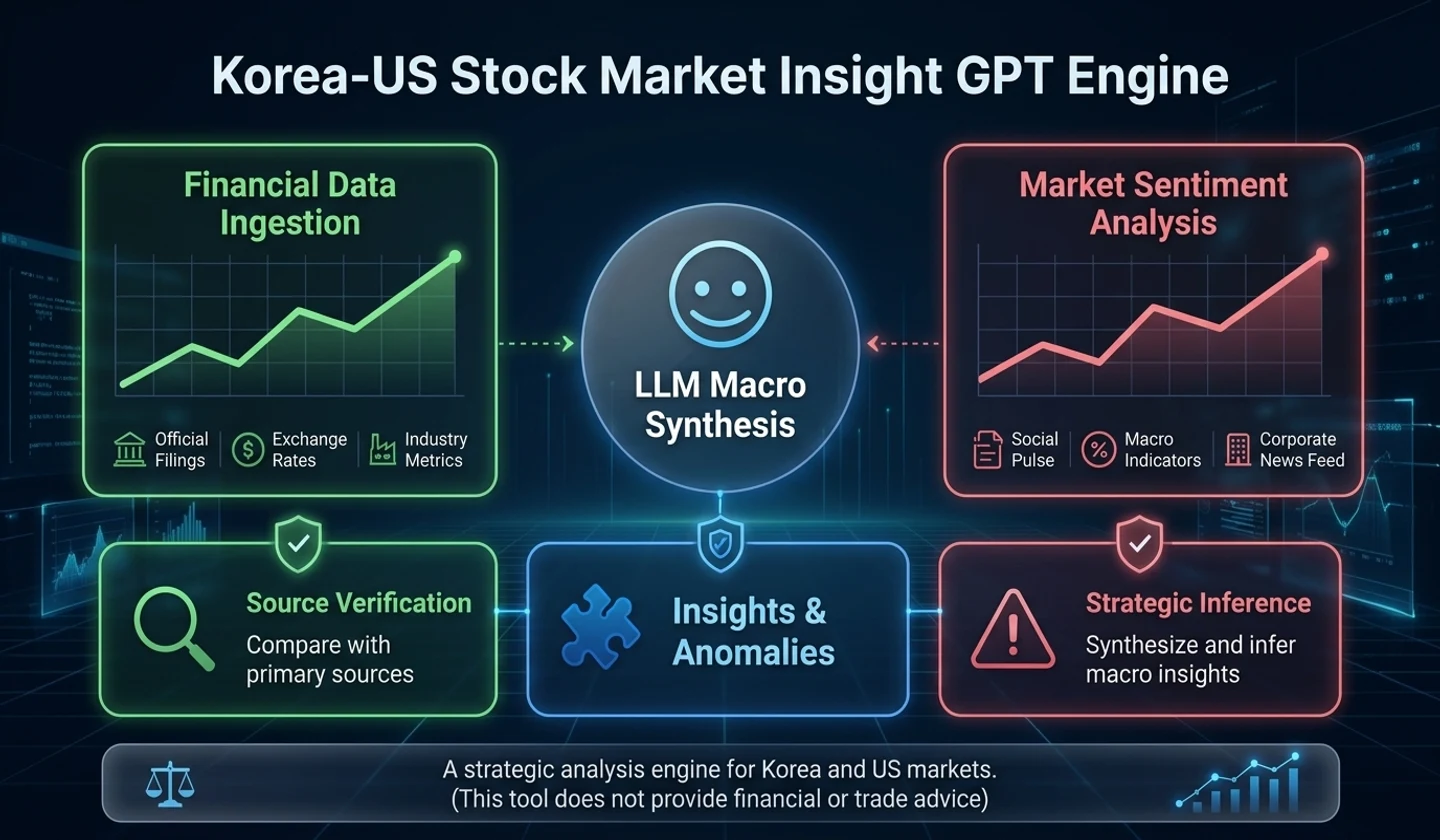
The reason why studying stocks is difficult is not because of a lack of information. Rather, it is difficult because there is too much information. The news keeps coming out, YouTube thumbnails are provocative, and the community is overflowing with sentences that seem to have already been concluded.
The problem is that the information is not coming in the same direction.
Does this news have an impact on performance?Which way are exchange rates and interest rates working now?Should we look at Korean market issues and US market issues together?What is more important: short-term materials or long-term business changes?Is the information I have just confirmed fact, interpretation, or atmosphere?If you miss this question, your stock research quickly narrows down to “What conclusion should I draw?” However, a calm market inspection usually begins with the order of questions rather than the stock name.
So I created Korea-US Stock Insight GPT. This GPT does not replace the decision to execute a trade. This is a research aid designed to provide context, comparison criteria, and risk questions before looking at the Korean and U.S. stock markets.
Ask questions before looking at the market
When many people look at stock information, they immediately look for conclusions. “What variables are important now?”, “Is the story already reflected in the price?”, “What is the original text that needs to be checked?” The method is to search for single-line judgments without asking the same questions. This doesn't mean that this attention is bad. However, it is dangerous to jump to conclusions too quickly.
The question you should ask first is a little different.
| Questions to ask first | reason |
|---|---|
| Does this issue affect sales, costs, or valuation? | You can reduce overinterpretation by positioning the news. |
| Which price reacted first: the Korean market or the US market? | Even within the same industry, market structures and investor characteristics are different. |
| Which variables among exchange rates, interest rates, raw materials, and policies move together? | Even if it seems like a stock issue, it may be a macro variable. |
| Is what you have just confirmed a fact, a perspective, or an opinion? | Mixing the nature of the data clouds your judgment. |
Korea-US Stock Insight GPT is a tool to raise these questions first. It is not a machine that guesses stocks, but rather a partner that organizes the starting line of research.
Differences that arise when looking at Korean stocks and American stocks together
Korean stocks and U.S. stocks use the same name, “stock,” but in reality, they often move in different rhythms.
In the Korean market, exports, exchange rates, supply chains of large corporations, policies, and supply and demand often loom large. In the US market, there are many moments when interest rates, Big Tech performance, consumption indicators, AI infrastructure investment, Fed comments, and sector rotations are reflected in larger prices.
For example, let's say we're looking at semiconductors. In Korea, memory industry conditions, exchange rates, investment plans of Samsung Electronics and SK Hynix, Chinese demand, and export data come to mind first. In the US, we see NVIDIA, AMD, Broadcom, hyperscaler capex, data center power demand, and AI server supply chain together.
Even if you look at the same industry, the questions should be different.
How quickly can Korean companies demonstrate cycle recovery through performance?To what extent have American companies already reflected the expected growth rate in their stock prices?Is the exchange rate favorable to Korean exporters, or does it act as a cost pressure?Is the AI investment story leading to actual orders, sales, and margins?By dividing the question this way, we can avoid simple interpretations such as “It went up in the U.S., so it goes up in Korea,” or “It’s weak in Korea, so the entire industry is bad.”
It's good to ask this
When using this GPT, it is better to provide context and purpose rather than just throwing out the name of the item. For example, you might ask:
We are looking at Samsung Electronics and NVIDIA together.By dividing the recent semiconductor industry situation, AI server demand, and exchange rate variables,Organize short-term checkpoints and mid- to long-term risks.Or you can view the market as a whole.
When looking at the Korean market and the US market together today,Interest rates, exchange rates, Big Tech performance, semiconductor industry conditionsCreate a research checklist to show in what order you should check things.It is also useful when you encounter individual news.
Is this news short-term supply and demand?Is it a material that can change performance estimates?Or please tell me if it is a repetition of an already known story.Please also let me know the official data I need to check.The key is to ask GPT for structure before asking for conclusions. “What should I check?” comes first rather than “Just decide the conclusion now.”
Easy to use incorrectly
Conversely, questions like this are not good usage.
Determine the market direction for tomorrow.Just decide the conclusion for this sport.Gather only positive evidence without verification.Please summarize the most provocative scenario.Questions like these hardly take advantage of GPT. The bigger problem is that the more plausible the answer, the more dangerous it is. Generative AI creates probabilistically plausible sentences. However, it is not an investment system that is responsible for actual prices, disclosures, execution supply and demand, analyst estimates, and intraday variables.
So, when using this GPT, it is better to focus on “quickly organizing questions to check” rather than “getting the right answer.”
Borderline case: The more plausible the answer, the more cautious it is.
The most common failure to watch out for is when the answer seems too natural to skip confirmation. For example, even if GPT talks about a company's performance, valuation, or policy benefits, it should not be regarded as facts consistent with the latest disclosures.
| borderline case | Will definitely see it again |
|---|---|
| I asked about stocks that had sharp intraday fluctuations. | Check the current price, trading volume, disclosure, and original news first. |
| Immediately after the earnings announcement, I asked for a summary. | Check the company's presentation materials and the original text of the conference call. |
| A simple comparison was made between Korean stocks and American stocks. | Separate exchange rates, taxes, listing markets, accounting standards, and valuation differences. |
| GPT gave a strong conclusion in a specific direction. | Ask separately about the opposite scenario and the conditions that will break. |
Expected usage scenes
The scene where you will most often use this GPT is before the chapter opens. You can organize questions in advance about the order in which sectors that moved in the U.S. market overnight will be transferred to the Korean market.
It's also useful when big news comes out. There is news that has a strong title but little actual impact on performance, and conversely, there is news that has a boring title but changes the cost structure of the industry. GPT helps you organize where to watch this news.
You need to be more careful when comparing Korean stocks and American stocks. Even with the same theme, exports and exchange rates may have a greater effect on Korean companies, and valuation and growth expectations may have a greater impact on American companies. Isolating this difference first makes the comparison much calmer.
How to stick to a research routine
If you want to start lightly, just use the following order once a day.
- Choose only three market variables to check today.
- Separate industry and macro variables before directly asking about stocks of interest.
- Display facts, forecasts, and opinions separately in GPT answers.
- Important figures and news are double-checked from official sources.
- At the end, not the transaction conclusion, but the remainder. Organize the question.
The purpose of this routine is not a quick conclusion. The idea is to organize the judgment material before coming to a conclusion.
What people need to check until the end
Even if GPT is useful, the final verification must be done by a human. In particular, the items below must be checked separately.
- Current stock price and trading volume
- Original text of disclosure and performance announcement
- Exchange rates, interest rates, raw material prices
- The company's latest guidance
- Analyst Estimates and Change History
- Taxes, currency exchange, fees, account-specific rules
Korea/US Stock Insight GPT does not replace this verification. Instead, it quickly lays out what to check, what order to think in, and what risks are easy to miss.
There is a lot of information in the stock market. But good questions are scarcer than we think. This GPT is a tool for asking that question first. If you want to figure out what you don't know before putting together your market notes, this is a great starting point.
Practical example: changing same-type questions to be safer
Bad questions are broad questions like “How should I view this stock?” This question lacks price, timeframe, loss limits, and comparisons, so the answer can easily come across as investment advice. A better question is, "What data should I start looking at when looking at this company's revenue growth, margins, debt, and valuation relative to its peers since its latest earnings release?" When asked this way, GPT organizes a confirmation sequence rather than an action conclusion.
| Question style | result |
|---|---|
| Will this stock go up? | Predictions and emotional expressions are prone to mixing up. |
| Which material should I look at first? | Go to disclosure, performance, and risk confirmation |
| How is it different from its competitors? | A standard for comparison was created |
| How do you know if you're wrong? | Failure conditions and monitoring indicators are created. |
A borderline case is up-to-date pricing and disclosure. Even if the GPT answer is plausible, information such as real-time prices, recent announcements, trading suspensions, stock splits, and ex-dividends require separate confirmation. In particular, for Korean stocks, disclosure, supply and demand, and governance issues can change in a short period of time, and for U.S. stocks, even exchange rates and taxes affect the results. This GPT is not a decision-making tool, but more of a checklist to ensure you don't miss any questions.
In reality, it is better not to draw a conclusion right away after receiving the answer, but to divide it into three columns and write it down again. First, this is a fact confirmed by official data. Second, it is an interpretation derived from that fact. Third, it is a variable that we do not yet know. For example, sales growth may be close to fact, but whether that growth rate will continue in the next quarter is an interpretation. Interest rates, exchange rates, raw material prices, and competitor price cuts may be variables that you do not yet know. If you make this distinction, you will not immediately jump to a trading decision even if the GPT answer sounds positive.
The same principle is used when creating comparison questions. Rather than “Which is better, Samsung Electronics or NVIDIA?”, it is better to ask, “When comparing the sales structure, customer concentration, investment cycle, and exchange rate sensitivity of the two companies, which items should be viewed on the same basis?” The former requires a conclusion, the latter a comparative table. Even if the user makes the investment decision later, establishing comparison criteria first can reduce the risk of becoming convinced after hearing only one side of the story.
When recording your answers, also include the date. Market information can change meaning in just a few days. The interest rates, exchange rates, and performance forecasts that were effective on July 7, 2026 cannot be considered to remain the same in the next month. GPT Answers are drafts of research notes, not investment evidence that will stand the test of time.
References and FAQs
When using this GPT, the primary data that should be used as a basis are not GPT answers, but official disclosures, exchange data, corporate IR, performance announcement data, securities company research texts, and central bank and government statistics. It is safer to use GPT to organize the order in which this data will be checked.
Q. Does this GPT make stock decisions?
no. The purpose is not to direct action on a specific stock, but to organize research questions. Users must make decisions on their own, such as whether to execute a transaction, its weight, and timing, after separately checking official data and personal circumstances.
Q. Can I trust real-time prices or the latest announcements?
You shouldn't use it like that. For real-time data and latest disclosures, you should check official sources or securities company screens. GPT answers may contain missing or outdated information.
댓글
GitHub 계정으로 로그인하면 댓글을 남길 수 있습니다. 댓글은 GitHub Discussions를 통해 운영됩니다.