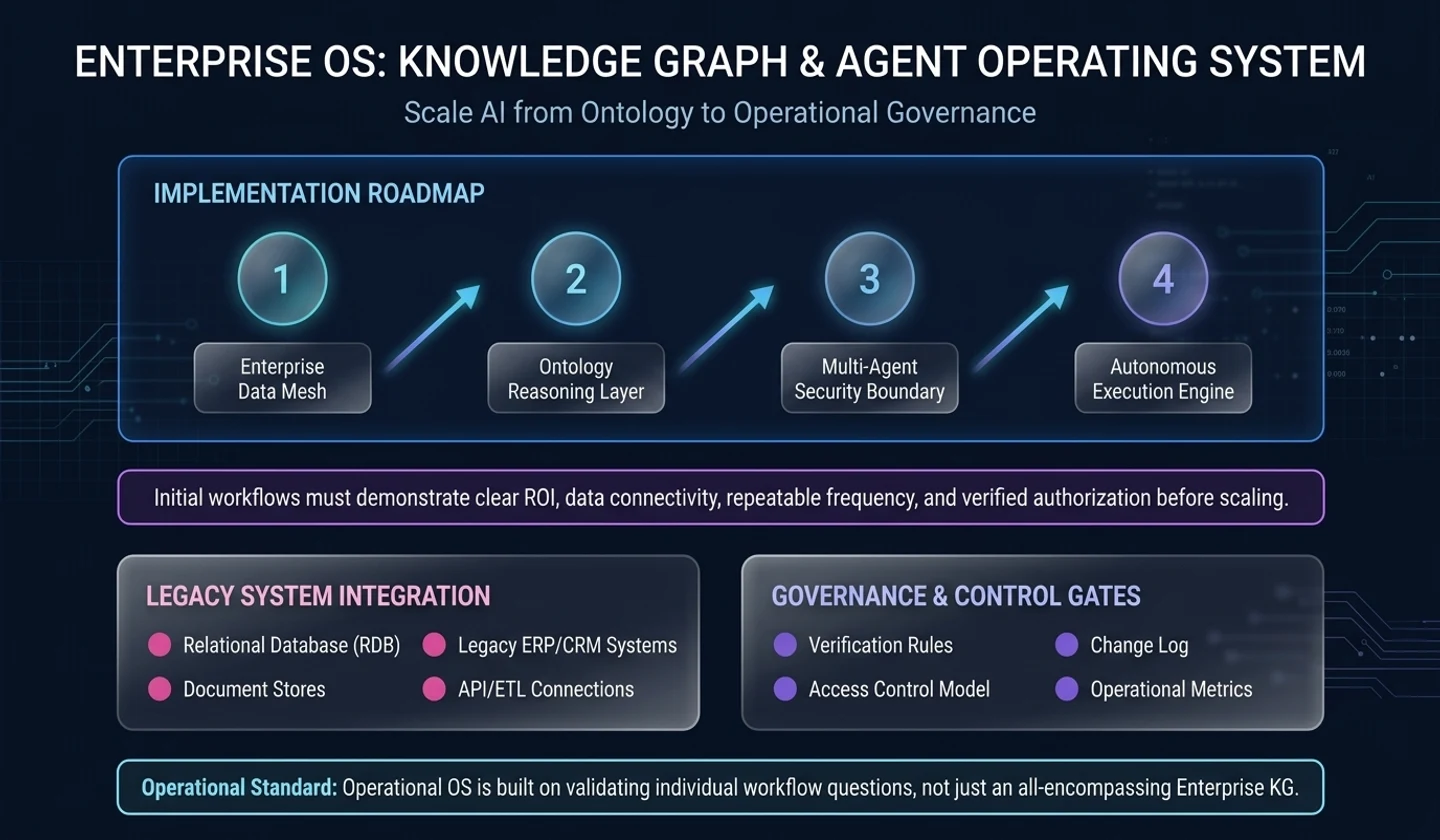
In Part 1, we summarized when an ontology and knowledge graph are needed for an AI agent.
In Part 2, we looked at the roles of Ontology, Knowledge Graph, RAG, GraphRAG, SHACL, and SPARQL from an architectural perspective.
Now, in Part 3, we will get into more practical questions.
So where should organizations start?
There is one most important principle here.
Don’t start with a company-wide KG, but start with one core task you want to automate.
Organizational AI automation is not a project that creates a huge knowledge graph at once. This is the process of selecting a repetitive task, organizing the concepts and questions required for that task, and adding a thin semantic layer on top of the existing DB, document, ticket, and API.
In this article, we outline a step-by-step strategy for extending team AI workflows to organizational AI operating systems.
Date of analysis: 2026-05-01 Key references: OpenAI/Anthropic agent design material, W3C R2RML/SPARQL/SHACL, Microsoft GraphRAG Scope of analysis: Not every detailed implementation of an enterprise-wide architecture, but a practical roadmap to start small and scale organizationally
Key takeaways
- The organizational AI operating system is not a project to create company-wide KG all at once. You should start with a minimal ontology on one core task.
- A good first task should be one where the frequency of repetition, risk, data connectivity, need for authority verification, and ROI are all visible.
- By defining
Competency Questionfirst, we can keep the ontology scope small. - There is no need to move all existing RDBs, document stores, and ticket systems to Graph DB. Connect to R2RML, SPARQL, API, ETL, and document extraction pipelines.
- The expansion order is realistic: workflow automation to team knowledge structuring to common business concept definition to minimum ontology to task KG to organizational AI operating system.
1. Why is it easy to fail if you start with warrior KG?
When talking about organizational-level AI automation, many teams immediately think of this picture.
# Example structureEnterprise data integrationto transcription ontology designto build a company-wide knowledge graphto Shared by all Agentsto Completion of organizational AI operating systemIn theory, it's a great picture. However, in practice it is dangerous.
Starting with Warrior KG, we have the following problem:
| problem | explanation |
|---|---|
| range explosion | We want to include everything from customers, products, contracts, human resources, finance, security, and operations. |
| delay in agreement | Each department has different terminology and processes, so it takes a long time to agree on the concept. |
| ROI unclear | It is not immediately visible which task automation will improve. |
| Data Quality Exposure | Problems with duplication, errors, and omissions in the existing system are revealed all at once. |
| Operating entity unclear | Ambiguity about who will manage the ontology and be responsible for graph quality |
| Automation and separation | It becomes a data modeling project unrelated to actual agent execution. |
The goal of AI automation is not “create nice graphs.” The goal is to get work done faster and safer.
So your starting point should be one task, not all of your data.
Practice Principles Before creating an enterprise KG, you must first decide what questions the AI Agent should answer and what actions it should safely execute in a specific task.
OpenAI and Anthropic's agent design materials also recommend an approach that starts from a simple and combinable structure rather than a complex framework. The same goes for organization KG. Rather than modeling everything from scratch, start by creating the semantic layer needed to reduce automation failures.
2. Criteria for choosing your first task
The first task selection determines the success or failure of the entire project.
A good first task satisfies the following conditions:
# Example structureIt repeats.Connect multiple systems.There are work rules.There is a cost to failure.But not too fatal.Performance can be measured.For example, you might be a candidate for the following jobs:
| candidate for job | merit | Things to note |
|---|---|---|
| New customer onboarding | Connect customers, contracts, security, contact persons, checklists | Need to manage differences in procedures by customer group |
| Review contract changes | Clear authority, approval, documentation, and policy verification | Human-in-the-loop is required due to legal/financial risks |
| Failure response report | Connect customers, services, tickets, and spheres of influence | If real-time requirements are high, initial PoC is burdensome. |
| Internal Policy Q&A | Get started quickly with RAG | Policy validation required to extend to action execution |
| Security exception approval | Tracking rules and evidence is important | Because it is a high-risk task, initial automatic execution should be avoided. |
| Create a sales proposal | Great effect of linking documents, customers, and products | Risk of creating inaccurate prices/terms |
The most recommended type for your first job is Medium Risk Job.
If it is too simple, the value of the ontology/KG will not be revealed. If it is too risky, the security, legal, and audit requirements will become excessive before automation can begin.
A good example is new customer onboarding.
# Example structureThere is customer information.There is a contract status.There is a security screening.There is a person in charge.There is a checklist.There are policies for each industry.Execution log is required.However, most actions can be performed after approval.This task is complex enough to demonstrate the value of Ontology and KG, but without requiring fully automated execution from scratch.
3. How to determine scope with Competency Question
The reason the ontology project is growing is because it starts with “what to model.”
A better starting point is “What questions should be answered?”
In ontology design, this is commonly calledCompetency Question. Simply put, this is a list of key questions this model should be able to answer.
Customer onboarding tasks include:
# Example structureWhat is this customer's contract status?What industry does this customer belong to?What onboarding checklist applies to this customer?Did you pass the security screening?Who is the responsible CSM?Who has permission to execute the Start Onboarding action?What is the supporting document for this action?What conditions must be met for this task to be completed?Once these questions are established, fewer concepts are needed.
| question | concepts needed | relationship needed |
|---|---|---|
| What is the contract status | Customer, Contract, Status | Customer hasContract Contract, Contract hasStatus Status |
| Did you pass the security screening? | Customer, SecurityReview, Status | Customer hasSecurityReview SecurityReview |
| Who is the responsible CSM? | Customer, Person, Role | Customer assignedTo Person |
| What is the application checklist? | Customer, Industry, Checklist | Checklist appliesTo Industry |
| Do you have execute permission? | Person, Role, Permission, Action | Person hasRole Role, Action requires Permission |
| What is a supporting document? | Decision, Evidence, Document | Decision basedOn Evidence |
The advantages of this approach are clear.
# Example structureDo not create concepts that are not necessary for the question.It is directly linked to work performance.PoC evaluation criteria become clear.Easy for domain experts to review.Practical Tips Don’t lay out “all of our company’s concepts” in your first ontology meeting. First, organize “10 questions this Agent must answer”.
4. Design a minimal ontology
Once the competency question is determined, a minimal ontology can be designed.
There is no need to create a perfect OWL model from scratch. First, organize business objects and relationships into a human-readable form.
Here's an example customer onboarding:
# Example structureClass:- Customer- Contract- SecurityReview- OnboardingChecklist- Person- Team- Role- Permission- Policy- Document- Evidence- Decision- Action- SystemA relationship can start like this.
# Example structureCustomer hasContract ContractCustomer hasSecurityReview SecurityReviewCustomer assignedTo PersonCustomer belongsToIndustry IndustryContract hasStatus ContractStatusPerson belongsTo TeamPerson hasRole RoleRole grants PermissionAction requires PermissionAction constrainedBy PolicyDecision basedOn EvidenceEvidence refersTo DocumentSystem owns DataAt this stage it is helpful to distinguish between three things:
| division | explanation | example |
|---|---|---|
| Class | Types of business objects | Customer, Contract, Policy |
| Relation | relationships between objects | hasContract, assignedTo, requiresPermission |
| Constraint | Conditions that must be met | Requires passing security screening before onboarding |
The minimal ontology must satisfy the following conditions:
# Example structureCan answer business questions.Reduce differences in terminology between teams.Can be mapped with existing system data.Verification rules can be added.Don't include too many exceptions in the first place.Naming rules are also established early on.
Even for small models, it is a good idea to establish naming rules early on.
| item | example rule |
|---|---|
| Class | PascalCase: Customer, Contract, SecurityReview |
| Relation | camelCase verb form: hasContract, assignedTo, requiresPermission |
| Status | Clear enums: Draft, Signed, Active, Closed |
| Permission | Action-driven: OnboardingStart, ContractModify |
| Evidence | Specify basis type: ContractDocument, SecurityReport |
Naming may seem trivial, but it becomes important later when multiple teams reuse the same model.
5. Connect existing DB, documents, tickets, and API
Creating an ontology does not mean that all existing systems must be moved to Graph DB.
In practice, it is more realistic to maintain the existing system and add a layer of meaning.
# Example structureCRMERPJiraConfluence / NotionSlackdocument storageIn-house approval system↓Mapping / Extraction / API / R2RML↓Business knowledge graph or virtual graph viewW3C R2RML is a language for mapping relational databases to RDF datasets. Enables existing relational data to be viewed in the RDF data model with a structure and vocabulary chosen by the map author.
SPARQL is also explained so that you can query not only data stored as RDF, but also data that looks like RDF through middleware.
In other words, the introduction strategy is not to “migrate everything to Graph DB” but to choose one of the following.
| Connection method | explanation | suitable situation |
|---|---|---|
| ETL loading | Replicate existing data into graph storage | Sufficient work with regular synchronization |
| API lookup | Calling existing system APIs at run time | Up-to-date work is important |
| R2RML mapping | Mapping RDB to RDF Structure | Connecting relational DB with semantic layer |
| Document extraction | Extract entities/relationships/foundations from documents | Wikis, contracts, policy documents |
| hybrid | Part for graph storage, part for API lookup | Most practical environments |
Document linking is especially important for evidence management.
Simply dividing unstructured documents into chunks may not be enough.
Because documents are the foundation for organizational automation.
# Example structureDocument→ containsClaim → Claim→ supportsDecision → Decision→ referencedBy → Action→ hasVersion → Version→ validFrom / validTo → DateFor example, when policy documents change, you need to distinguish between decisions based on previous policies and decisions based on new policies.
Therefore, your document extraction pipeline must manage the following:
# Example structureDocument IDversionCreation date/revision dateexpiration periodownership teamsupporting sentence or paragraphlinked business objectRAG finds document chunks, and KG manages which business object that chunk is associated with.
6. Attaching verification rules and policy engine
For an organization's AI Agent to execute actual tasks, verification is required before execution.
Verification rules can be broadly divided into two types.
| division | role | example |
|---|---|---|
| Structural verification | Verify that data has the necessary relationships and properties | Contracts must have states |
| Policy verification | Verify that an action satisfies organizational rules | No changes to contract without approval |
SHACL is a standard that verifies that an RDF graph satisfies certain conditions. For example, you can verify the following conditions:
# Example structureThe onboarding action requires a customer.A customer must have a contract attached to it.The contract status must be Signed or Active.The security review status must be Passed.The executor must have OnboardingStart permission.Decisions must be accompanied by supporting documentation.Conceptually, it goes like this.
# Example structureAgent creates candidate actions for execution↓Search related subgraphs↓SHACL or policy engine validation↓Run tool on pass↓In case of failure, explain missing conditions to the userThe verification failure message is also important.
The bad message is this:
# Example structureCannot run.A good message is this:
# Example structureOnboarding cannot begin.reason:1. Customer A’s security screening status is not Passed.2. The current requester does not have OnboardingStart permission.3. The application checklist version has not been confirmed.These messages prompt the user to take the following actions:
Practical Judgment More important than the quality of your LLM's answers is your ability to explain why you failed when you fail. In organizational automation, “judgment not to execute” is also an important automation outcome.
7. Return Agent execution log to graph
There are aspects that are often missed in AI Agent operations.
Many teams only think of the knowledge graph as “data read by agents.” However, in the organizational AI operating system, the Agent execution results must also be recorded in the graph again.
# Example structureAction→ executedBy → Agent→ requestedBy → Person→ executedAt → Timestamp→ usedTool → Tool→ basedOn → Evidence→ produced → Document / Ticket / Decision→ hasResult → Success / Failed / NeedsApprovalRecording this allows you to:
| record entry | conjugation |
|---|---|
| requester | Permission audit, analysis of usage patterns by user |
| Run Agent | Performance/error analysis by agent |
| tools used | Monitor risk tool calls |
| supporting document | Decision provenance tracking |
| Verification results | Rule failure pattern analysis |
| Generate result | Track the origin of documents/tickets/notifications |
| failure log | Ontology and policy improvement |
For example, if an Agent fails to start onboarding, you can graph the reason why.
# Example structureAction:StartOnboarding-ExampleA→ requestedBy → Person:Lee→ targetCustomer → Customer:A→ validationStatus → Failed→ failedBecause → MissingSecurityReview→ failedBecause → MissingPermission→ checkedBy → Policy:OnboardingPolicyV3This log will be very important later.
# Example structureWhich rules cause a lot of failures?Which permissions issues do your teams often encounter?What documents are often used as sources?Which Agents frequently attempt to call incorrect tools?Ultimately, the execution log is not just a simple operation log, but becomes learning data that improves the organization's AI operating system.
8. Order of expansion from team to team
It starts with one team's work.
For example, let's say you start with the Customer Success team responsible for customer onboarding.
# Example structureStep 1: Automate onboarding within your CSM teamStep 2: Connect with your sales team contract statusStep 3: Connect with your security team review statusStep 4: Create operations team account/associate with deployment statusStep 5: Connect with Finance Billing/Contract TermsStep 6: Promote to Common Customer/Contract/Policy ModelThe important thing when expanding is to expand around common objects.
We don’t connect all the work of all teams from the beginning. Standardize core objects shared across multiple teams.
# Example structureCustomerContractProductProjectPersonTeamPolicyPermissionDocumentActionDecisionEvidenceWhen these objects are repeated across multiple tasks, they can be promoted to organizational standards.
| expansion phase | target | output |
|---|---|---|
| PoC | Determine the feasibility of automating specific tasks | Key Question List, RAG, Simple Tool Connections |
| Pilot | Stabilization of team-based repetitive work | Team knowledge base, workflow definitions, logs |
| Semantic Layer | Resolve meaning inconsistency | Common glossary, minimal ontology |
| KG Integration | Data, document, and system connection | Business knowledge graph, entity mapping |
| Governance | safe execution | Validation rules, permission model, audit log |
| Operating System | Organizational Unit Expansion | Policy Engine, Agent Registry, Operations Dashboard |
In this order, rather than forcing a “company standard,” concepts that have been repeatedly verified in actual automation become the standard.
Practical Tips Company-wide standards are not established all at once in a conference room, but are reused in multiple tasks, and it is more stable if surviving concepts are promoted to standards.
9. Operating organization and role division
Ontology/KG-based AI automation is difficult to operate with just one team.
The following roles are required:
| role | responsibility |
|---|---|
| business owner | Define the scope of work to be automated and success criteria |
| domain expert | Review concepts, terminology, exceptions, and policies |
| AI Engineer | Agent design, tool call, RAG/GraphRAG configuration |
| data engineer | System integration, ETL, entity mapping, graph loading |
| Ontology/Data Architect | Conceptual model, relationship, and constraint design |
| Security/Compliance Manager | Review permissions, audit, and data access policies |
| Platform Operations Team | Deployment, monitoring, logs, failure response |
In small organizations, one person may wear multiple roles. However, the roles themselves must be differentiated.
In particular, it is a good idea to separate the following three responsibilities:
# Example structureResponsibility for defining the meaning of workResponsible for linking data and controlling qualityResponsibility for ensuring that the AI Agent runs safelyDuring operational meetings, it is recommended to look at the following metrics:
| characteristic | meaning |
|---|---|
| Automation Success Rate | The percentage of agents completing tasks normally |
| Verification failure rate | Percentage blocked due to missing policies/permissions/data |
| Human-in-the-loop ratio | Human approved or calibrated ratio |
| Evidence missing rate | Proportion of Results Generated Without Evidence |
| Entity Mapping Error Rate | Customer/Contract/Document Linkage Error Rate |
| Number of reuse concepts | Number of ontology concepts shared across multiple tasks |
| Number of blocked dangerous tool calls | Number of unauthorized execution attempts blocked |
These metrics are more important than just usage. This is because the purpose of an organizational AI operating system is not to use it a lot, but to run it safely and consistently.
10. Failure patterns and avoidance methods
Ontology/KG introduction is a project prone to failure. You need to know the typical failure patterns in advance.
| failure pattern | symptoms | evasion method |
|---|---|---|
| Start with warrior scope | Modeling meetings become longer | Start with one core task |
| Technology-driven adoption | Graph DB is created, but no work results | Define Competency Question first |
| Lack of on-site review | The concept seems correct, but the actual work is different. | Domain expert review required |
| Ignoring data quality | Agent makes a decision based on an incorrect graph | Entity mapping and verification rule operation |
| run without rules | Call the tool just by LLM judgment | Add SHACL/Policy Engine/Permission Verification |
| Insufficient log | Can't trace why it was executed | Action-Evidence-Decision log design |
| GraphRAG overconfidence | Increased costs and delays even with simple questions | Separate RAG/KG/GraphRAG question types |
| standardization overload | Even small changes require central approval | Separation of common models and team-specific extensions |
The most dangerous failure is “you create a graph, but the Agent doesn’t actually use it.”
This usually happens for one of the following reasons:
# Example structureCould not connect to the Agent tool.There is no way to cut out the subgraph needed for the question.Data is not up to date.Verification rules are not operational.The business does not trust the graph results.Therefore, KG construction should be viewed as an agent operation project, not a data project.
11. Practical checklist
The checklist below can be used by your organization to begin actual adoption.
# Example structureStep 1: Task Selection [ ] The task to be automated has been narrowed down to one.[ ] Repetition frequency and expected ROI were confirmed.[ ] The risk in case of failure is at a manageable level.[ ] The business owner and domain expert are determined. Step 2: Define the question [ ] Competency questions that the agent must answer are organized into 10 or less.[ ] The data sources required for each question are identified.[ ] Success/failure standards are set for each question. Step 3: Minimal ontology [ ] Core classes are defined.[ ] Core relationships are defined.[ ] Differences in terminology by team are summarized.[ ] Can be mapped to existing system fields. Step 4: Connect your data [ ] The necessary sources among CRM/ERP/ticket/document/API are organized.[ ] There is an entity ID mapping strategy.[ ] You can track document versions and supporting paragraphs.[ ] Data freshness requirements are established. Step 5: Verify and Execute [ ] There is authority verification before execution.[ ] There is policy verification before implementation.[ ] Missing conditions can be explained to the user.[ ] High-risk actions are handled human-in-the-loop. Step 6: Operations [ ] Leaves an Agent execution log.[ ] Records the Action, Evidence, and Decision relationships.[ ] Analyze failure logs to improve ontology and policies.[ ] Promote concepts that are reused across multiple teams to standards.12. Q&A, references, conclusion
Q1. When should I create a transcription ontology?
Rather than creating one from scratch, it is better to promote a concept to an organizational standard when it arises and is reused repeatedly across multiple tasks. For example, if concepts such as Customer, Contract, Policy, Permission, and Evidence are repeated across multiple teams, they are worth standardizing.
Q2. Do I need to move all existing RDBs to Graph DB?
no. You can keep an existing RDB and use a mapping language like R2RML, or you can combine API lookups and graph storage. What is important is not the physical transfer, but the semantic layer and query method.
Q3. Who should manage ontology?
It is realistic for a central platform team to manage structure and quality standards, and for each domain team to manage business concepts and exceptions. A balance of centralization and team autonomy is needed.
Q4. How far should I go during the PoC period?
We recommend that you do not target enterprise scaling in your PoC. It is enough to check one core task, 5 to 10 key questions, a minimum ontology, some data connection, and verification before execution.
Q5. When should I add GraphRAG?
It is recommended to initially start with plain RAGs and object mappings. Review GraphRAG when your question crosses multiple documents and multiple entities, and you need a full structural summary or relationship-based search.
Q6. How should policy engine and SHACL be divided?
SHACL is suitable for verifying the structure and data conditions of RDF graphs. Broader permissions, organizational policies, approval flows, and risk score-based decisions can be separated into separate policy engines.
References and Uncertainty
References
- OpenAI, A practical guide to building agents
- Anthropic, Building Effective AI Agents
- W3C, R2RML: RDB to RDF Mapping Language
- W3C, SPARQL 1.1 Query Language
- W3C, Shapes Constraint Language SHACL
- Microsoft, GraphRAG Documentation
confirmed facts
- R2RML is a W3C standard for mapping relational databases to RDF datasets.
- SPARQL is a W3C standard for querying RDF graphs, and through middleware, you can also query data that looks like RDF.
- SHACL is a W3C standard for verifying that an RDF graph satisfies certain conditions.
- OpenAI and Anthropic describe an approach to agent design that starts from simple, composable structures.
Author's interpretation
- The organizational AI operating system is not an enterprise data integration project, but is closer to an operating system that gradually expands the semantic model of repetitive tasks.
- Rather than setting company-wide standards from scratch, it is more realistic to promote concepts that are reused in multiple tasks.
uncertainty
- Depending on your organization's existing data quality, permissions structure, and system structure, implementation difficulty can vary significantly.
- Financial, healthcare, public and security areas have separate regulatory and auditing requirements and require further review.
finish
In summary, the following sequence is the most realistic way to expand team AI workflow to an organizational AI operating system.
# Example structureWorkflow Automationto structure team knowledgeto define common business conceptsto minimal ontologyto work knowledge graphto validation rules and policy engineto organization AI operating systemThe key is not to build a warrior KG all at once.
In one repetitive task, the question that the AI Agent must answer is defined, the concepts and relationships required for the question are modeled to a minimum, connected to the existing system, verified before execution, and logs added after execution.
If you summarize it in one line, it is like this.
Organizational AI operating system is not a project to create a huge knowledge graph at once, but is a process of expanding semantic models verified in repetitive work to multiple teams.
The main story has been summarized through parts 1 to 3 of this series.
# Example structurePart 1: When do you need ontology/KG?Part 2: What is the role of Ontology, KG, RAG, GraphRAG, and SHACL?Part 3: Where and how should an organization be introduced?If you write your next extension, it would be a good idea to cover “Creating a Mini Ontology/KG with New Customer Onboarding Tasks” as a real-world example. Beyond theory, classes, relationships, verification rules, and even Agent execution logs can be shown as examples.
summary card
- One-line summary: Do not create a company-wide KG, but start with a minimum ontology from one core task.
- Recommended for: CTOs, AI TFs, platform teams, and data teams who want to expand AI automation across their organization.
- Not recommended for: Teams that only need a simple document search PoC
- The most important setting: Limiting the scope of the ontology with Competency Questions
- Biggest risk: Data modeling project grows bigger and loses real automation results
- What to do now: Pick three candidate tasks for automation and select only one based on repeatability, risk, and data connectivity.
댓글
GitHub 계정으로 로그인하면 댓글을 남길 수 있습니다. 댓글은 GitHub Discussions를 통해 운영됩니다.