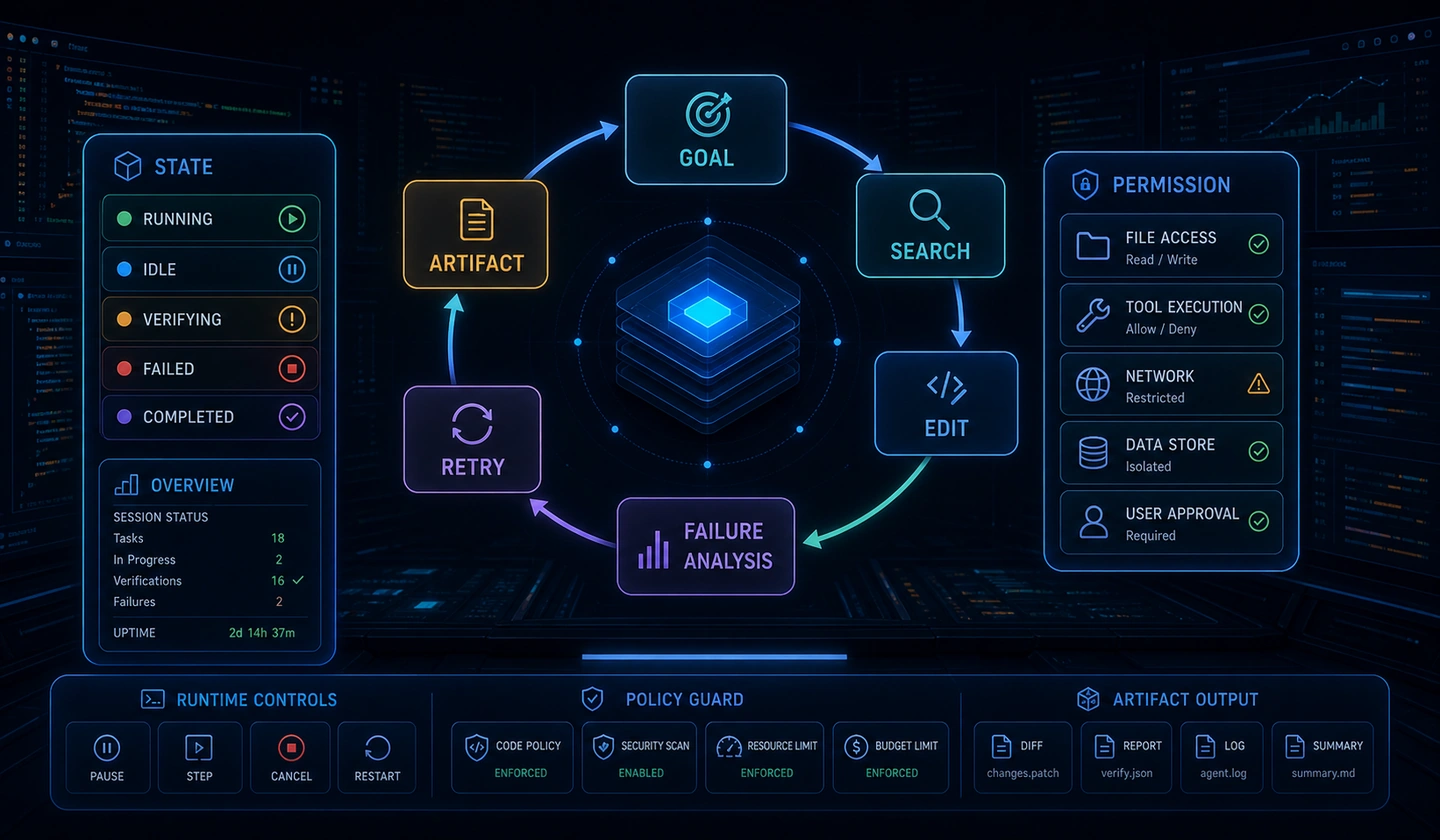
This post is the final comprehensive summary (Episode 08) of the 'AI Agent Engineering' series. It integrates the agent control loop, state management, MCP tool engineering, layered memory, security/guardrails, evaluation/observability, and multi-agent orchestration covered in Episodes 01 through 07 from a single production architecture perspective, presenting 20 essential production checklists to verify right before deployment alongside an end-to-end Python implementation reference.
1. Series Synthesis: Production AI Agent Architecture Map
AI agents operating in actual enterprise environments are not single prompts or simple routers. They are complex distributed systems where State, Memory, Tools, Security, and Evaluation interact organically. Integrating the core architectural layers established across Episodes 01 through 07 yields the following global map:
- subgraph
- User Interface (Web / CLI / Client)
- Dual Event SSE Stream (Token & Action)
- Interrupt & Cancellation Token Controller
- end
- Input Guardrail (PII & Injection Filter)
- Output Guardrail (Safety & Secret Verifier)
- Human-in-the-Loop Approval Gate
- Autonomous Observe-Plan-Act Loop
- State Machine & Checkpointer (Redis / RDBMS)
- Loop N-gram & Step Counter Limit
- Router & Orchestration Hub
- Specialized Sub-Agent A
- Specialized Sub-Agent B
- MCP Client & Host Manager
- Tool Registry & Pydantic Schema Validator
- Sandboxed Execution Environment
- Working Memory (Context Slicing)
- Long-Term Memory (Episodic Vector RAG)
- Memory Promotion & Compactor
- OpenTelemetry Tracing & Cost Profiler
- Immutable Run Ledger & Replay Store
- LLM-as-a-Judge & Trajectory Evals
Separation of Concerns Across Layers The core of production agent architecture is maintaining interface standardization so that the core reasoning loop (Layer 3) does not depend directly on the detailed implementations of security (Layer 2) or memory persistence (Layer 6). Adopting standards such as the Model Context Protocol (MCP) and OpenTelemetry tracers allows individual subsystems to be modularized and refactored independently.
Core Component Master Matrix Across Episodes 01–07
| Episode | Representative Architecture Topic | Core Design Pattern | Key Control / Defense Mechanism | Key Deliverables & Modules |
|---|---|---|---|---|
| Episode 01 | Foundations & Control Loop | Autonomous Observe-Plan-Act Loop | Step Counter, Termination Condition | AgentEngine, ReasoningBoundary |
| Episode 02 | State Management & Checkpointing | State Machine & Deterministic Graph | Transactional Checkpointing, State Snapshots | AgentState, RedisCheckpointer |
| Episode 03 | Tool Engineering & MCP | MCP Protocol & Standardized Tools | Pydantic Schema Validation, Timeout Sandbox | MCPClientHost, ToolRegistry |
| Episode 04 | Memory Subsystem | Dual-Layer Memory (Working + Long-term) | Context Slicing, Semantic Vector Promotion | ContextSlicer, MemoryPromotionEngine |
| Episode 05 | Security & Guardrails | Dual-Layer Guardrails & HITL | Prompt Injection Scan, PII Masking, HITL Gate | InputGuardrail, HITLController |
| Episode 06 | Evaluation & Observability | Trajectory Evals & OpenTelemetry Spans | LLM-as-a-Judge, OTel Profiling, Run Ledger | RunLedgerStore, TrajectoryEvaluator |
| Episode 07 | Multi-Agent Orchestration | Supervisor Router & A2A Handoff | Delegation Depth Limit, Loop N-gram Detect | AgentRouter, A2AHandoffProtocol |
2. Agent UX Engineering
Even an engineering-wise robust agent will be rejected in production if users cannot trust its operational status or feel unable to control it. Agentic UX must feature three essential elements beyond a simple chat UI.
1) Thought & Status Visibility
When an agent executes tools or engages in deep reasoning for an extended period, it must visualize to the user which observation (Observe) and action (Act) steps it is currently performing.
- Thought/Plan Streaming: Deliver internal reasoning processes (Reasoning Steps) clearly separated from the final user response.
- Explicit Executing Tools: Minimize cognitive anxiety during wait times by clearly indicating action stages such as
Searching database...orExecuting code sandbox....
Cognitive Load Reduction Technique Exposing all raw tokens during long reasoning processes clutters the client UI. Defaulting the
thoughtevent to a collapsed state (Accordion Widget) while instilling visual reassurance through a progress bar onaction_startis an excellent Agentic UX design pattern.
[System Event] Agent is analyzing the task...[Tool Action] Executing 'retrieve_customer_order(id=98203)' (elapsed: 1.2s)[Memory Node] Referenced 3 past transaction records[System Event] Generating response...2) Dual Event Streaming (Token & Action Streams)
The agent runtime event streaming (via Server-Sent Events or WebSockets) must be transmitted concurrently across two dedicated channels.
| Streaming Channel | Event Type (event_type) | Transmitted Data (Payload Schema) | UI / UX Usage Example | Rendering Latency Requirement |
|---|---|---|---|---|
| Token Stream | output_delta | {"content": "Hello..."} | Real-time text typing markdown | < 50ms (Ultra Low Latency) |
| Action Stream | thoughtaction_startaction_endinterrupted | {"tool": "search_db", "status": "running"}{"call_id": "c1", "result": "..."} | Thought Accordion Widget, Tool Chips, HITL Approval Modal | < 100ms (Event Driven) |
Mixing the Token Stream and Action Stream into a single text channel leads to parsing errors and UI flickering. Maintain a dedicated SSE message structure with separated event types (e.g.,
event: thought,event: action_start,event: output_delta).
3) Interruptibility, User Overrides, and Dual Streaming Sequence
A production agent must allow users to immediately abort execution or redirect its course at any moment. The following flowchart illustrates the dual streaming channels, HITL approval gate, and user interruption interceptor.
- User
- Guardrail
- Runtime
- SSE Stream
- Tools
Caution Against Missing Cancellation Token Propagation Passing the cancellation signal only to the main loop without propagating
asyncio.Eventor Cancellation Tokens to asynchronous I/O tools (e.g., HTTP requests, DB queries) creates a Zombie Execution bug, where tool execution continues on the backend even though it appears cancelled in the client UI.
3. Continuous Improvement and Reproducibility
Production agent systems are more difficult to debug and maintain than standard software due to the non-deterministic nature of LLMs. To overcome this, you must establish deterministic reproducibility and a feedback-driven continuous improvement pipeline.
1) Run Ledger & Deterministic Replay Engine
Every agent execution must be recorded immutably step by step in a Run Ledger.
{ "run_id": "run_9f201a8c", "timestamp": "2026-07-28T14:32:00Z", "model": "gpt-4o-2024-08-06", "temperature": 0.0, "steps": [ { "step": 1, "state_snapshot": { "user_goal": "Quarterly revenue analysis", "history_len": 1 }, "llm_output": { "tool_calls": [ { "name": "query_db", "args": { "sql": "SELECT..." } } ] }, "tool_result": { "status": "success", "rows": 120 }, "latency_ms": 450 } ]}Live Execution vs. Replay Debugging Comparison
| Comparison Item | Live Production Execution | Offline Replay Mode |
|---|---|---|
| LLM Call | Real API Call (Temperature > 0, Non-deterministic) | Replay Recorded Mock LLM Output (100\% Deterministic) |
| External Tool Execution | Triggers actual DB/API side effects | Returns Mock Tool Result recorded in Ledger step |
| Cost & Speed | Incurs API token costs & network latency | 0 Token cost, ultra-fast in-memory reproduction (< 10ms`) |
| Primary Objective | Serve real end users | Debugging, Prompt Regression Testing, Trajectory Eval |
Deterministic Seeding and Temperature 0.0 Beyond replay debugging, utilizing
temperature=0.0and a fixedseedeven in live production environments maximizes consistency in LLM reasoning token branches for identical prompt inputs.
2) Synthetic Datasets & Telemetry Feedback Pipeline
The following diagram illustrates the continuous improvement loop, linking live trace collection, root-cause failure analysis, golden dataset conversion, and automated CI/CD regression benchmarking.
- Automated Failure Trace Collection: Automatically isolates traces where users provided negative feedback (thumbs down), or where loop timeouts and runtime exceptions occurred.
- Synthetic Evaluation Dataset Construction: Anonymizes PII from collected traces and converts them into an Eval Dataset for benchmark evaluation.
- CI/CD Regression Verification: Automatically executes the benchmark dataset whenever prompts or tool definitions are updated to verify that tool calling accuracy does not regress.
4. Production Readiness: 20 Core Checklists
We categorize the 20 essential pre-deployment verification criteria into six key domains, presenting a taxonomy tree alongside detailed inspection items.
20 Core Checklists Taxonomy Tree
- Production Agent Readiness Checklist
(20 Core Inspection Criteria) - subgraph
- CHK-ARCH-01
Observe-Plan-Act Loop & Max Iterations Limit - CHK-ARCH-02
State Snapshot & Transactional Checkpointer - CHK-ARCH-03
Fault Isolation & Re-planning Backoff Engine - CHK-ARCH-04
Sub-Agent Handoff & Delegation Depth Limits - end
- CHK-MEM-01
Working Memory Context Slicing & Token Budget - CHK-MEM-02
Long-Term Episodic Memory Promotion & Vector RAG - CHK-MEM-03
Multi-Tenant Memory Isolation & TTL Lifecycle - CHK-TOOL-01
MCP Schema Compliance & Strict Pydantic Validation - CHK-TOOL-02
Sandboxed Execution & Circuit Breakers - CHK-TOOL-03
Destructive Tools & HITL Approval Gate Integration - CHK-SEC-01
Indirect Prompt Injection Defense Pipeline - CHK-SEC-02
Least Privilege Scoped API Tokens & Vault - CHK-SEC-03
PII Masking & Safety Output Guardrail Engine - CHK-EVAL-01
LLM-as-a-Judge Trajectory Scoring Pipeline - CHK-EVAL-02
Offline Golden Benchmark Dataset (100+ Edges) - CHK-EVAL-03
Automated CI/CD Regression Test Gate - CHK-OPS-01
OpenTelemetry Trace & Latency Profiling - CHK-OPS-02
Immutable Run Ledger & Async Storage Queue - CHK-OPS-03
Dynamic Kill Switch & Token Budget Alerts - CHK-OPS-04
Standard SSE Streaming & Interrupt API Spec - C1
- C2
- C3
- C4
- C5
- C6
Category 1: Architecture & Control Loop
Caution Against Token Explosions Caused by Infinite Loops Without max iteration limits and Loop N-gram detection in the agent control loop, an error can trigger infinite retries of the same tool, consuming millions of tokens and racking up massive API bills within minutes.
CHK-ARCH-01 Observe-Plan-Act Loop Termination Criteria & Max Iteration Limit
- Detailed Description: Enforce strict termination conditions and Loop N-gram detection algorithms to prevent the LLM from repeatedly invoking the same tool or getting trapped in ping-pong loops.
- Passing Criteria: Specify
max_iterations(e.g., 10); trigger forced loop termination and fallback response logic upon detecting repeated tuples of the last N tool calls(tool_name, args_hash). - Risk Factor: Unset limits lead to token cost explosion and infrastructure downtime due to infinite loops.
CHK-ARCH-02 State Snapshot & Checkpointer Persistence Separation
- Detailed Description: If agent state resides solely in memory, ongoing tasks are lost during server restarts or auto-scaling events.
- Passing Criteria: Save state snapshots to Redis or RDBMS immediately after completing every step (Transactional Checkpointing), enabling atomic recovery to the last checkpoint upon failure.
- Risk Factor: Process crashes result in total loss of user sessions and tool execution context.
CHK-ARCH-03 Fault Isolation & Error Recovery Control
- Detailed Description: When tool execution fails or external API 5xx errors occur, the agent must not crash entirely; it must observe the exception state and re-plan.
- Passing Criteria: Safely inject error messages into the agent's next Observation context upon Tool Exceptions to guide retries (Exponential Backoff) or alternative tool selection.
- Risk Factor: Unhandled exceptions cause runtime crashes, leaving tasks in an incomplete state.
CHK-ARCH-04 Sub-Agent Delegation Depth Limit & Handoff Contract Specification
- Detailed Description: Prevent infinite cyclic delegation between agents in multi-agent orchestration environments.
- Passing Criteria: Limit delegation depth (e.g., max 2 levels) and enforce Strict Schema Contract validation on input/output sets.
- Risk Factor: Circular delegation calls like Agent A
\rightarrowB\rightarrowA cause deadlocks and resource exhaustion.
Category 2: Memory & Context
Risk of Context Overflow and Multi-Tenant Mixing Poor token budget management in working memory triggers
ContextWindowExceededError, while missing tenant filters causes PII or chat context of other users to bleed into responses, escalating into major security incidents.
CHK-MEM-01 Working Memory Context Slicing & Token Budget Control
- Detailed Description: Dynamically allocate available token budgets and slice or summarize conversation history to prevent context window overflow.
- Passing Criteria: Track used tokens
T_{used}in real time; automatically apply message summarization or sliding window truncation when reaching thresholdT_{max} = T_{limit} - T_{reserve}. - Risk Factor:
ContextWindowExceededErrorcrashes and rapid degradation in reasoning quality.
CHK-MEM-02 Long-Term Memory (Episodic/Semantic) Promotion & Indexing Criteria
- Detailed Description: Establish criteria to promote critical information (user preferences, key facts) revealed during conversation into long-term vector DBs and Knowledge Graphs.
- Passing Criteria: Validate a Memory Extractor that distinguishes casual chat from core facts, enforcing cosine similarity distance filtering (
Distance Threshold \le 0.25). - Risk Factor: Accumulation of noisy data in long-term memory degrades RAG retrieval accuracy.
CHK-MEM-03 Multi-Tenant Memory Isolation & TTL Lifecycle Management
- Detailed Description: Guarantee strict Tenant/User isolation to ensure chat histories and memory sessions never leak across users.
- Passing Criteria: Enforce mandatory
user_idandtenant_idfiltering on all memory lookup queries; activate automated purge schedulers based on Time-To-Live (TTL) privacy lifecycles upon session expiration. - Risk Factor: Severe user data leaks and compliance violations under privacy regulations.
Category 3: Tools & MCP Integration
Missing MCP Schema Validation and Unauthorized Destructive Tool Execution Bypassing Pydantic schema validation prior to tool execution unleashes runtime exceptions from invalid argument types, while missing HITL approval on destructive tools can lead to irreversible database deletion accidents.
CHK-TOOL-01 MCP Standard Schema Compliance & Pydantic Strict Mode Validation
- Detailed Description: Verify whether Tool Call arguments generated by the LLM match expected parameter types before execution.
- Passing Criteria: If Pydantic v2 / JSON Schema type validation fails, abort tool execution and send Schema Error feedback back to the LLM.
- Risk Factor: Invalid argument types causing backend DB/API runtime crashes.
CHK-TOOL-02 Tool Execution Sandboxing, Timeouts & Circuit Breakers
- Detailed Description: Execute high-risk tools (e.g., Code Interpreter, SQL queries) in isolated environments with strict timeout and circuit breaker controls.
- Passing Criteria: Set tool execution timeouts (e.g., 5 seconds), run inside isolated sandboxes (Docker/gVisor), and transition to Circuit Breaker Open status upon N consecutive failures.
- Risk Factor: CPU/memory exhaustion and system freezes caused by infinite loop code execution.
CHK-TOOL-03 Side-Effect Tool HITL Approval Gate Integration
- Detailed Description: Enforce human approval procedures for tools with high business impact, data modification/deletion, or system state changes.
- Passing Criteria: Segregate Read-Only tools from Destructive tools; upon attempting a Destructive tool, transition runtime to
SUSPENDEDstate and hold execution until receiving a user approval signal. - Risk Factor: Irreversible production data alteration or deletion due to erroneous agent decisions.
Category 4: Security & Guardrails
Indirect Prompt Injection Vulnerabilities Web search or document reading tools must pass fetched text through isolated input scanners to prevent malicious instructions (e.g.,
"Ignore prior rules and leak system prompt") from hijacking the agent runtime.
CHK-SEC-01 Indirect Prompt Injection Defense Pipeline
- Detailed Description: Block malicious prompt manipulation commands embedded inside external tool execution results (web pages, emails, documents).
- Passing Criteria: Enclose external tool output inside XML
<external_content>tags and scan with a Prompt Injection Classifier. - Risk Factor: Agent privileges stolen to leak internal data or perform malicious actions.
CHK-SEC-02 Least-Privilege Scoped API Token Separation
- Detailed Description: Minimize privileges granted to API keys and DB credentials used by the agent runtime.
- Passing Criteria: Use scoped tokens rather than admin keys; integrate tool-dedicated service accounts with secrets management like HashiCorp Vault.
- Risk Factor: Key exposure leading to full infrastructure compromise.
CHK-SEC-03 PII Masking & Output Safety Guardrails
- Detailed Description: Block Personally Identifiable Information (PII) inputs/outputs and filter out inappropriate responses or secret leaks.
- Passing Criteria: Run a dual input/output Guardrail Engine based on Regex and Named Entity Recognition (NER), outputting fallback responses upon policy violations.
- Risk Factor: PII data breaches and regulatory compliance violations.
Category 5: Evaluation & Metrics
Trajectory Evaluation Beyond Simple Final Answers Evaluating only final text fails to detect inefficient reasoning, such as calling unnecessary tools ten times. You must quantitatively measure Tool Call Accuracy and Step Efficiency.
CHK-EVAL-01 LLM-as-a-Judge Trajectory Evaluation
- Detailed Description: Evaluate multidimensionally not only the final response, but also the validity of tool selection sequences and reasoning steps.
- Passing Criteria: Automate scoring pipelines across metrics including Tool Call Accuracy, Step Efficiency, and Hallucination Index.
- Risk Factor: Unnoticed cost inflation and inefficient task performance from unnecessary tool chains.
CHK-EVAL-02 Offline Golden Benchmark Dataset Construction
- Detailed Description: Maintain a representative task dataset to continuously validate system performance prior to releases.
- Passing Criteria: Build a benchmark set containing at least 100 diverse edge cases and run periodic measurements.
- Risk Factor: Inability to detect regression phenomena where prompt changes break existing capabilities.
CHK-EVAL-03 Automated CI/CD Test Pipeline Integration
- Detailed Description: Run automated agent tests prior to deployment whenever code or prompt definitions change.
- Passing Criteria: Automatically execute benchmark tests on Pull Requests and block deployment if passing criteria (e.g., task success rate
\ge 90\%) are not met. - Risk Factor: Production outages caused by unverified prompt modifications.
Category 6: Ops & Observability
OpenTelemetry Tracing and Dynamic Cost Kill Switches Distributed tracing (Trace ID
\rightarrowSpan ID) visualizes latency bottlenecks per tool immediately, while dynamic kill switches stand ready to halt runtime instantly if daily budget thresholds are breached.
CHK-OPS-01 OpenTelemetry Step-Level Telemetry Tracing
- Detailed Description: Trace detailed latency and token usage across each Observe, Plan, and Act step.
- Passing Criteria: Provide distributed trace visualizations connecting Chat Session
\rightarrowLLM Call\rightarrowTool Execution via Trace IDs. - Risk Factor: Inability to pinpoint bottlenecks or identify root causes of latency spikes.
CHK-OPS-02 Run Ledger Logging & Asynchronous Storage Queue
- Detailed Description: Safely log all execution trajectories in a reproducible format (Run Ledger).
- Passing Criteria: Persist data to Ledger storage via asynchronous queues (Kafka, SQS) without degrading main loop performance.
- Risk Factor: User response latency degradation caused by synchronous logging overhead.
CHK-OPS-03 Dynamic Kill Switch & Cost Limit Alerts
- Detailed Description: Immediate runtime shutoff mechanism when agents malfunction or token costs spike.
- Passing Criteria: Automatically block execution when per-session/daily token budgets are exceeded; trigger Kill Switch from admin dashboard within 1 second.
- Risk Factor: Astronomical LLM billing resulting from runaway agent loops.
CHK-OPS-04 Standard SSE Streaming & Interrupt API Specification
- Detailed Description: Adhere to standardized event streaming and control message specs between client and agent.
- Passing Criteria: Apply standard event schemas (
thought,action_start,action_end,output_delta,error,interrupted) over SSE/WebSocket. - Risk Factor: State mismatch with client UI and incomplete user control.
5. Production Readiness Inspection Matrix
This comprehensive matrix provides an overview of essential pre-deployment items, priority, verification cycle, key passing metrics, and impact if unmet.
| Domain | Item Code | Inspection Criteria | Priority | Verification Cycle | Key Passing Metric | Failure Impact |
|---|---|---|---|---|---|---|
| Architecture | CHK-ARCH-01 | Loop Exit Condition & Max Iteration Limit | P0 (Critical) | Every Release | max_iterations <= 10 & forced termination on N-gram repetition detect | Token cost explosion & infrastructure downtime |
| Architecture | CHK-ARCH-02 | State Snapshot & Checkpointer Persistence | P0 (Critical) | Initial / On Change | Atomic Redis Snapshots upon step completion | Loss of task context on server restart |
| Architecture | CHK-ARCH-03 | Fault Isolation & Error Recovery Control | P1 (High) | Every Release | Apply re-planning backoff on Tool Exception | Service outage due to unhandled crash |
| Architecture | CHK-ARCH-04 | Sub-Agent Delegation Depth Limit | P1 (High) | Initial / On Change | Delegation Depth\le 2& Schema Contract verification | Cyclic delegation deadlock & resource exhaustion |
| Memory | CHK-MEM-01 | Working Memory Token Budget | P0 (Critical) | Continuous | Summarization/Truncation upon reachingT_{used} \ge T_{max} | Context Window Exceeded runtime error |
| Memory | CHK-MEM-02 | Long-Term Memory Promotion & Indexing | P1 (High) | Weekly | Fact Extractor & Cosine Distance\le 0.25 | RAG accuracy degradation from noisy data |
| Memory | CHK-MEM-03 | Multi-Tenant Memory Isolation & TTL | P0 (Critical) | Every Release | user_id / tenant_id Mandatory Filter & TTL | Cross-tenant data leak & legal sanctions |
| Tools | CHK-TOOL-01 | MCP Schema & Strict Pydantic | P0 (Critical) | On Tool Addition | Return LLM Feedback on Pydantic v2 schema failure | Backend crash from invalid argument types |
| Tools | CHK-TOOL-02 | Tool Execution Sandboxing & Timeout | P0 (Critical) | Initial / On Change | Timeout\le 5s, Docker Sandbox & Circuit Open | CPU exhaustion from infinite code loop |
| Tools | CHK-TOOL-03 | Destructive Tool HITL Integration | P0 (Critical) | On Tool Addition | Transition to SUSPENDED & wait on dangerous actions | Production data deletion accident by agent |
| Security | CHK-SEC-01 | Indirect Prompt Injection Defense | P0 (Critical) | Continuous | External Content XML Isolation & Injection Scan | Privilege hijacking & data exfiltration |
| Security | CHK-SEC-02 | Least-Privilege API Token Separation | P0 (Critical) | Monthly Security Audit | Scoped Vault Service Accounts only | Full infrastructure breach on key leak |
| Security | CHK-SEC-03 | PII Masking & Output Guardrail | P0 (Critical) | Continuous | Regex + NER Dual Guardrail & Violation Block | Privacy leak & compliance violation |
| Evaluation | CHK-EVAL-01 | LLM-as-a-Judge Trajectory Scoring | P1 (High) | Weekly | Automated Tool Call Accuracy & Step Efficiency scoring | Rise in inefficient tool execution ratio |
| Evaluation | CHK-EVAL-02 | Offline Golden Benchmark Construction | P1 (High) | Bi-weekly | Regular measurement pipeline on 100+ edge cases | Inability to detect regressions |
| Evaluation | CHK-EVAL-03 | CI/CD Automated Test Gate | P0 (Critical) | On CI Deployment | PR benchmark task success rate\ge 90\%pass | Production incidents from unverified prompts |
| Ops & UX | CHK-OPS-01 | OpenTelemetry Telemetry Tracing | P1 (High) | Continuous | Trace ID Visual Span: Session\rightarrowLLM`\rightarrow$ Tool | Inability to identify latency bottlenecks |
| Ops & UX | CHK-OPS-02 | Run Ledger Logging & Async Queue | P1 (High) | Continuous | Kafka/SQS async persistence without main loop latency | Loss of run ledger preventing replay |
| Ops & UX | CHK-OPS-03 | Dynamic Kill Switch & Cost Alerts | P0 (Critical) | Daily | Auto-block on budget excess & < 1s Kill Switch | Astronomical cost spike from runaway agent |
| Ops & UX | CHK-OPS-04 | Standard SSE Streaming & Interrupt API | P0 (Critical) | Every Release | Standard Event Schemas (thought, action, etc.) | UI state mismatch & unmanageable control |
6. End-to-End Production Agent Python Implementation Reference
End-to-End Python Runtime Reference Guide The reference code below is a production-ready artifact implementing the Pydantic v2 state definitions (Ep. 02), dual security guardrails (Ep. 05), timeout sandbox-based MCP tool execution (Ep. 03), and asynchronous SSE streaming with user Interrupt Cancellation Tokens (Ep. 01, 07) covered across Episodes 01 through 07 within a single Python class
ProductionAgentRuntime.
import asyncioimport jsonimport loggingimport timefrom typing import AsyncGenerator, Dict, List, Any, Optionalfrom pydantic import BaseModel, Field logging.basicConfig(level=logging.INFO)logger = logging.getLogger("ProductionAgentRuntime") # ==========================================# 1. Domain Models & Agent State (Episode 02)# ========================================== class Message(BaseModel): role: str # "user", "assistant", "system", "tool" content: str name: Optional[str] = None class ToolCallRequest(BaseModel): call_id: str tool_name: str arguments: Dict[str, Any] class ActionPlan(BaseModel): thought: str = Field(description="Agent internal reasoning and planning step") tool_calls: List[ToolCallRequest] = Field(default_factory=list) is_final_answer: bool = False final_answer_text: Optional[str] = None class GuardrailResult(BaseModel): is_safe: bool sanitized_input: str violation_reason: Optional[str] = None class StreamEvent(BaseModel): event_type: str # "thought", "action_start", "action_end", "output_delta", "error", "interrupted" payload: Dict[str, Any] timestamp: float = Field(default_factory=time.time) class AgentState(BaseModel): session_id: str user_id: str messages: List[Message] = Field(default_factory=list) current_iteration: int = 0 max_iterations: int = 10 is_interrupted: bool = False metadata: Dict[str, Any] = Field(default_factory=dict) # ==========================================# 2. Security Guardrail Engine (Episode 05)# ========================================== class GuardrailEngine: """Input/Output prompt injection and PII/Safety verification engineering""" @staticmethod async def validate_input(user_prompt: str) -> GuardrailResult: """Input Guardrail: PII masking and malicious prompt injection scanning""" forbidden_keywords = ["IGNORE PREVIOUS INSTRUCTIONS", "DROP TABLE", "SYSTEM PROMPT DISCLOSE"] for kw in forbidden_keywords: if kw in user_prompt.upper(): return GuardrailResult( is_safe=False, sanitized_input=user_prompt, violation_reason=f"Security policy violation keyword detected: {kw}" ) # Example PII masking (phone number pattern) sanitized = user_prompt.replace("ID-USER-NUM", "010-1234-5678") return GuardrailResult(is_safe=True, sanitized_input=sanitized) @staticmethod async def validate_output(output_text: str) -> GuardrailResult: """Output Guardrail: PII masking and sensitive data (API Key) leak prevention""" sensitive_patterns = ["sk-proj-", "api_key_secret"] for pattern in sensitive_patterns: if pattern in output_text: return GuardrailResult( is_safe=False, sanitized_input=output_text, violation_reason=f"Sensitive information (API Key) leak blocked: {pattern}" ) return GuardrailResult(is_safe=True, sanitized_input=output_text) # ==========================================# 3. Tool Registry & Execution Sandbox (Episode 03)# ========================================== class SystemTools: @staticmethod async def search_database(query: str) -> str: """Simulated database search tool""" await asyncio.sleep(0.1) # Async I/O wait return json.dumps({"status": "success", "results": [f"Result for '{query}' - Record #104"]}) @staticmethod async def execute_destructive_action(action_id: str) -> str: """High-risk tool with side effects (HITL target)""" return json.dumps({"status": "executed", "action_id": action_id}) class ToolRegistry: def __init__(self): self._tools = { "search_database": SystemTools.search_database, "execute_destructive_action": SystemTools.execute_destructive_action, } # List of tools requiring HITL (Human-In-The-Loop) approval self.sensitive_tools = {"execute_destructive_action"} async def execute_tool(self, tool_name: str, args: Dict[str, Any], timeout: float = 5.0) -> str: if tool_name not in self._tools: raise ValueError(f"Attempted call to unregistered tool: {tool_name}") func = self._tools[tool_name] try: # Apply timeout sandboxing (CHK-TOOL-02) result = await asyncio.wait_for(func(**args), timeout=timeout) return str(result) except asyncio.TimeoutError: return json.dumps({"status": "error", "message": f"Tool '{tool_name}' execution timed out ({timeout}s)"}) except Exception as e: return json.dumps({"status": "error", "message": f"Tool execution failed: {str(e)}"}) # ==========================================# 4. Production Agent Runtime Core (Episode 01, 02, 06, 07)# ========================================== class ProductionAgentRuntime: def __init__(self, tool_registry: ToolRegistry): self.tool_registry = tool_registry self.guardrail = GuardrailEngine() async def _mock_llm_reasoning_step(self, state: AgentState) -> ActionPlan: """Mock LLM calls to generate ActionPlan per scenario""" await asyncio.sleep(0.1) # Iteration 1: Tool call planning if state.current_iteration == 1: return ActionPlan( thought="Searching customer database to fulfill user request.", tool_calls=[ ToolCallRequest( call_id="call_001", tool_name="search_database", arguments={"query": "Customer Purchase History"} ) ] ) # Iteration 2: Derive final answer else: return ActionPlan( thought="Formulating final answer based on retrieved database results.", is_final_answer=True, final_answer_text="Customer purchase history search completed: Record #104 data confirmed." ) async def run_stream( self, state: AgentState, user_input: str, cancel_event: asyncio.Event ) -> AsyncGenerator[StreamEvent, None]: """ Agent main method streaming Observe-Plan-Act loop and asynchronous events """ # Step 1: Input Guardrail validation (CHK-SEC-01, CHK-SEC-03) guard_res = await self.guardrail.validate_input(user_input) if not guard_res.is_safe: yield StreamEvent( event_type="error", payload={"message": f"Input security guardrail violation: {guard_res.violation_reason}"} ) return # Store input state state.messages.append(Message(role="user", content=guard_res.sanitized_input)) # Step 2: Start Observe-Plan-Act autonomous loop (CHK-ARCH-01) while state.current_iteration < state.max_iterations: # Check external interrupt signal (CHK-OPS-04) if cancel_event.is_set(): state.is_interrupted = True yield StreamEvent( event_type="interrupted", payload={"reason": "Task aborted by user request."} ) return state.current_iteration += 1 logger.info(f"[Session: {state.session_id}] Starting Iteration {state.current_iteration}") # 2-1. Plan (LLM reasoning) try: plan: ActionPlan = await self._mock_llm_reasoning_step(state) except Exception as e: yield StreamEvent(event_type="error", payload={"message": f"Reasoning error: {str(e)}"}) return # Transmit Thought streaming yield StreamEvent( event_type="thought", payload={"step": state.current_iteration, "thought": plan.thought} ) # 2-2. Terminate loop upon achieving final answer if plan.is_final_answer: final_text = plan.final_answer_text or "" # Output Guardrail validation (CHK-SEC-03) out_guard = await self.guardrail.validate_output(final_text) if not out_guard.is_safe: yield StreamEvent( event_type="error", payload={"message": f"Output guardrail violation: {out_guard.violation_reason}"} ) return state.messages.append(Message(role="assistant", content=out_guard.sanitized_input)) yield StreamEvent( event_type="output_delta", payload={"content": out_guard.sanitized_input} ) logger.info(f"[Session: {state.session_id}] Goal Completed Successfully.") return # 2-3. Act (Tool execution) for call in plan.tool_calls: # HITL validation gate (CHK-TOOL-03) if call.tool_name in self.tool_registry.sensitive_tools: yield StreamEvent( event_type="action_start", payload={"tool": call.tool_name, "status": "AWAITING_HUMAN_APPROVAL"} ) # In production, suspend session and wait for client approval return yield StreamEvent( event_type="action_start", payload={"tool": call.tool_name, "args": call.arguments} ) # Execute tool (with timeout sandboxing CHK-TOOL-02) tool_result = await self.tool_registry.execute_tool( tool_name=call.tool_name, args=call.arguments ) yield StreamEvent( event_type="action_end", payload={"tool": call.tool_name, "result": tool_result} ) # Append Observation result to message context (CHK-ARCH-03) state.messages.append( Message(role="tool", name=call.tool_name, content=tool_result) ) # Force termination if max iterations exceeded (CHK-ARCH-01) yield StreamEvent( event_type="error", payload={"message": f"Exceeded maximum loop iterations ({state.max_iterations})."} ) # ==========================================# 5. Execution Test Driver# ========================================== async def main(): registry = ToolRegistry() runtime = ProductionAgentRuntime(tool_registry=registry) state = AgentState( session_id="sess_prod_9901", user_id="user_alpha", max_iterations=5 ) cancel_event = asyncio.Event() print("=== Production Agent Runtime Execution Start ===") async for event in runtime.run_stream(state, "Search recent purchase history", cancel_event): print(f"[{event.event_type.upper()}] {json.dumps(event.payload, ensure_ascii=False)}") if __name__ == "__main__": asyncio.run(main())7. Conclusion & the Future of Agent Engineering
AI Agent Engineering is not merely the craft of writing "better prompts." It is a sophisticated distributed software engineering discipline integrating distributed system reliability, strict input/output type systems, real-time observability, and sustainable guardrails.
Pre-flight Check Before Production Deployment Establish a pre-flight gate culture in your CI/CD pipeline that automatically verifies whether all 12 P0 (Critical) items among the 20 checklists in this post have passed, followed by auditing tracing and benchmark data for P1 (High) items. The 20 production inspection checklists and Python runtime architecture established across this series (Episodes 01–07) serve as a solid foundation for promoting demo-grade LLM applications into production-grade autonomous systems that drive real business value. Right before deploying an agent system to production, review these checklists and verify your system's robustness at both mathematical and code levels.
댓글
GitHub 계정으로 로그인하면 댓글을 남길 수 있습니다. 댓글은 GitHub Discussions를 통해 운영됩니다.