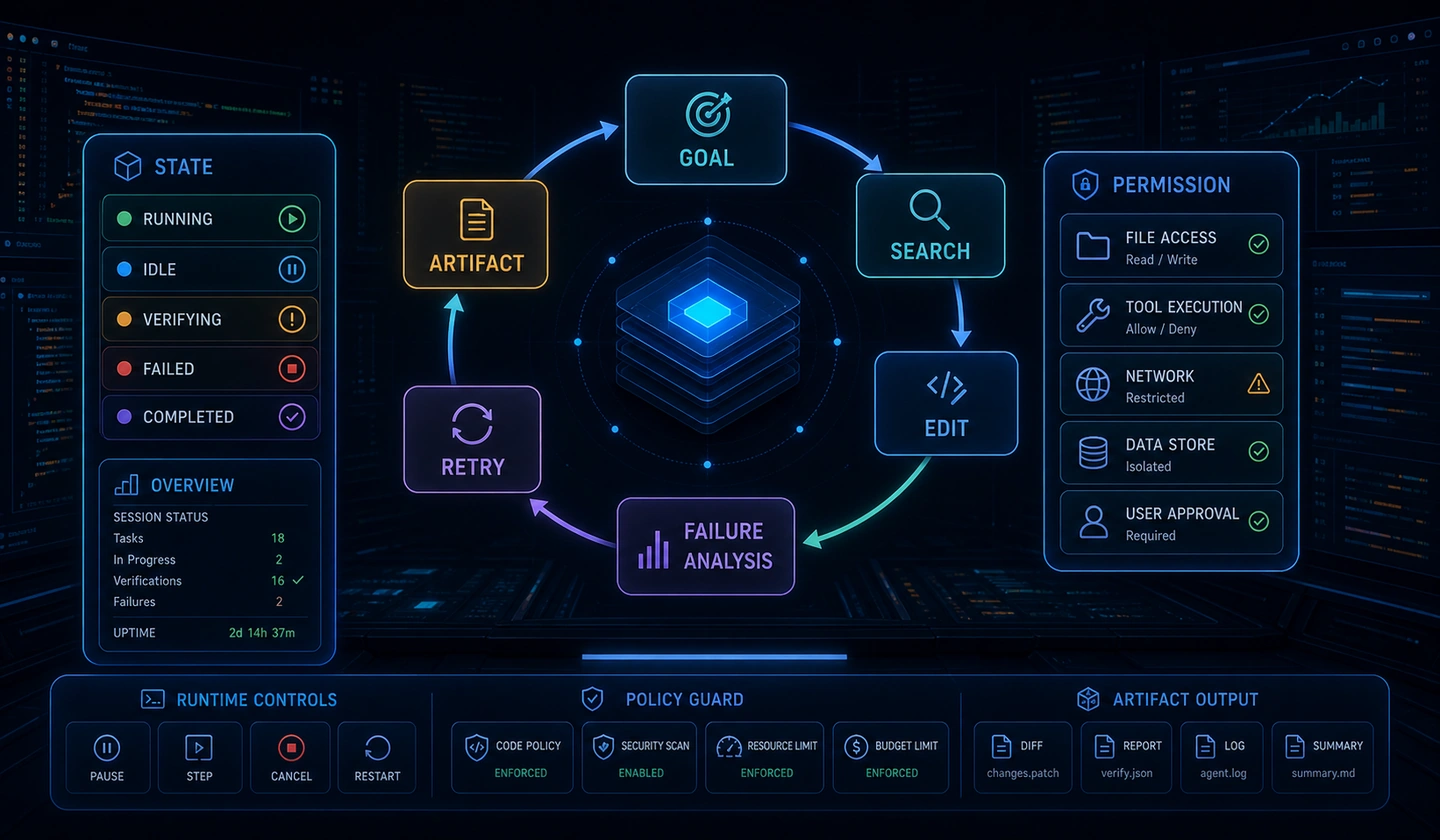
This post is Part 7 of the AI Agent Engineering series. It systematically covers observability, debugging, incident response, governance, and operational pipelines for AI agents executing nondeterministic and complex autonomous loops in production environments.
1. The Observability Paradigm Shift for Production AI Agents
In traditional web applications or single-prompt LLM API calls (Single Prompt Execution), the relationship between input and output is relatively intuitive. When an HTTP request arrives, the backend queries a database or executes static business logic to return a predictable response. Standard Application Performance Monitoring (APM) tools focusing on Latency, Throughput, and Error Rates are sufficient for detecting system anomalies.
However, with the adoption of autonomous AI agents, the observability paradigm has fundamentally shifted.
- subgraph
- User Request
- Static Logic / DB Query
- end
- User Prompt
- LLM Completion Engine
- User Goal
- State Evaluation
- LLM Reasoner
- Tool Execution
- State Update & Memory Store
- Final Goal Completion
- classDef
- class
1.1 Comparison of Observability Characteristics by System Type
| Metric Category | Traditional Web API | Single-turn LLM Call | Autonomous AI Agent |
|---|---|---|---|
| Execution Path | Static & Deterministic | Single I/O (Prompt → Completion) | Nondeterministic Dynamic Loop |
| State Management | DB / Session-based Static State | Stateless | Per-iteration State Delta & Memory Store |
| Core Observability Metrics | Latency, Throughput, HTTP 5xx Rate | Token Count, Time to First Token (TTFT) | Span Hierarchy, Tool Call Accuracy, Step Count |
| Debugging Approach | Stack Trace, APM Log | Input/Output Prompt Pair Log | Checkpoint Replay, Time-travel State Inspection |
| Primary Failure Modes | Null Pointer Exception, DB Timeout | Hallucination, Format Error | Infinite Loop, Cascading Sub-agent Deadlock |
In an agent runtime environment, unique engineering challenges arise:
- Nondeterministic Dynamic Execution Paths: Even when given the exact same goal, generated plans and tool invocation sequences can vary significantly based on environment state, LLM sampling, and external tool responses.
- Multi-turn Loop & State Transition: Rather than finishing in a single call, the agent iterates through $N$ or more turns, continually mutating its internal
State. When a failure occurs, pinpointing "in which turn and tool call state corruption happened" is exceptionally difficult. - Sub-agent Cascading Delegation: An N-tier hierarchical structure emerges where manager agents delegate tasks to worker agents, which in turn call external Model Context Protocol (MCP) servers or API tools.
The Necessity of Agent Observability Operating agents in production requires an engineering framework capable of tracking internal reasoning steps, tool input/output data, state mutation deltas, token costs, and safety guardrail triggers in real time, going far beyond simple log files or HTTP request metrics.
2. OpenTelemetry-Based Distributed Tracing & Hierarchical Span Design
The core pillar of AI agent observability is Distributed Tracing compliant with the OpenTelemetry (OTel) standard. A single full agent execution cycle forms a Root Span, while internal iterations, LLM Reasoner calls, Tool Executions, and Sub-agent calls form Child Spans with explicit Parent-Child relationships.
2.1 Span Hierarchy Tree Architecture
The agent runtime span structure is categorized into 5 primary layers:
- Root Span (
agent.run): Records the user's input goal, Session ID, Agent ID, execution start/end timestamps, and final success status. - Iteration Span (
agent.iteration): Represents the $n$-th iteration of the agent loop, recording agent state deltas before and after entering the turn. - LLM Reasoner Span (
llm.call): Records prompt token count, completion token count, model name used, temperature, stop sequences, and raw thought/tool calls returned by the LLM. - Tool Execution Span (
tool.execute): Records called tool name (tool_name), arguments (tool_args), execution output (tool_output), external API latency, and exception details on failure. - Sub-Agent Delegation Span (
subagent.run): Propagates trace context (traceparent) when delegating to sub-agents, seamlessly linking parent and child agent traces into a unified distributed trace.
<i>(run_id: run_88f1a, agent_id: DataAnalyst)</i>
<i>(iteration: 1, status: OK)</i>
<i>(model: gpt-4o, prompt_tokens: 1240)</i>
<i>(tool: sql_query_runner, latency: 120ms)</i>
<i>(iteration: 2, status: OK)</i>
<i>(model: gpt-4o, prompt_tokens: 2890)</i>
<i>(subagent_id: CodeReviewer, traceparent: header)</i>
2.2 OTel Semantic Conventions for Agent Execution
Defining standard span attributes following OpenTelemetry LLM/GenAI Workgroup specifications and agent engineering standards is crucial.
OpenTelemetry GenAI Semantic Conventions In the LLM and Agent Observability ecosystem, standardizing Span Attribute keys according to the OpenTelemetry GenAI Workgroup semantic conventions ensures full interoperability. This guarantees zero telemetry data loss when transitioning across APM backends or LLM observability platforms such as Datadog, Honeycomb, LangSmith, or Arize Phoenix.
| Attribute Name | Type | Description | Example |
|---|---|---|---|
gen_ai.system | string | LLM provider or runtime name | openai, anthropic, langgraph |
gen_ai.request.model | string | Frontier model name used for request | gpt-4o, claude-3-5-sonnet |
gen_ai.usage.input_tokens | int | Prompt tokens consumed for input | 1420 |
gen_ai.usage.output_tokens | int | Completion tokens consumed for generation | 380 |
agent.run_id | string | Unique identifier for a single agent execution unit | run-9a8f23 |
agent.iteration | int | Current agent execution loop count | 3 |
agent.tool.name | string | Unique name of executed tool | execute_python_code |
agent.tool.status | string | Tool execution result status | success, error, blocked |
agent.circuit_breaker.triggered | bool | Whether safety guardrail tripped the circuit breaker | true, false |
3. Structured Logging and Agent Loop Debugging
While distributed tracing visualizes the temporal and hierarchical flow of overall execution, Structured Logging handles fine-grained state mutation tracking and precision debugging.
3.1 Limitations of Plain Text Logging and Pydantic Event Schemas
Simply logging formatted strings like logger.info(f"Agent state: {state}") makes it difficult for log management platforms (Elasticsearch, Datadog, Loki, etc.) to query nested fields or configure automated alerts. Therefore, all agent events must be encoded and emitted using strict JSON schemas powered by Pydantic v2.
{ "timestamp": "2026-07-27T10:15:30.124Z", "level": "INFO", "event_type": "agent_tool_execution_completed", "trace_id": "4bf92f3577b34da6a3ce929d0e0e4736", "span_id": "00f067aa0ba902b7", "agent_id": "DataAnalystAgent", "run_id": "run-9a8f23", "iteration": 2, "payload": { "tool_name": "query_database", "execution_time_ms": 142.5, "input_params": {"query": "SELECT count(*) FROM users;"}, "output_summary": {"row_count": 1, "status": "ok"}, "state_delta": { "added_keys": ["db_result"], "updated_keys": ["messages"] } }}3.2 Replayability Checkpoints and Deterministic Replay Mode
When errors occur in non-deterministic production agents, the hardest issue to solve is: "The bug cannot be reproduced locally even with the exact same input prompt." To resolve this, the agent runtime must operate a Checkpoint Store that persists three critical elements for each iteration:
- Input Snapshot: Agent
Stateand fullMessage Historyat loop entry. - LLM Response Freeze: Raw text and function call JSON returned by the LLM.
- Tool Execution Result Freeze: Exact values returned by external APIs/tools.
- User
- Engine
- Store
- LLM
- Tool
- Dev
The Value of Deterministic Replayability Production failures caused by agent non-determinism are nearly impossible to reproduce from raw logs alone. By freezing and locking snapshots of State, LLM Completions, and External API Responses for every iteration in a Checkpoint Store (e.g., Redis, PostgreSQL), developers can perform step-by-step offline replay debugging without triggering live external API calls.
3.3 Debugging Approach Comparison
| Debugging Approach | External API Calls | Determinism | Debug Speed & Cost | Ideal Failure Analysis Use Case |
|---|---|---|---|---|
| Plain Text Log Analysis | None (Log query only) | Very Low | Fast / $0 Cost | Simple syntax errors, server crash detection |
| Live Re-run (Re-execution) | Live API re-call | Non-deterministic (Varying results) | Slow / Incurs API cost | Testing non-deterministic prompt improvements |
| Deterministic Checkpoint Replay | None (Mocked replay) | 100% Deterministic | Extremely Fast / $0 Cost | Complex loop state corruption, edge case analysis |
4. Agent Failure Analysis & Real-Time Detection/Mitigation
Building real-time automatic mitigation (Circuit Breakers) for the 4 Major Production Agent Failure Patterns is essential for operating production agents.
4.1 Comparison of 4 Major Production Agent Failure Patterns
| Failure Pattern | Root Cause | System Impact | Mitigation & Circuit Breaker |
|---|---|---|---|
| Infinite Loop / Recursion | Repeatedly calling the same tool with identical arguments / failing to converge | API hanging, resource exhaustion, stuck loops | Duplicate Tool Call Detector (Trips circuit breaker if identical (tool, args) is called 3 consecutive times) |
| Hallucinated Tool Call | Calling undefined tool names / argument type mismatch | Execution runtime exception | Pydantic Guardrail & Retry Prompt (Re-sends argument correction prompt once before fail-safe fallback) |
| Token Storm & Cost Spike | Large tool outputs (500KB JSON) accumulating / prolonged loops | LLM API cost spikes, Context Window overflow | Context Window Pruner & Budget Cap (Enforces cumulative token budget limit & history summarization) |
| Cascading Sub-agent Deadlock | Unhandled worker timeouts, cyclic delegation (Agent A → B → A) | System-wide deadlock (Thread starvation) | Cascading Timeout & Cycle Detector (Delegation depth limiting & timeout propagation) |
4.2 Circuit Breaker State Transition Architecture
Inside the agent runtime loop, Safety Middleware operating independently of LLM decisions is required to forcibly terminate execution or hand over control to Human-in-the-Loop workflows.
Key Guardrail Mechanisms:
- Max Iteration Limit: Enforces maximum loop counts (e.g., immediate abort if exceeding 10 turns).
- Duplicate Tool Call Detector: Aborts loop if identical
(tool_name, tool_args)combinations repeat 3 or more times within recent $N$ iterations. - Context Window Pruner / Token Budget Cap: Blocks execution if cumulative token consumption per run exceeds designated budget (e.g., 100,000 Tokens).
- Schema Validation Guardrail: Validates LLM tool call outputs using Pydantic. On validation failure, re-sends an argument correction prompt once; on second failure, gracefully returns an error.
Preventing API Cost Explosions from Unchecked Loops Infinite loops triggered by repeatedly invoking tools with identical arguments or retrying hallucinated tools can consume millions of tokens and trigger excessive external API queries within minutes. Circuit breakers are not optional features; they are an indispensable safety kill-switch for production runtimes.
5. Versioning, Regression Testing, Deployment & Governance
Agent software is a composite system combining standard application code with System Prompts, Tool Specifications, and LLM Model Versions.
5.1 Agent Specification Versioning Standard
When deploying agents, an explicit Agent Spec Version combining three core components must be maintained:
Agent Spec Version = [Code Release] + [Prompt Revision] + [Tool Specification Hash]Example: v2.4.0-p12.a9b1c3| Component | Identifier Format | Metadata Included | Impact & Action |
|---|---|---|---|
| Code Release | vX.Y.Z (SemVer) | Agent runtime, orchestration engine, circuit breaker code | Full CI/CD test suite execution on Major/Minor updates |
| Prompt Revision | p1, p2, ... | System Instruction, Few-shot Examples, Task Constraints | Must pass Golden Evaluation Suite when prompts change |
| Tool Spec Hash | a9b1c3 (SHA-256) | MCP Server specification, Pydantic Tool Schema, API Endpoints | API compatibility regression testing on Tool Signature change |
If any single element changes, it constitutes a new Agent Spec Version and must undergo Regression Evaluation within the CI/CD pipeline.
5.2 CI/CD Regression Evaluation Flow
To prevent agent degradation when deploying new prompts or tools, automated evaluations against a Golden Dataset are executed.
<i>(10% Traffic Routing)</i>
5.3 Core Agent Evaluation Metrics
| Eval Metric | Target Threshold | Evaluation Method | Description & Validation Content |
|---|---|---|---|
| Task Completion Rate | $\ge 95%$ | Ground Truth Output comparison / LLM-as-a-Judge | Verifies whether agent successfully completes given goal |
| Tool Selection Accuracy | $\ge 98%$ | Exact Schema Matching & Parameter Check | Confirms correct tools are invoked with valid argument formats |
| Step Efficiency | $\le 4.5$ turns | Aggregate iteration count (Avg Iteration Count) | Average iterations spent per goal (detects unnecessary exploration) |
| Token Cost Efficiency | $\le $0.05$/run | OTel Token Span Aggregate | Average dollar cost per execution run |
5.4 Security & Compliance Governance
- Human-in-the-Loop (HITL) Approval System: Destructive actions (DB deletions, payments, external emails, etc.) transition to a
WAITING_FOR_APPROVALpending state requiring admin authorization before execution. - Audit Log Immutability: All observability telemetry and tool execution history are immediately synchronized to an immutable Write-Once-Read-Many (WORM) audit log store.
- PII / Secret Masking: Automatic redaction masking is applied to sensitive data (SSNs, credit cards, API keys) prior to sending OpenTelemetry spans and log events to exporters.
PII Protection and Destructive Action Governance LLM prompts and completions captured in traces and logs frequently contain sensitive customer data (SSNs, API keys, financial records). Passing telemetry through a PII Redaction Engine upstream of OTel Exporters is mandatory. Additionally, destructive tool calls (data deletion, payment execution) must transition into a
WAITING_FOR_APPROVALstate to enforce Human-in-the-Loop approval.
6. Python Implementation: OpenTelemetry Agent Observability Runtime Core
The Python snippet below demonstrates a production-grade runtime combining OpenTelemetry SDK, Pydantic v2, and asyncio to provide hierarchical tracing, infinite loop circuit breakers, and structured logging.
"""AI Agent Observability & Circuit Breaker Runtime Core Module(OpenTelemetry Distributed Tracing + Pydantic v2 + Safety Guardrails)""" import asyncioimport jsonimport loggingimport timefrom typing import Any, Dict, List, Optional, Tuplefrom pydantic import BaseModel, Field # OpenTelemetry Modulesfrom opentelemetry import tracefrom opentelemetry.trace import Status, StatusCode, SpanKindfrom opentelemetry.sdk.trace import TracerProviderfrom opentelemetry.sdk.trace.export import BatchSpanProcessor, ConsoleSpanExporter # OTel Tracer Setupprovider = TracerProvider()processor = BatchSpanProcessor(ConsoleSpanExporter())provider.add_span_processor(processor)trace.set_tracer_provider(provider) tracer = trace.get_tracer("agent.observability.core", "1.0.0")logger = logging.getLogger("AgentLogger")logging.basicConfig(level=logging.INFO, format="%(message)s") # ---------------------------------------------------------------------------# 1. Pydantic Schema Definitions# --------------------------------------------------------------------------- class ToolCallRequest(BaseModel): tool_name: str = Field(description="Name of the tool to invoke") tool_args: Dict[str, Any] = Field(default_factory=dict, description="Tool input parameters") class AgentState(BaseModel): goal: str messages: List[Dict[str, Any]] = Field(default_factory=list) context_data: Dict[str, Any] = Field(default_factory=dict) iteration_count: int = 0 is_completed: bool = False class AgentExecutionConfig(BaseModel): max_iterations: int = 5 max_duplicate_tool_calls: int = 2 max_token_budget: int = 50000 class StructuredLogEvent(BaseModel): """Structured event log schema powered by Pydantic v2""" timestamp: str = Field(default_factory=lambda: time.strftime("%Y-%m-%dT%H:%M:%SZ", time.gmtime())) event_type: str trace_id: Optional[str] = None span_id: Optional[str] = None agent_id: str run_id: str iteration: int payload: Dict[str, Any] = Field(default_factory=dict) # ---------------------------------------------------------------------------# 2. Circuit Breaker & Guardrail Classes# --------------------------------------------------------------------------- class AgentCircuitBreaker: """Guardrail that detects infinite loops and agent failure patterns to abort execution""" def __init__(self, config: AgentExecutionConfig): self.config = config self.tool_call_history: List[str] = [] self.total_tokens_used: int = 0 def check_guardrails(self, state: AgentState, pending_tool: Optional[ToolCallRequest] = None) -> None: # 1. Max iteration limit check (abort if max_iterations exceeded) if state.iteration_count > self.config.max_iterations: raise RuntimeError(f"[CircuitBreaker] Exceeded max iterations ({self.config.max_iterations}). Forcibly terminating execution.") # 2. Token budget check if self.total_tokens_used >= self.config.max_token_budget: raise RuntimeError(f"[CircuitBreaker] Exceeded allocated token budget ({self.config.max_token_budget}).") # 3. Duplicate tool call check (Infinite Loop Detector) if pending_tool: tool_signature = f"{pending_tool.tool_name}:{json.dumps(pending_tool.tool_args, sort_keys=True)}" same_calls = [sig for sig in self.tool_call_history if sig == tool_signature] if len(same_calls) >= self.config.max_duplicate_tool_calls: raise RuntimeError( f"[CircuitBreaker] Repeated tool invocation detected ({pending_tool.tool_name}). Aborting execution." ) self.tool_call_history.append(tool_signature) def record_tokens(self, tokens: int) -> None: self.total_tokens_used += tokens # ---------------------------------------------------------------------------# 3. Observability Agent Runtime Engine# --------------------------------------------------------------------------- class ObservabilityAgentRuntime: def __init__(self, agent_id: str, config: AgentExecutionConfig): self.agent_id = agent_id self.config = config async def execute_run(self, run_id: str, goal: str) -> AgentState: """Generates Root Run Span and executes agent main loop""" state = AgentState(goal=goal) circuit_breaker = AgentCircuitBreaker(self.config) # 1. Create Root Span: agent.run with tracer.start_as_current_span( name="agent.run", kind=SpanKind.SERVER, attributes={ "agent.id": self.agent_id, "agent.run_id": run_id, "agent.goal": goal, } ) as root_span: self._log_structured_event("agent_run_started", run_id, 0, {"goal": goal}) try: while not state.is_completed: state.iteration_count += 1 # 2. Create Child Span: agent.iteration with tracer.start_as_current_span( name=f"agent.iteration_{state.iteration_count}", attributes={"agent.iteration": state.iteration_count} ) as iter_span: # Check guardrail state circuit_breaker.check_guardrails(state) # Execute LLM reasoning step llm_decision, tokens_used = await self._step_llm_reasoner(run_id, state) circuit_breaker.record_tokens(tokens_used) # If tool call requested if llm_decision.get("type") == "tool_call": tool_req = ToolCallRequest(**llm_decision["payload"]) # Re-verify guardrails before tool execution circuit_breaker.check_guardrails(state, pending_tool=tool_req) # Execute tool tool_result = await self._step_execute_tool(run_id, state.iteration_count, tool_req) state.messages.append({"role": "tool", "content": tool_result}) elif llm_decision.get("type") == "finish": state.is_completed = True state.context_data["final_answer"] = llm_decision["payload"]["answer"] iter_span.set_attribute("agent.status", "completed") except Exception as exc: root_span.record_exception(exc) root_span.set_status(Status(StatusCode.ERROR, str(exc))) self._log_structured_event("agent_run_failed", run_id, state.iteration_count, {"error": str(exc)}) raise exc root_span.set_status(Status(StatusCode.OK)) self._log_structured_event("agent_run_completed", run_id, state.iteration_count, { "total_tokens": circuit_breaker.total_tokens_used, "final_answer": state.context_data.get("final_answer") }) return state async def _step_llm_reasoner(self, run_id: str, state: AgentState) -> Tuple[Dict[str, Any], int]: """LLM reasoning span and token usage aggregation""" with tracer.start_as_current_span("llm.call") as span: start_time = time.time() # Simulated LLM processing await asyncio.sleep(0.1) prompt_tokens = 1500 + (state.iteration_count * 200) completion_tokens = 150 total_tokens = prompt_tokens + completion_tokens # Record OTel Attributes span.set_attribute("gen_ai.system", "openai") span.set_attribute("gen_ai.request.model", "gpt-4o") span.set_attribute("gen_ai.usage.input_tokens", prompt_tokens) span.set_attribute("gen_ai.usage.output_tokens", completion_tokens) # Simulated reasoning decision (completes on turn 3 after 2 tool calls) if state.iteration_count < 3: decision = { "type": "tool_call", "payload": { "tool_name": "fetch_user_analytics", "tool_args": {"user_id": "usr_9912", "period": "30d"} } } else: decision = { "type": "finish", "payload": {"answer": "User analytics collection successfully completed."} } latency_ms = (time.time() - start_time) * 1000 self._log_structured_event("llm_call_completed", run_id, state.iteration_count, { "prompt_tokens": prompt_tokens, "completion_tokens": completion_tokens, "latency_ms": latency_ms }) return decision, total_tokens async def _step_execute_tool(self, run_id: str, iteration: int, req: ToolCallRequest) -> str: """Tool execution span recording and async execution""" with tracer.start_as_current_span(f"tool.execute:{req.tool_name}") as span: span.set_attribute("agent.tool.name", req.tool_name) span.set_attribute("agent.tool.args", json.dumps(req.tool_args)) start_time = time.time() try: # Simulated tool execution await asyncio.sleep(0.05) output = f"Result for {req.tool_name} with args {req.tool_args}" span.set_attribute("agent.tool.status", "success") latency_ms = (time.time() - start_time) * 1000 self._log_structured_event("tool_execution_completed", run_id, iteration, { "tool_name": req.tool_name, "latency_ms": latency_ms, "status": "success" }) return output except Exception as e: span.record_exception(e) span.set_status(Status(StatusCode.ERROR, str(e))) raise e def _log_structured_event(self, event_type: str, run_id: str, iteration: int, payload: Dict[str, Any]) -> None: """JSON structured log encoding and emission powered by Pydantic v2""" current_span = trace.get_current_span() ctx = current_span.get_span_context() event = StructuredLogEvent( event_type=event_type, trace_id=format(ctx.trace_id, "032x") if ctx.is_valid else None, span_id=format(ctx.span_id, "016x") if ctx.is_valid else None, agent_id=self.agent_id, run_id=run_id, iteration=iteration, payload=payload ) logger.info(event.model_dump_json()) # ---------------------------------------------------------------------------# 4. Entrypoint Test# --------------------------------------------------------------------------- async def main(): agent_config = AgentExecutionConfig(max_iterations=5, max_duplicate_tool_calls=2) runtime = ObservabilityAgentRuntime(agent_id="AnalyticsAgent_v1", config=agent_config) print("=== [AI Agent Observability Runtime Test] ===") result_state = await runtime.execute_run(run_id="run-test-1002", goal="Analyze recent 30-day data for user usr_9912") print(f"\n[Final Execution Result]: {result_state.context_data.get('final_answer')}") provider.shutdown() if __name__ == "__main__": asyncio.run(main())7. Production Operations Checklist
A comprehensive 4-domain operational checklist that engineering teams must review prior to deploying production agents.
| Domain | Item | Validation Details | Status |
|---|---|---|---|
| Tracing & Telemetry | OpenTelemetry Hierarchical Spans | Are Parent-Child relationships between Root (agent.run), Iteration, LLM, and Tool Spans correctly formed? | [ ] |
| GenAI OTel Attributes | Are standard fields like gen_ai.system, input_tokens, output_tokens, and tool.name captured without omission? | [ ] | |
| Cross-agent Context Propagation | Is context propagated via Traceparent headers during sub-agent delegation to unify traces? | [ ] | |
| Debugging & Replay | Structured JSON Logging | Are JSON event logs containing Trace ID and Span ID transmitted to central log aggregators? | [ ] |
| Checkpoint Store Setup | Are per-iteration input State, LLM completions, and Tool outputs stored to enable offline Replay? | [ ] | |
| Guardrails & Safety | Max Iteration Circuit Breaker | Does the runtime automatically terminate when loop iteration limits are breached? | [ ] |
| Duplicate Tool Detector | Are non-convergent, repeated tool calls with identical arguments detected and halted immediately? | [ ] | |
| Token & Cost Budget Cap | Are infrastructure-level kill-switches triggered when token thresholds per run or account are exceeded? | [ ] | |
| Governance & Deploy | Agent Versioning | Are Code, Prompt Revision, and Tool Spec Hash tracked as a unified specification version? | [ ] |
| Golden Eval Suite | Is automated regression evaluation performed in CI/CD, blocking deployment if benchmark scores fall short? | [ ] | |
| HITL & PII Masking | Are pre-approval mechanisms for risky tools and sensitive data (PII) redaction enabled? | [ ] |
8. Conclusion: Observable Agents Are Trustworthy Agents
Promoting AI agents from simple proof-of-concept (PoC) stages to enterprise production systems ultimately hinges on Observability and Safety Guardrails. Even in nondeterministic LLM-based systems, visualizing every loop and reasoning step via OpenTelemetry distributed tracing, combined with Pydantic-based structured data capture and time-travel replay debugging, empowers engineering teams to rapidly diagnose and control incidents. Build a production-grade, reliable agent runtime by leveraging the hierarchical tracing architecture, failure pattern circuit breakers, governance versioning strategies, and operational checklists detailed in this post.
댓글
GitHub 계정으로 로그인하면 댓글을 남길 수 있습니다. 댓글은 GitHub Discussions를 통해 운영됩니다.