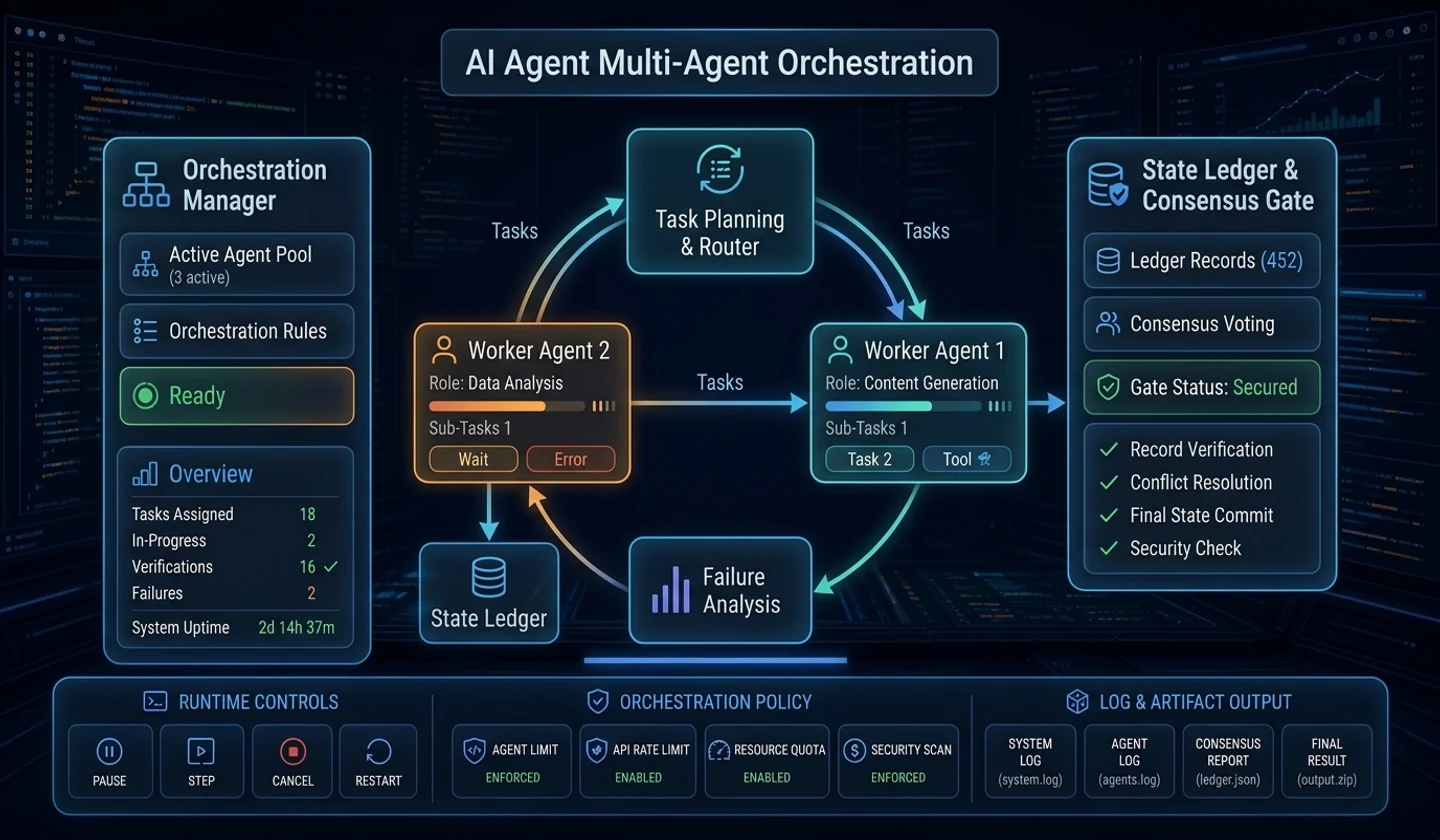
This is Episode 4 of the 'AI Agent Engineering' series. It covers supervisors, sub-agent handoffs, HITL approval gates, and state graphs.
1. Limitations of Single Agents and the Need for Graph Orchestration
A PoC may place every tool and instruction in one agent. As the tool set and task scope grow, context size and tool selection can become harder to manage.
The Single Monolithic Agent path is System instruction bloat across all domains (System Instruction Overhead) → 30+ fragmented tool schemas (Tool Schema Bloat) → Massive monolithic context loop (Context Contamination) → Hallucinations & instruction drift (Instruction Drift & Compounding Errors).
Graph Orchestration separates these connections:
| From | To | Payload or condition |
|---|---|---|
| Supervisor Router: Central State Control Node | Research Agent: Isolated Search Context | State Reduction |
| Research Agent | Supervisor Router | Return Report |
| Supervisor Router | Developer Agent: Code-Dedicated Tool Scope | Pass Scoped Prompt |
| Developer Agent | HITL Gate: Async Interrupt | Request Patch Validation |
| HITL Gate | Deploy Agent: Isolated Execution Environment | Approved |
1.1 Bottlenecks of Single-Agent Architectures
Model capability is only one factor. Mixed context and the number of available tools also affect execution.
| Bottleneck Type | Root Cause | Production Impact | Graph Orchestration Solution |
|---|---|---|---|
| Context Contamination | Indiscriminately accumulated conversation history and large tool payloads | Instruction drift caused by LLM attention dispersion | Dynamic transfer of isolated scoped context per sub-agent and synthetic summary aggregation |
| Tool Schema Overhead | Direct injection of 30+ OpenAPI tool schemas into a single prompt | Token cost explosion and skyrocketing probability of mis-selecting similar tools | Node-specific tool schema isolation (allocating max 3–5 tools per node) |
| Error Compounding | Initial reasoning errors remain in the loop context and are continually re-cited | Trapped in compounding errors that repeatedly hallucinate based on flawed premises | Checkpoint rollback and conditional edge-based fallbacks |
When a single faulty tool input or parsing error occurs in a single-agent loop and propagates into the full context history, all subsequent reasoning steps become corrupted—leading to severe compounding errors.
1.2 Procedural Workflows vs. Graph-Based State Machines
To overcome these limitations, agent architectures are evolving from simple linear workflows (DAGs) into dynamic state graphs.
| Category | Deterministic Workflow | Dynamic State Graph |
|---|---|---|
| Control Flow | Hardcoded Python sequential execution (A -> B -> C) | Autonomous routing based on conditional edges |
| Cycling & Recovery | Complex to implement loops and dynamic retries/fallbacks | Autonomous re-entry via cyclic graphs |
| State Immutability | Simple variable passing between function parameters | Global state storage and snapshot management based on Pydantic schemas |
| Interrupt Support | Server thread blocking due to synchronous waiting | Async interrupts (Pause) and checkpoint restoration (Resume) |
| Error Resilience | Forceful termination of entire process upon exception | Node-level isolation and rollback snapshot recovery support |
In agentic applications, looping to revert to a previous state upon failure and interrupts to await external approval occur frequently alongside simple branching. Therefore, a cyclic state graph—rather than a directed acyclic graph (DAG)—must be chosen as the core architecture.
2. Supervisor Pattern and Dynamic Handoff
A supervisor delegates tasks according to the overall goal, collects sub-agent results, and decides what to do next.
| Step | From → To | Payload or operation |
|---|---|---|
| 1 | User → Supervisor | Task Request: “Refactor & Deploy Payment API” |
| 2 | Supervisor → Research Agent | Handoff: Dependency Search Scope |
| 3 | Research Agent → Supervisor | Code Analysis Report: State Reduction |
| 4 | Supervisor → Developer Agent | Handoff: Report + Dev Tools Only |
| 5 | Developer Agent → Supervisor | Patch File Generated |
| 6 | Supervisor → HITL Gate | Issue Deploy Approval Interrupt: State Checkpointed |
2.1 Centralized Supervisor vs. P2P Swarm Network Pattern
Patterns for passing control among sub-agents are broadly divided into centralized router approaches and autonomous handoff approaches.
| Architecture Pattern | Control Flow Structure | Key Advantages | Risk Factors & Disadvantages | Recommended Domain |
|---|---|---|---|---|
| Centralized Router | Central router node inspects state and branches to sub-agents | • Clear visibility and traceability • Centralized security and permission control | • Supervisor prompt performance bottleneck • Increased hops due to routing overhead | Enterprise workflow automation, systems requiring mandatory HITL approval |
| P2P Swarm (Dynamic Handoff) | Sub-agents directly invoke handoff_to_agent() tools | • Fast execution speed (reduced router hops) • Flexible dynamic autonomous collaboration | • Risk of infinite handoff loops • Difficulty in tracking overall state flow | Exploratory research, data analysis, creative tasks needing autonomous ping-pong |
While P2P Swarm architectures offer freedom in delegating control, sub-agents can easily fall into infinite handoff loops by repeatedly calling each other. A global counter or loop breaker must be incorporated.
2.2 State Transfer Strategy: Full Transcript vs. State Reduction
When transferring control to a sub-agent, passing the full conversation history reintroduces the single-agent context contamination problem. Production agent engines adopt state reduction techniques.
| Transfer Strategy | Transferred Data Scope | Token Efficiency | Model Attention | Contamination Prevention |
|---|---|---|---|---|
| Full Transcript | Full conversation history and all prior tool execution results | Token consumption maximized (cost explosion) | Attention dispersed across irrelevant patches | Initial errors continually propagate |
| State Reduction | Refined Pydantic State (essential goals + summarized results only) | Maximum token savings | 100% focused on essential task context | Complete isolation between sub-agents |
# Example of State Reduction Mechanismclass GlobalState(BaseModel): task_id: str original_goal: str plan_steps: list[str] research_summary: Optional[str] = None generated_code: Optional[str] = None approval_status: str = "PENDING" messages: list[BaseMessage] # Global message listWhen the supervisor invokes DeveloperAgent, instead of supplying the entire GlobalState.messages, it extracts and injects only original_goal and research_summary into the prompt, maximizing the sub-agent's focus.
Passing a scoped context to a sub-agent and receiving task results back as structured state mutations to merge into global state is key to reducing token costs and boosting precision.
3. Human-in-the-Loop (HITL) Interrupts and Approval Gates
When an agent performs irreversible high-risk actions—such as calling external APIs, deleting DB records, executing financial transactions, or deploying to production servers—a Human-in-the-Loop (HITL) approval gate must intervene.
3.1 HITL Approval Gate State Transition Diagram
| Scope | From → To | Condition or operation |
|---|---|---|
| Whole model | Entry → Idle | Create Graph Session |
| Inside SupervisorRouting | Idle → Analyzing | Task Decomposition & Routing |
| Inside SupervisorRouting | Analyzing → SubAgentExecution | Delegate Control to Sub-agent |
| Inside SupervisorRouting | SubAgentExecution → EvaluatingRisk | Collect Results & Assess Risk |
| Outer connection | EvaluatingRisk → ExecutingAction | Low-Risk Action (Safe Action) |
| Outer connection | EvaluatingRisk → InterruptedPending | High-Risk Action Detected |
| Inside InterruptedPending | Entry → CheckpointSaved | Persist State Snapshot to DB |
| Inside InterruptedPending | CheckpointSaved → WaitingHumanInput | Non-blocking Async Server Thread (Pause) |
| Inside HumanDecision | WaitingHumanInput → Approved | Human Admin Approved |
| Inside HumanDecision | WaitingHumanInput → Rejected | Human Admin Rejected w/ Feedback |
| Inside HumanDecision | WaitingHumanInput → TimedOut | Timeout / Session Cancelled |
| Outer connection | Approved → ExecutingAction | Restore Checkpoint & Run Node |
| Outer connection | Rejected → RePlanning | Inject Feedback & Re-work in Developer |
| Outer connection | RePlanning → Analyzing | Supervisor Re-routing |
| Outer connection | TimedOut → RollbackState | Rollback to Prior Safe Snapshot |
| Outer connection | RollbackState → End | Safe Session Termination |
| Outer connection | ExecutingAction → Completed | Task Finalized |
| Outer connection | Completed → End | Completion exit |
The original places WaitingHumanInput in both InterruptedPending and HumanDecision. The table preserves that overlapping notation.
3.2 Async Interrupt and 4-Phase Execution Lifecycle
To successfully implement HITL, the graph execution engine must support an asynchronous pause and resume lifecycle rather than synchronous blocking wait.
| Execution Phase | State Transition | Checkpoint Saved Content | System Thread Behavior |
|---|---|---|---|
| 1. Risk Detection | NONE -> PENDING | Saves current AgentState snapshot to DB | Async pause right before executing high-risk node |
| 2. Async Waiting | Maintains PENDING | Retains DB snapshot state (is_interrupted=True) | Releases thread after returning HTTP response |
| 3. Human Decision Injection | PENDING -> APPROVED / REJECTED | Updates approval status and feedback attributes | Triggered upon receiving Webhook / API request |
| 4. Graph Resume | APPROVED -> NONE | Executes next node based on restored snapshot | Reconnects async stream and completes execution |
The core of HITL interrupt implementation is that web server threads must operate asynchronously without blocking resources, and even during indefinite waiting periods, the state must be safely recoverable from DB checkpoints after server restarts.
The HITL Resume endpoint can become a target for state tampering attacks by malicious users. Mandatory RBAC (Role-Based Access Control) authorization checks and immutable audit logging must be enforced.
4. Python Transactional State Management and Real-Time Streaming Interface
Because a multi-agent state machine is an environment where multiple asynchronous nodes concurrently read and write state, transactional isolation and real-time streaming architectures are essential.
4.1 Async Checkpoint State Persistence Sequence
The checkpointer persists state immediately before and after each node execution, guaranteeing recovery during async pauses or system failures.
| Step | From → To | Message or operation |
|---|---|---|
| 1 | Engine → Checkpointer | save(AgentState) call |
| 2 | Checkpointer → DB | HSET thread_id:tx_9901 state_json |
| 3 | DB → Checkpointer | OK (Save Confirmed) |
| 4 | Engine → Client | Stream Event [INTERRUPT]: Thread Async Exit |
| 5 | Admin → Client | Click “Approve & Deploy”: Feedback attached |
| 6 | Client → Engine | POST /api/v1/resume (thread_id='tx_9901', approved=True) |
| 7 | Engine → Checkpointer | load('tx_9901') |
| 8 | Checkpointer → DB | HGET thread_id:tx_9901 |
| 9 | DB → Checkpointer | Raw AgentState JSON Data |
| 10 | Checkpointer → Engine | Deserialize AgentState Object |
| 11 | Engine → Engine | Mutate State: approval_status=APPROVED |
| 12 | Engine → Node | Run Deployer Node: Resume Execution |
| 13 | Node → Engine | Execution Success |
| 14 | Engine → Checkpointer | save(FinalState) |
| 15 | Engine → Client | Stream Event [NODE_END]: Task Completed |
4.2 Event-Driven Streaming
To provide transparency into the multi-agent execution process from a UX perspective, four levels of streaming events should be provided.
| Stream Event Type | Trigger Timing | Key Payload Composition | Front-end UX Usage |
|---|---|---|---|
NODE_START | Entering a new state node | node_name, history_len, timestamp | Progress bar update and agent change notification |
NODE_END | Completing node execution | node_name, next_node, state_diff | Step completion checkmark and next step indicator |
INTERRUPT | HITL Gate detection | patch_to_review, approval_status | User approval modal popup and feedback input form |
STREAM_CHUNK | LLM token generation | delta_text, agent_id | Real-time typing text rendering in Monaco editor |
To guarantee state immutability, transitions between nodes should create and modify a copy of state (State Mutation) before saving, adhering to a transactional state pattern.
5. Production-Level Python Implementation: Supervisor Graph & HITL Approval Engine
The Python asyncio example uses Pydantic v2 to connect a state graph, supervisor routing, an HITL gate, memory checkpoints, and event streaming.
Written in pure Python without third-party frameworks, this code is designed to provide an intuitive understanding of the underlying interrupt and snapshot restoration mechanics found in engines like LangGraph, AutoGen, and CrewAI.
"""Production-grade Multi-Agent State Graph Orchestrator with HITL GateFilename: agent_orchestrator.py""" import asynciofrom enum import Enumfrom typing import Any, AsyncGenerator, Awaitable, Callable, Dict, List, Optionalfrom pydantic import BaseModel, Field # --------------------------------------------------# 1. State Models & Types# -------------------------------------------------- class ApprovalStatus(str, Enum): NONE = "NONE" PENDING = "PENDING" APPROVED = "APPROVED" REJECTED = "REJECTED" class AgentState(BaseModel): thread_id: str user_query: str current_node: str = "supervisor" next_node: Optional[str] = None # Domain specific data research_notes: List[str] = Field(default_factory=list) generated_patch: Optional[str] = None # Control & HITL Flags is_interrupted: bool = False approval_status: ApprovalStatus = ApprovalStatus.NONE hitl_feedback: Optional[str] = None execution_history: List[str] = Field(default_factory=list) def log(self, step: str) -> None: self.execution_history.append(step) class StreamEvent(BaseModel): event_type: str # "NODE_START", "NODE_END", "INTERRUPT", "STREAM_CHUNK" node_name: str payload: Dict[str, Any] # --------------------------------------------------# 2. State Checkpointer & Persistence Store# -------------------------------------------------- class AsyncCheckpointer: def __init__(self) -> None: self._store: Dict[str, AgentState] = {} async def save(self, state: AgentState) -> None: # Deep copy simulated via model_copy self._store[state.thread_id] = state.model_copy(deep=True) async def load(self, thread_id: str) -> Optional[AgentState]: state = self._store.get(thread_id) if state: return state.model_copy(deep=True) return None # --------------------------------------------------# 3. Subagent Nodes & Logic# -------------------------------------------------- async def supervisor_node(state: AgentState) -> AgentState: state.log("Supervisor: Assessing task status...") if not state.research_notes: state.next_node = "researcher" elif state.generated_patch is None: state.next_node = "developer" elif state.approval_status == ApprovalStatus.NONE: state.next_node = "hitl_gate" elif state.approval_status == ApprovalStatus.APPROVED: state.next_node = "deployer" elif state.approval_status == ApprovalStatus.REJECTED: state.next_node = "developer" # Re-plan/Re-code on rejection else: state.next_node = "end" return state async def researcher_node(state: AgentState) -> AgentState: state.log("Researcher: Gathering system requirements and codebase context...") await asyncio.sleep(0.3) # Async API work simulation state.research_notes.append("Found legacy payment gateway route requiring OAuth2 update.") state.research_notes.append("Dependency check: Auth SDK v2.4 compatibility confirmed.") state.next_node = "supervisor" return state async def developer_node(state: AgentState) -> AgentState: state.log("Developer: Drafting code patch...") await asyncio.sleep(0.4) if state.approval_status == ApprovalStatus.REJECTED: # Refine code based on HITL feedback state.generated_patch = f"PATCH v2 (Refactored based on feedback: {state.hitl_feedback})" state.approval_status = ApprovalStatus.NONE # Reset for re-approval else: state.generated_patch = "PATCH v1: Fix OAuth2 Authorization Header formatting in payment_client.py" state.next_node = "supervisor" return state async def hitl_approval_gate_node(state: AgentState) -> AgentState: state.log("HITL Gate: Checking safety boundary for code deployment...") if state.approval_status == ApprovalStatus.NONE: state.log("HITL Gate: High-risk action detected (Deploy)! Interrupting graph execution.") state.is_interrupted = True state.approval_status = ApprovalStatus.PENDING state.next_node = "supervisor" elif state.approval_status in (ApprovalStatus.APPROVED, ApprovalStatus.REJECTED): state.is_interrupted = False state.next_node = "supervisor" return state async def deployer_node(state: AgentState) -> AgentState: state.log("Deployer: Applying patch to production environment...") await asyncio.sleep(0.5) state.log(f"Deployer: Successfully deployed -> {state.generated_patch}") state.next_node = "end" return state # --------------------------------------------------# 4. State Graph Orchestrator Engine# -------------------------------------------------- class StateGraphEngine: def __init__(self, checkpointer: AsyncCheckpointer) -> None: self.nodes: Dict[str, Callable[[AgentState], Awaitable[AgentState]]] = {} self.checkpointer = checkpointer def add_node(self, name: str, func: Callable[[AgentState], Awaitable[AgentState]]) -> None: self.nodes[name] = func async def run_stream(self, thread_id: str, initial_query: Optional[str] = None) -> AsyncGenerator[StreamEvent, None]: # Load or initialize state state = await self.checkpointer.load(thread_id) if state is None: if not initial_query: raise ValueError("Initial query required for new thread.") state = AgentState(thread_id=thread_id, user_query=initial_query) while state.current_node != "end": current_name = state.current_node node_func = self.nodes.get(current_name) if not node_func: raise KeyError(f"Node '{current_name}' is not registered in state graph.") yield StreamEvent( event_type="NODE_START", node_name=current_name, payload={"history_len": len(state.execution_history)} ) # Execute Node state = await node_func(state) # Check for HITL Interrupt if state.is_interrupted: await self.checkpointer.save(state) yield StreamEvent( event_type="INTERRUPT", node_name=current_name, payload={ "message": "Graph paused for human approval.", "patch_to_review": state.generated_patch, "approval_status": state.approval_status.value } ) return # Exit stream, waiting for external resume trigger yield StreamEvent( event_type="NODE_END", node_name=current_name, payload={"next_node": state.next_node} ) state.current_node = state.next_node await self.checkpointer.save(state) async def resume_with_approval(self, thread_id: str, approved: bool, feedback: Optional[str] = None) -> AsyncGenerator[StreamEvent, None]: state = await self.checkpointer.load(thread_id) if not state or not state.is_interrupted: raise RuntimeError(f"Thread '{thread_id}' is not in an interrupted state.") # Inject Human Decision state.approval_status = ApprovalStatus.APPROVED if approved else ApprovalStatus.REJECTED state.hitl_feedback = feedback state.is_interrupted = False state.log(f"Human Decision Injected: Approved={approved}, Feedback={feedback}") await self.checkpointer.save(state) # Resume execution stream async for event in self.run_stream(thread_id): yield event # --------------------------------------------------# 5. Verification & Execution Walkthrough# -------------------------------------------------- async def main() -> None: checkpointer = AsyncCheckpointer() engine = StateGraphEngine(checkpointer) # Register Graph Nodes engine.add_node("supervisor", supervisor_node) engine.add_node("researcher", researcher_node) engine.add_node("developer", developer_node) engine.add_node("hitl_gate", hitl_approval_gate_node) engine.add_node("deployer", deployer_node) thread_id = "tx_session_9901" print("=== [Phase 1: Execution until HITL Interrupt] ===") async for event in engine.run_stream(thread_id, initial_query="Update payment API route"): print(f"[{event.event_type}] Node: {event.node_name} -> {event.payload}") # Inspect state at interrupt point paused_state = await checkpointer.load(thread_id) print(f"\n[System Status] Graph Interrupted? {paused_state.is_interrupted}") print(f"[Review Target] Proposed Code: {paused_state.generated_patch}") print("\n=== [Phase 2: Simulated Human Rejection & Feedback Loop] ===") async for event in engine.resume_with_approval(thread_id, approved=False, feedback="Use Bearer prefix for Auth header"): print(f"[{event.event_type}] Node: {event.node_name} -> {event.payload}") print("\n=== [Phase 3: Final Human Approval & Deployment] ===") async for event in engine.resume_with_approval(thread_id, approved=True): print(f"[{event.event_type}] Node: {event.node_name} -> {event.payload}") final_state = await checkpointer.load(thread_id) print("\n=== [Final Execution Log] ===") for idx, log_entry in enumerate(final_state.execution_history, 1): print(f"{idx}. {log_entry}") if __name__ == "__main__": asyncio.run(main())6. Mermaid Architecture & Sequence Diagrams
6.1 Supervisor & Sub-agent Graph Orchestration
State graph diagram visualizing the state node transitions and supervisor control structure across the entire system.
Begin at Start Task → Node: Supervisor Router.
| From node | Condition or payload | To node |
|---|---|---|
| Supervisor Router | Research Needed | Researcher Sub-agent |
| Researcher Sub-agent | Return Notes | Supervisor Router |
| Supervisor Router | Code Needed | Developer Sub-agent |
| Developer Sub-agent | Return Patch | Supervisor Router |
| Supervisor Router | Approval Required | HITL Approval Gate |
| HITL Approval Gate | Pending / Interrupt | Checkpointer Store |
| HITL Approval Gate | Approved | Deployer Sub-agent |
| HITL Approval Gate | Rejected w/ Feedback | Developer Sub-agent |
| Deployer Sub-agent | End task | Task Finished |
The original has no outgoing connection from Checkpointer Store to execution. Read the separate resume sequence below for that process.
6.2 HITL Interrupt & Async Resume Sequence
Sequence diagram demonstrating the async interrupt and state restoration (Resume) process between external web/application interfaces and the agent graph engine.
| Step | From → To | Message or operation |
|---|---|---|
| 1 | Engine → Engine | Enter HITL Gate Node: High-Risk Action Detected |
| 2 | Engine → DB | Save AgentState: is_interrupted=True, thread_id='tx_123' |
| 3 | Engine → API | Stream Event: INTERRUPT, End Response & Disconnect |
| 4 | API → Inspector | UI Notification: “Deployment Approval Pending (Patch v1)” |
| 5 | Inspector → API | POST /api/v1/agent/resume (Approved=True) |
| 6 | API → Engine | engine.resume_with_approval('tx_123', approved=True) |
| 7 | Engine → DB | Load AgentState('tx_123') |
| 8 | DB → Engine | State Restoration Complete |
| 9 | Engine → Engine | Update approval_status = APPROVED |
| 10 | Engine → Node | Execute Deployer Node |
| 11 | Node → Engine | Deployment Successfully Completed |
| 12 | Engine → API | Stream Event: NODE_END, Final Completion |
7. Multi-Agent Orchestration Operational Checklist
Checklist to validate before deploying supervisor and multi-agent orchestration into production environments.
| Domain | Item | Verification Point | Severity |
|---|---|---|---|
| Architecture | Sub-agent Single Responsibility | Are the roles and available tools of each sub-agent clearly isolated? (Recommended: 10 tools or fewer) | High |
| State Management | State Reduction | Is unnecessary conversation history summarized/trimmed when transitioning between supervisor and sub-agents? | Critical |
| State Management | Checkpoint Persistence | Can pending interrupt states be safely restored from the DB upon process restart? | Critical |
| HITL Security | Interrupt Rollback Guarantee | Is there a workflow to revert to a previous safe node and perform re-planning upon approval rejection? | Critical |
| HITL Security | Authorization Gate | Is the identity triggering the resume signal verified via integration with an RBAC system? | Critical |
| Ops / Observability | Infinite Loop Detection (Loop Breaker) | Is execution forcibly terminated if handoff count between sub-agents exceeds max iterations (e.g., Max 15 steps)? | High |
| Ops / Observability | Event Streaming Tracing | Are Node Transitions, Tool Calls, and LLM Streaming synchronized with OpenTelemetry/LangSmith traces? | Medium |
Deploying multi-agent orchestration to production servers without checkpoint persistence and infinite loop prevention (Loop Breaker) risks incurring excessive LLM API costs and facing out-of-control system execution.
Conclusion
Before splitting work among agents, define the shared state, routing rules, and context passed to each agent. Approval waits also need a stored state and a resume path.
Episode 5 covers reliability and security in agent execution.
댓글
GitHub 계정으로 로그인하면 댓글을 남길 수 있습니다. 댓글은 GitHub Discussions를 통해 운영됩니다.