Key Takeaways
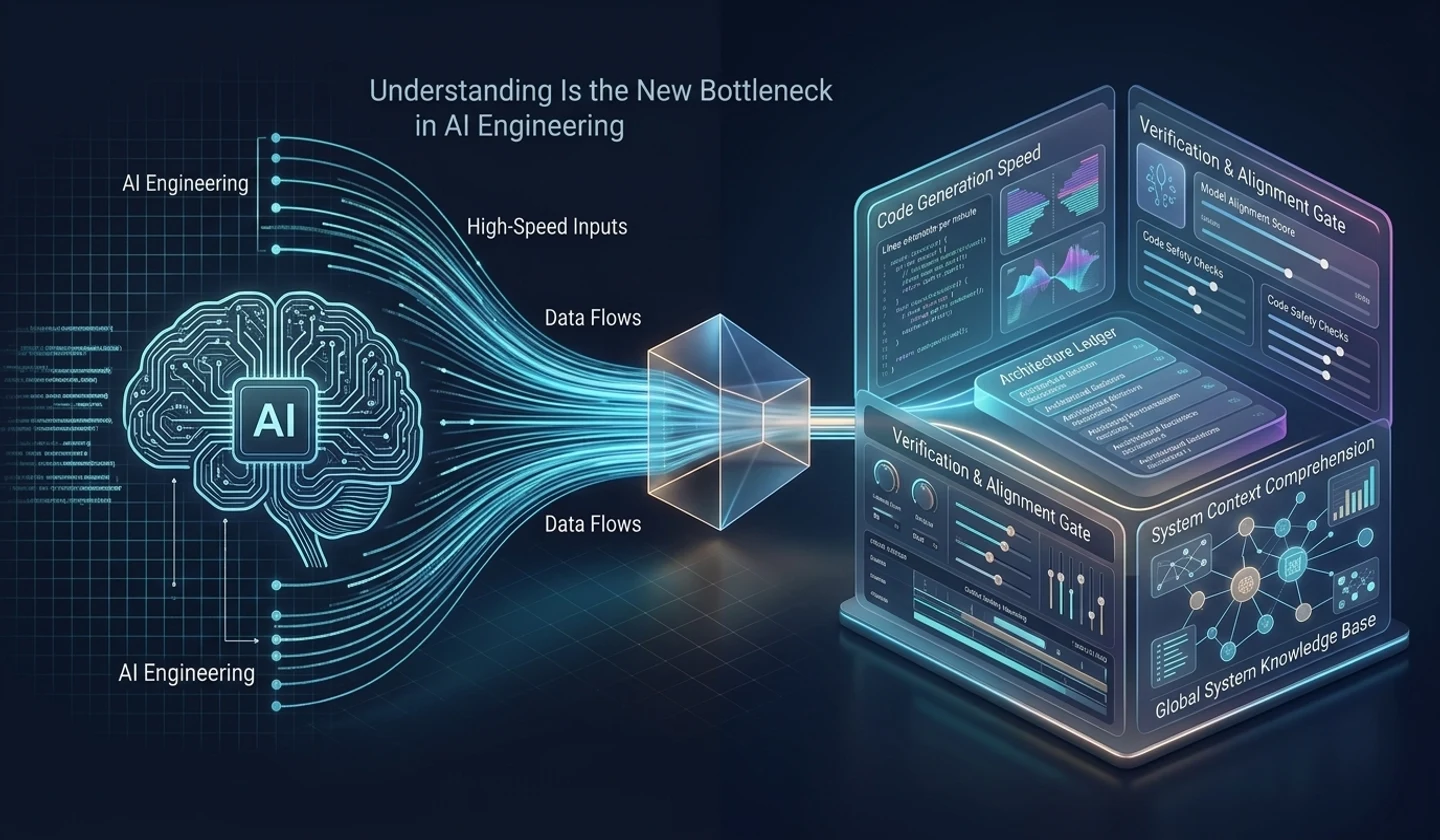
- As AI coding agents accelerate code generation, the primary bottleneck in software engineering is shifting from creation speed to human understanding speed.
- Accepting AI-generated code without a solid mental model accumulates cognitive debt and intent debt, ultimately breaking long-term maintainability.
- Architectural solutions include literate diffs (Logical walkthroughs with embedded quizzes), ephemeral UIs (real-time interactive micro-worlds to scrub and observe states), and Model Context Protocol (MCP) shared spaces.
- Successful organizations prioritize deterministic systems first, use LLMs solely as explanation layers, and strategically insert friction at critical cognitive boundaries.
Introduction: Automated Generation and the Rise of Understanding as a Constraint
We live in an era where AI coding agents can generate tens of thousands of lines of pull requests (PRs) or perform massive library migrations in just a few minutes. As the speed of physical code creation grows exponentially, development teams face an unexpected paradox: the speed at which humans can comprehend and verify code is lagging far behind the speed of code production.
At the 2026 AI Engineer World's Fair, design engineer Geoffrey Litt declared, "Understanding is the new bottleneck." The fundamental constraint determining the overall velocity of a project is no longer machine typing throughput, but the cognitive limits and understanding speed of the human engineer.
As agents develop the capability to write their own test suites and verify their own executions, simple one-dimensional verification ("does it compile?") is becoming a low-value activity. Software development is not a collection of one-off scripts, but the continuous expansion and evolution of a mental model. According to the "Understand to participate" framework advocated by Litt and open-source developer Simon Willison, unless developers fully internalize the system's state and design principles, they cannot direct the system's trajectory, design creative architectures, or steer the ship.
Theoretical Background: The Triple Debt Model and the Ironies of Automation
Merging code generated by machines without reading it might yield a brief burst of velocity, but it builds up invisible liabilities. In academic and professional circles, this is analyzed beyond traditional Technical Debt through two concepts: cognitive debt and intent debt.
The Triple Debt Model
1. Technical Debt
- Location: Inside Source Code
- Definition & Cause: Code smells, poor modularity, and structural shortcuts that make the codebase rigid.
- AI Era Impact: Relatively easy to mitigate as AI agents can quickly refactor or migrate code repeatedly.
2. Cognitive Debt
- Location: Human Brain (Mental Model)
- Definition & Cause: The erosion of the shared team understanding of system interactions, even while the code runs correctly. In 1985, Peter Naur noted in "Programming as Theory Building" that source code is merely a trace of the mental system in the programmer's mind. Indeed, a 2025 randomized controlled trial by METR showed that while experienced developers expected AI tools to boost their velocity by 24%, they actually suffered a 19% slowdown in mature repositories due to the effort required to parse hidden context and resolve cognitive debt.
- AI Era Impact: Manifests as silent comprehension loss. It becomes unclear where new requirements should be implemented, turning the system into a giant black box.
3. Intent Debt
- Location: Documentation & Context
- Definition & Cause: The loss of the design rationale, constraints, and business goals behind specific architectural decisions.
- AI Era Impact: Leads to agent hallucinations and circular code generation as the agent's reference knowledge base disappears.
This dynamic matches Lisanne Bainbridge's classic study, the "Ironies of Automation." When human operators are relegated to passive monitors of automated systems, they lose cognitive fluency and find themselves unable to intervene effectively when the automation fails. Engineering leaders must look beyond the immediate green test suite and ask: "Can we safely modify this codebase twelve months from now?"
Solution I: Literate Diffs and Automated Explanation Packets
To manage cognitive load, developers should avoid reading raw, alphabetical diffs. Instead, we should integrate literate diffs into the development workflow—utilizing tools like explain-diff to translate raw code changes into high-level logical narratives.
Four Principles of Literate Diff Design
An effective explanation packet is not a simple summary. It must structure the narrative to respect human cognitive limits:
- Establish Background Context: Before showing modified code, explain the surrounding architecture. Separate broad background context from the immediate change boundaries to ease the reader into the system's mental model.
- Build Intuition First: Describe the essence of the change in plain English before presenting code snippets. For instance, explain an isometric camera change as "a 2D rendering trick to simulate 3D space" rather than starting with matrix transformations. Use toy data inputs/outputs or diagrams to establish intuition.
- Provide a Logical Walkthrough: Sequence the code changes by execution flow or logical dependency rather than alphabetical order. Show only the critical code snippets and explain why those specific lines were selected.
- Embed Speed-Regulating Quizzes: Append a 5-question multiple-choice quiz testing the core logic of the change. This quiz acts as a speed regulator, preventing developers from clicking "Approve" without actually processing the changes, aligning the human understanding cycle with the machine's speed.
Implementing the explain-diff Pipeline
In a production environment, this explanation packet should generate automatically during the pull request lifecycle.
A clean pattern—demonstrated by developer Ankitg12's render.py architecture—splits content spec generation from HTML/Notion rendering. Rather than prompting the LLM to output verbose HTML boilerplates, the LLM is restricted to outputting a clean JSON spec containing titles, markdown paragraphs, and quiz questions. The python script then reads this JSON and builds a self-contained, offline-compatible HTML file or updates a Notion page.
This can be integrated into GitHub Actions using modern TypeScript-based AI frameworks like Mastra. Mastra provides built-in RAG capabilities and OpenTelemetry tracing, enabling the action to fetch relevant code repository context, build highly specific diff narratives, and publish them directly to the PR description.
Solution II: Ephemeral UI and Micro-worlds for Physical Intuition
While reading is helpful, the deepest system understanding comes from active play. Instead of reading thousands of lines of text, developers should interact with micro-worlds built by AI agents, where they can adjust parameters and observe state changes in real time.
The Ephemeral UI Paradigm
Traditionally, building visual debugging dashboards required significant frontend engineering resources, resulting in "dashboard rot" when requirements changed. Today, LLM code generation makes it practical to spin up ephemeral UIs—visual control panels created for a single debugging session and discarded immediately after use.
During a codebase migration, Litt directed Claude to build an ephemeral "command center" game UI to monitor the migration script in real time. In another instance, to debug a Prolog interpreter, the developer and agent built an interactive visual debugger to scrub through call stacks and variable bindings.
By visualising the machine's execution paths, developers gain immediate physical intuition for the system without having to write the tracing code themselves. This micro-world approach is also proving vital in infrastructure engineering, where visualizing microbursts at sub-second intervals is crucial for diagnosing root causes.
Next-Gen Protocols for Agent-to-User Interaction
Dynamically rendering these ephemeral UIs requires standard protocols to link back-end agents with front-end rendering engines. Three main standards are emerging:
1. A2UI (Agent to UI)
- Lead & Purpose: Google / Safe, declarative UI rendering
- Key Architecture: Instead of sending executable scripts (which pose security risks), the agent sends a JSON intent spec. The frontend maps this intent to pre-approved native components (maps, charts, data tables).
- Use Cases: Safely embedding static UI components (like map widgets or data tables) within chat streams.
2. AG-UI (Agent-User Interaction)
- Lead & Purpose: CopilotKit Team / Real-time event streaming and state synchronization
- Key Architecture: Streams 16 standard events over Server-Sent Events (SSE) and WebSockets. Syncs state deltas between backend agent frameworks (like LangGraph or CrewAI) and frontend components in real time.
- Use Cases: Long-running job visualization, and interactive UIs for requesting human approval (Human-in-the-loop) before executing destructive actions.
3. Promptions
- Lead & Purpose: Microsoft Research / Dynamic prompt middleware
- Key Architecture: Analyzes initial user inputs and dynamically generates temporary UI elements (sliders, toggles) to fine-tune model parameters, bypassing the limitations of text-only prompt adjustments.
- Use Cases: Interactive filtering of data analysis, adjusting generation tone and format, and setting difficulty levels for educational tutors based on context.
The AG-UI protocol is especially powerful for human-in-the-loop workflows. As an agent refactors code, AG-UI streams the agent's thinking steps and tool execution states to the browser. Before executing destructive operations (like database migrations), the agent pauses and requests authorization. The developer can simulate the changes in the micro-world before granting approval, dramatically reducing cognitive friction.
Solution III: MCP and Shared Spaces for Collective Alignment
Private direct messages between a developer and an agent in a local editor benefit only the individual, leaving the rest of the team in the dark. We need to pull agent communications into the team's shared workspace—creating shared spaces for collaborative alignment.
Anthropic's Model Context Protocol (MCP) provides the open architectural backbone for these collaborative spaces. Connecting coding agents to Notion via Notion MCP allows the agent to read product requirement documents (PRD) and architecture decision records (ADR) in real time.
More importantly, the agent's outputs are written back to this shared space. When drafting a database schema, the agent writes the proposal directly to a shared Notion page instead of outputting it to a local terminal. The team can review the schema, leave inline feedback, and watch the agent update the draft in real time. This cooperative loop makes the agent's reasoning transparent and aligns the team's mental model.
To connect internal platforms (like custom JIRA instances or private telemetry databases) to the shared workspace, developers can write a custom MCP server using Anthropic's FastMCP Python framework in a few hours.
Organizational Physics and Architectural Principles
Embedding these patterns into production requires updates to both the software development lifecycle (SDLC) and team behaviors.
1. Deterministic First, AI Second
AI agents are excellent at summarizing context but fail at precise, multi-step logical operations like reconciling raw CSV data or analyzing firewall rules.
Asking an LLM to interpret complex iptables configurations, for example, often leads to dangerous simplifications, such as misinterpreting double-negative rules (! -i docker0). Data verification should always be handled first by deterministic libraries (like Pandas). Keep the source of truth controlled by code, and use the AI strictly as an Explanation Layer to translate outputs into business logic.
2. Redesigning Friction
AI has eliminated the physical friction of coding, such as writing boilerplates or manual refactoring. However, maintaining quality requires that we intentionally re-introduce friction where critical human thinking is needed. While trivial bug fixes can flow through automated CI/CD gates, destructive changes (like authorization updates or schema migrations) must require passing a literate diff quiz or obtaining explicit human approval through an AG-UI gate.
3. Invest in the Multiplicand
An AI agent is a multiplier of a team's baseline ability. If a team's modularity standards, architectural patterns, and engineering taste—the multiplicand—are close to zero, the multiplier will only produce unmaintainable spaghetti code at a faster rate. Before accelerating the automation loop, teams must codify clear design principles and clean up code boundaries. In an era where code generation is cheap, rewriting components from scratch often becomes more cost-effective than trying to refactor a low-quality codebase.
Conclusion: Amplifying Human Comprehension
Software engineering has always been about locating and resolving bottlenecks. Now that compile times, server capacity, and typing speed have been optimized, the final constraint is human cognitive throughput.
To navigate this transition, organizations must move beyond the fantasy of the "human-out-of-the-loop" developer. The path forward lies in building cognitive infrastructure—literate diffs, ephemeral UIs, and MCP shared spaces—that allows developers to sit deeper in the loop.
Fifty years ago, Alan Kay envisioned computing not as a tool to automate human thought, but as a dynamic medium to amplify human creativity and intuition. The future of AI-assisted engineering remains true to this vision. The most successful teams will not treat AI as a code factory; they will use it as a lens to master complexity and regain control over their systems.
댓글
GitHub 계정으로 로그인하면 댓글을 남길 수 있습니다. 댓글은 GitHub Discussions를 통해 운영됩니다.