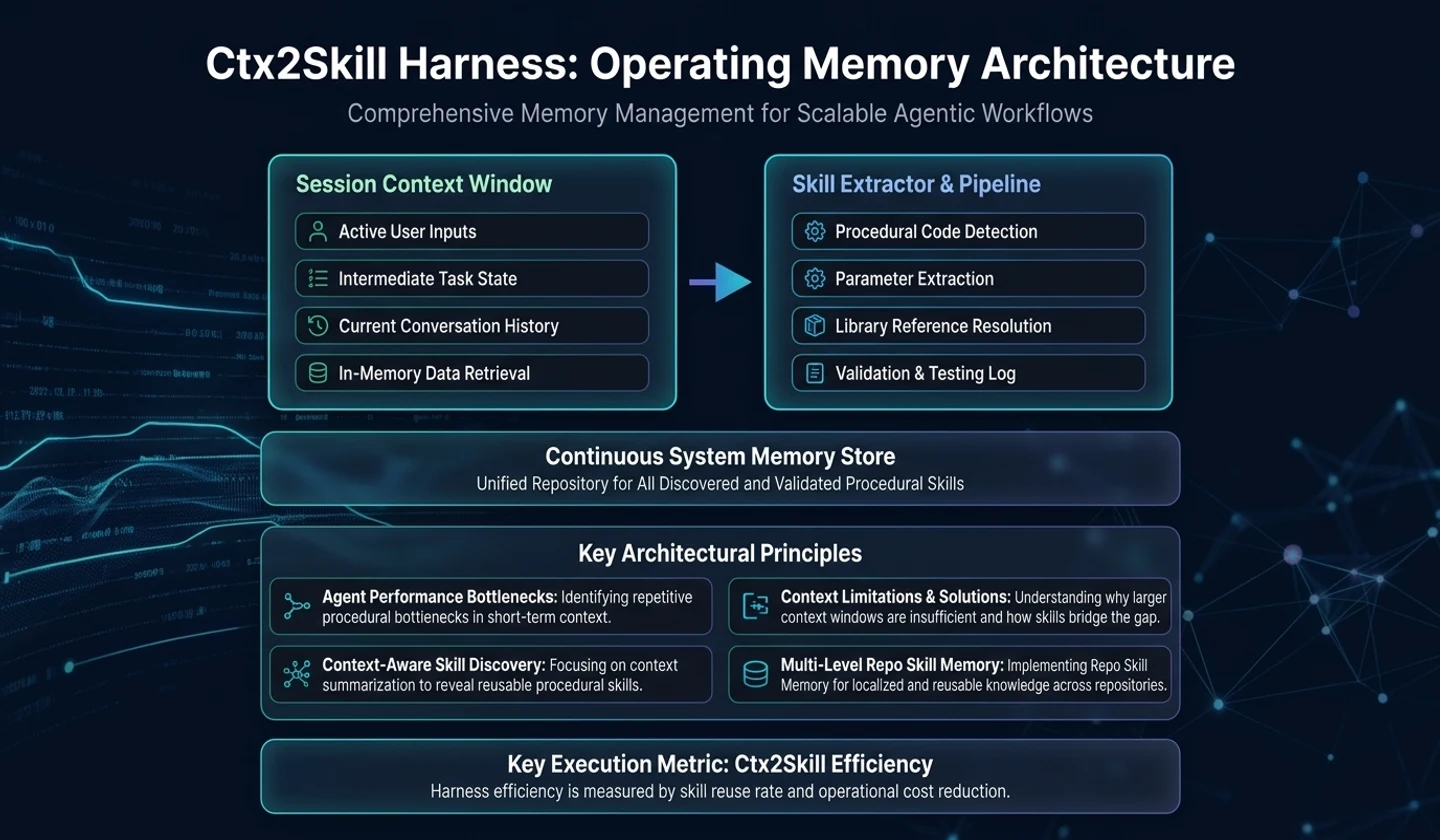
This article is about harness implementation, but if we go straight into implementation, the flow of why this structure is needed becomes weak. So, first, I will briefly review the paper as a starting point, and then move on to the application analysis from the development harness perspective.
The starting point is Ctx2Skill,From Context to Skills: Can Language Models Learn from Context Skillfully?to be exact. The paper ID isarXiv:2604.27660. The problem the paper directly addresses iscontext learning, not the development harness. It deals with whether the model can read the necessary knowledge in a given complex context and use it to solve problems, rather than only using knowledge already known through prior learning.
The paper presentsinference-time skill augmentationas one approach to this problem. This method extracts rules and procedures from a long context, turns them into natural language skills, and discovers, refines, and selects those skills in a self-play loop.
This is the explanation in the paper. Now let's put this idea into a development harness perspective.
From a harness perspective,skillis more of a work rule than a simple summary statement. If the summary is to say “This repo has an API contract rule,” then the skill for the harness should be a check rule that changes the next action, like this:
When changing the public API request/response structure,Update not only the implementation code, but also the contract artifact and contract verifier evidence.In other words, the point of reference to Ctx2Skill in this article is not a technique to briefly summarize a long context, but the perspective of extracting rules and procedures to be reused in the next execution from a long context**.
Bringing this idea into the development harness raises some pretty interesting questions.
Can an AI coding agent actually be less likely to repeat the failures it experienced in its last run in its next run?
In this article, based on this question, we will summarize the process of applying the Ctx2Skill thesis idea to theAWTL,RSME,MemoryGraph, andreplay gatestructures of the development harness.
This article is part 1 of the “Ctx2Skill Development Harness Application” series. Part 2 covers MemoryGraph promotion boundaries, and Part 3 covers the AWTL failure observation loop.
| standard | detail |
|---|---|
| Analysis base date | 2026-05-07 |
| Paper standard | From Context to Skills: Can Language Models Learn from Context Skillfully?,arXiv:2604.27660 |
| analysis target | Harness improvement ideas based on Ctx2Skill paper, AWTL, RSME, MemoryGraph promotion boundary |
| applied area | Development harness, AI coding agent, Codex/Claude Code runtime, Project MemoryGraph |
| caution | This article was written based on a publicly available design summary and harness application perspective. |
An adjacent study with a similar name is alsoFrom Skill Text to Skill Structure: The Scheduling-Structural-Logical Representation for Agent Skills. The main starting point of this article is Ctx2Skill's context-to-skill self-play structure, and adjacent papers that structure agent skills are viewed only as a reference point.
Key takeaways
Ctx2Skillis a framework that extracts rules and procedures from long contexts into natural language skills and improves them in a self-play manner.- The paper structure can be summarized as
Context -> Challenger -> Reasoner -> Judge -> Skill Update -> Cross-Time Replay. - In development harness, we can reinterpret this idea as
Repo Skill Memory, or per-repository working memory. - However, since there is strong execution feedback such as test, lint, build, and verifier in the development environment, it is safer to focus on the deterministic verifier rather than the LLM Judge.
- Therefore, the harness does not store the raw execution log in long-term memory, but finds the cause of failure in the action/span/event unit trace and promotes only the verified compact rules to MemoryGraph.
- This structure requires two layers:
RSMEandAWTL.
One-line summary of Ctx2Skill thesis
Ctx2Skill can be summarized in one sentence like this.
Rather than having to reread the long context every time, the approach is to extract the rules and procedures needed to solve the problem from that context with
skill, and then leave only the skills that can be used for self-play and replay.
The problem addressed by the paper iscontext learning.
A typical LLM relies on pre-learned knowledge. However, in actual work, the model must read long documents, repository rules, domain manuals, and test policies that cannot be known in advance and apply them immediately.
There are three main options at this time.
| access | explanation | margin |
|---|---|---|
| Long context | Include as much needed context as possible | It is expensive, noisy, and inefficient for repetitive tasks. |
| RAG | Search for and insert the necessary documents | It's great for finding information, but it doesn't reliably change work procedures. |
| Skill extraction | Extract repeatable rules and procedures from context | The problem is how to verify skill quality. |
Ctx2Skill is closer to the third approach. Rather than simply summarizing the document, we look at the context and draw work rules to refer to when solving future problems.
For example, a general skill drawn from a long technical document might be at this level.
If you're dealing with compatibility behavior,First find the relevant version boundaries,Check whether the same rules apply to the old and new paths.If you turn this into a skill for development harness, the obligation to execute is attached to a simple judgment sequence.
When modifying compatibility-related codeDivide the affected execution path into old path and new path.Actually execute the test/verifier commands in both paths.When the public contract changes, the contract artifact is also updated.If it fails, which action failed is left as a failure attribution candidate.While general skills organize the decision order, harness skills include execution contracts. Which verifications to run, which outputs to update, and where to log failures must come together before you can actually reuse them in the next run. It is not about adding a lot of information, but rather creating judgment criteria and completion criteria for the next execution.
Paper structure: Challenger, Reasoner, Judge, Replay
The basic structure of Ctx2Skill is self-play.
The paper structure can be simplified as follows:
- Context
- Challenger
task + rubric
- Reasoner
solve with skills - Judge
binary feedback - Proposer
failure analysis - Generator
skill update
- Cross-Time Replay
stable skill selection
Each role can be explained in developer language as follows.
| component | role | Developer-style interpretation |
|---|---|---|
| Context | Long context for the model to learn | Repo code, documentation, testing policy, CI rules |
| Skill | Natural language process extracted from context | Action rules to reuse for next run |
| Challenger | Create difficult problems and rubrics | replay probe or synthetic verifier of harness |
| Reasoner | Solve problems using your current skills | real coding agent |
| Judge | Answer Rating | test, lint, build, verifier, completion gate |
| Proposer | Failure cause analysis | failure attribution |
| Generator | skill update | memory candidate builder |
| Cross-Time Replay | Filter out overfitting skills | replay gate, regression probe, human approval |
The most important part of this structure isCross-Time Replay.
Self-play easily overfits if you just run it. Challengers can create increasingly difficult problems, and Reasoners can build narrow skills tailored only to that problem. The paper alleviates this problem with Cross-Time Replay.
Conceptually, we re-pass skill candidates from multiple points in time through the representative problem, and select the most stable skill rather than the most recent skill.
The same problem arises in the development harness. If you put too strong a memory to prevent one failure, it may cause strange behavior in the next task.
bad memory:All contract failures may be due to environment problems, so do not block. Good memory:Only if the contract verifier fails with a specific known flaky signatureClassified as environment_blocker, and other contract mismatches are maintained as blocking failure.The first is too wide. The second has scope and exceptions. So the memory to be entered into MemoryGraph must always havescope,anti-scope,evidence, andreplay result.
Switching to a development harness issue
If you use an AI coding agent for a long time, you will continue to encounter similar scenes.
At first you do pretty well. Find code, edit files, and run tests. But the problem is “next time”.
Today we make the same mistakes we avoided yesterday, we forget the repo rules we learned last time, and we come up with new inferences about why a particular test failed, even though we've already experienced it. Ultimately, the developer ends up repeating the same explanation to the agent over and over again.
For example, this happens:
- A test command that has already failed once is incorrectly executed again.- I changed the public contract, but I forgot to update the artifact again.- It is impossible to distinguish between flaky failure and actual contract mismatch.- The rules stored in MemoryGraph are read but applied incorrectly.- Pretend you have passed the failed verifier and move on to the next step.This can be resolved to some extent by providing a longer context. However, long contexts are expensive and generate more noise. Above all, there is a difference between “reading a lot” and “remembering correct operating procedures.”
So from a development harness perspective, Ctx2Skill's skill is effectively redefined as repository-specific AI working memory.
However, it is not a memory that stores just any content.
Repository Skill Memory= Understand the repo structure+ Working procedures+ Prohibited actions+ test/build commands+ Frequently failed patterns+ Based on PR reviews+ Regression Prevention Checklist+ Rules learned from past failuresThis structure is close toRepo Skill MemoryorRepository Operating Memory.
An important difference when moving paper structure from a development harness perspective is the strength of feedback. The paper addresses the context learning problem of lack of external feedback. Development harness, on the other hand, has strong execution feedback.
- exit code- test result- lint result- typecheck result- build result- verifier result- artifact hash- file diff- CI resultTherefore, in the development harness, deterministic verifier / execution judge should be the focus rather than LLM Judge.
- Ctx2Skill
context -> skill -> self-play -> judge -> replay - Developer Harness
agent trace -> attribution -> candidate -> gate -> MemoryGraph
The key is that Harness should not be a simple executor, but rather an operating system that observes failures and promotes only verified memories.
RSME: Repository-specific working memory engineering.
This perspective can be summarized asRSME, or Repository Skill Memory Engineering.
RSME is a methodology that structures and executes verification of repo-specific knowledge, procedures, constraints, and failure patterns so that an AI coding agent can work stably in a specific repo.
- Truth source
code / tests / CI / docs / production behavior - Work trace
action / observation / judge_result - Memory candidate
scope / evidence / blocker - Replay or human approval
- Project MemoryGraph
compact reusable rule - Next agent run
The core principle is simple.
| principle | Operational implications |
|---|---|
| memory is not truth | The source of truth is code, test, CI, contract, and production behavior. |
| Memory is the acceleration layer | Helping agents find the source of truth faster. |
| Memory must be verified | Memory that does not pass tests or verifiers is dangerous. |
| Failure is learning data | It feeds back to the failure situation, cause, recurrence prevention rules, and verification probe. |
| Latest memory is not always better | A replay is necessary because new memory can ruin existing work. |
The important thing in RSME is not “accumulating a lot of memory.” The idea is to separate the repo's source of truth from the agent's memory layer.
| hierarchy | role |
|---|---|
| Source of truth | code, test, CI, contract, production behavior |
| Trace | Execution observations such as action, observation, judge_result |
| Memory candidate | Promotion Candidates Derived from Failure |
| Replay gate | Overfitting or dangerous memory blocking |
| MemoryGraph | Long-term memory layer with proven compact rule |
AWTL: Observing failures by action
If RSME is an operational memory methodology, AWTL is the observation layer from which the raw materials are created. AWTL stands for Agent Work Trace Logging, which records agent work in units of action/span/event rather than final PR.
Failure usually doesn't just happen at the end result. It already starts with intermediate actions such as incorrect file selection, unfounded assumptions, misjudgment of test commands, and misunderstanding of verifier logs.
This structure allows the harness to answer the following questions:
- After what action did the failure occur?
- Which verifier failed?
- What artifact did the failed verifier refer to?
- What memory was that action reading?
- Does this failure deserve elevation to project knowledge?
- Won't the same rule in replay ruin other operations?
Harnessed Architecture: From Trace to MemoryGraph
To summarize this structure in one line, it is as follows.
run agentto collect action/span/event traceto judge_result detectionCreate to failure attributionto memory candidate generationto replay or confirm human approvalOnly to compact rule promotes MemoryGraphYou should not use MemoryGraph directly on failure. You must first leave it as a candidate.
{ "schema": "awtl.memory_candidate.v2", "failure_type": "contract_mismatch", "failure_class": "agent_failure", "source_action_ids": ["a-004-002"], "root_cause_summary": "Runtime behavior changed without updating public contract evidence.", "proposed_memory": "If the public API schema changes, contract artifact and verifier evidence are updated together.", "scope": { "applies_to": ["public_api", "contract_change"], "does_not_apply_to": ["internal_refactor", "test_only_change"] }, "evidence_refs": ["judge:contract-test", "artifact:test-output-001"], "promotion_status": "candidate", "requires_human_review": true}The important fields here arescopeandevidence_refs. Without scope, the rules become too broad, and without evidence, it is impossible to trace why this memory was created.
Actual code example
The example below is a structure that reduces the actual harness code to a publicly available form. The key is that the judge result is not just a string, but must contain both a source action and an artifact.
async function recordJudgeResult(details = {}) { return emit("judge_result", { judge_name: toText(details.judgeName, "phase-verifier"), result: toText(details.result, "warn"), source_action_id: actionId, artifact_refs: normalizeArtifactRefs(details.artifactRefs ?? [], repoRoot), detail: toText(details.detail, ""), });}This event requires the failure attribution to create the following structure:
return { failureEvent, failureTurnId, failedArtifactRefs, sourceActionIds, verifierActionId, memoryReadNodeIds, evidenceRefs, rootCauseSummary, verificationProbeCandidate, classification,};And the promotion gate should operate conservatively.
if (!approval.approved && !replayOk) { reasons.push("replay or human approval is required before promotion");} if (isImportedOnlyCandidate(candidate)) { reasons.push("imported-only candidate is blocked");}This level of barrier ensures that failure logs, environmental issues, flaky failures, and speculative rules do not go straight into long-term memory.
Practical gains
There are three most useful conclusions from this application process.
| conclusion | practical meaning |
|---|---|
| Skill is not a summary but a rule of conduct | The process of changing the next action is more important than summarizing a text or document. |
| A deterministic verifier takes precedence. | In the development harness, test, lint, build, and verifier are stronger than LLM Judge. |
| Memory without replay is dangerous | A rule that prevents a recent failure could ruin the next task. |
After all, longer context isn't the only thing AI coding agents need. It is an operational loop in which the harness observes failures, attributes causes, and retains only verified memories.
Risks still remaining
Before introduction, check the following items:
RSME/AWTL application risk checklist [ ] Separate raw execution log and long-term memory storage.[ ] Records work in action/span/event units.[ ] judge_result is included in the canonical event stream.[ ] Failure attribution connects source action, artifact, verifier, and memory read.[ ] Memory candidates have application and exclusion scopes.[ ] Candidates without evidence_refs are not promoted.[ ] Do not write to MemoryGraph without replay evidence or human approval.[ ] imported-only candidates do not pass the promotion gate.[ ] If redaction fails, the payload is not saved.[ ] Place a guard to prevent trace artifacts from entering Git.finish
Longer context isn't the only thing AI coding agents need. Longer contexts show more of the past, but do not reliably change the next action.
The job of the harness is not to accumulate failure logs, but to attribute failures to action units and promote only verified compact rules to operational memory.
In the next installment, we'll cover where to draw the line when applying this principle to MemoryGraph. The key is simple. MemoryGraph should be a proven memory layer, not an automatic store.
References
From Context to Skills: Can Language Models Learn from Context Skillfully?: Ctx2Skill paper,arXiv:2604.27660From Skill Text to Skill Structure: The Scheduling-Structural-Logical Representation for Agent Skills: Adjacent paper on agent skill structuring,arXiv:2604.24026- The main code example has been rewritten to remove internal absolute paths and private repository paths, and focus on roles and publicable structures.
댓글
GitHub 계정으로 로그인하면 댓글을 남길 수 있습니다. 댓글은 GitHub Discussions를 통해 운영됩니다.